This is also from August 2016.
It was a Danish girl with parents - one Finnish, one Syrian - and she started a mosque with a woman in charge. Her name was Ahlaam. That means 'dreams' in Arabic!
They interviewed her on the BBC Arabic.
She described how people say: you don't live in Arab countries, it's because you've lived in foreign places that you think the women-run mosque is okay.
This is partly true, she conceded. "The Ahlaam of today is not the same Ahlaam of 30 years ago. I lived in Switzerland, and I saw things I wasn't used to in Arab countries. I had to ask myself, why can't I find these things in my religion? I had opportunities and possibilities to think this way.
"But then again, right now, I'm living in Qatar, and I have traveled all over the Muslim world. What I found in Switzerland can also be found in Malaysia, Kashmir - it can already be found among Muslims.
"And I see the youth today looking for a way to live their religion in the world of today."
Showing posts with label Denmark. Show all posts
Showing posts with label Denmark. Show all posts
Wednesday, August 23, 2017

Wednesday, July 16, 2014
Danish company on the Arabic news
The BBC Arabic does a weekly show on technology. Back in March or April, they interviewed two people from a company called AirHelp. They help people get compensation from airlines when a flight goes awry.
Here's the interview:
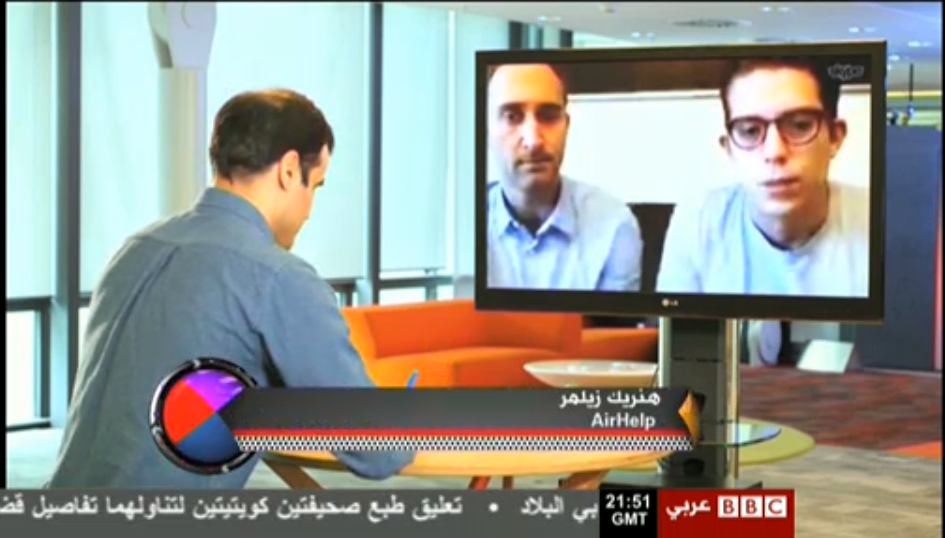
I thought there was something familiar when I heard the names. In the caption it says Henrik Zillmer in Arabic. Turns out it is a Danish company.
Here's the BBC Arabic host asking the questions:

And here are two of the AirHelp entrepreneurs. Anyone know what that bridge is behind them?

Here's the interview:
I thought there was something familiar when I heard the names. In the caption it says Henrik Zillmer in Arabic. Turns out it is a Danish company.
Here's the BBC Arabic host asking the questions:
And here are two of the AirHelp entrepreneurs. Anyone know what that bridge is behind them?
Wednesday, April 2, 2014
Danish zoo
(March 25, 2014)
Denmark was on the Arabic news, courtesy of the BBC Arabic:
They showed this Danish zoo director with a polar bear banner:

and these protesters and some Danish words:

and these giraffes at the Danish zoo:

and these lions:

Denmark was on the Arabic news, courtesy of the BBC Arabic:
They showed this Danish zoo director with a polar bear banner:
and these protesters and some Danish words:
and these giraffes at the Danish zoo:
and these lions:
Sunday, March 9, 2014
Swedish and Danish banks
(February 18, 2014)
The BBC Arabic was yet again hosting debates between Palestinian and Israeli politicians and analysts.
This guy was on the show:
 He took the Palestinian side. And in the midst of all his bluster (you can tell by just looking at his face that he blusters a lot), he said something very nice. He said, he didn't care what excuses the Israelis made because he knew that time and justice was on the Palestinian side, especially when it comes to boycotts and international banks withdrawing their funds from Israeli settlement schemes.
Then he specifically mentioned Swedish and Danish banks.
So, my dear fellow, since you are so grateful to the Swedish and Danish banks, there are many ways for you to show your good wishes. For example, you could try to convince your neighbors not to blow up Scandinavian embassies and consulates, and not to kill Scandinavian humanitarian workers. That would indeed be highly appreciated.
The BBC Arabic was yet again hosting debates between Palestinian and Israeli politicians and analysts.
This guy was on the show:
Then he specifically mentioned Swedish and Danish banks.
So, my dear fellow, since you are so grateful to the Swedish and Danish banks, there are many ways for you to show your good wishes. For example, you could try to convince your neighbors not to blow up Scandinavian embassies and consulates, and not to kill Scandinavian humanitarian workers. That would indeed be highly appreciated.
Saturday, February 8, 2014
EU Corruption
(February 3, 2014)
The EU released a report about their corruption. The lady presenting the report was Swedish:
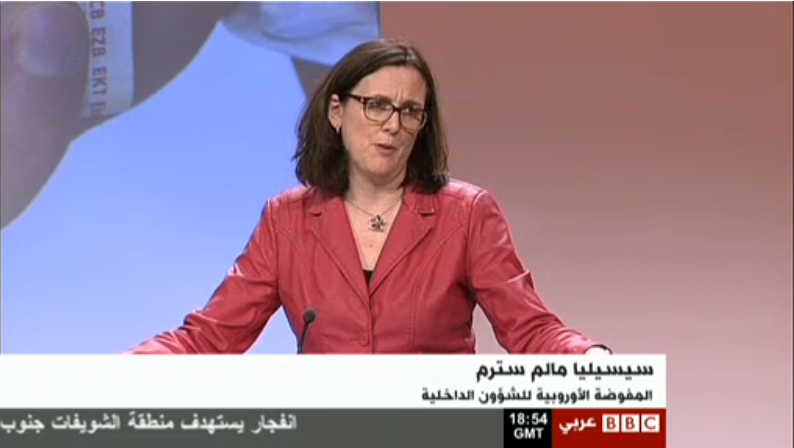
Her name is Cecilia Malmström, and she was on the BBC Arabic throughout the day! But in Arabic, they've written her name Cecilia Malm Ström. Ha! And they never said she was Swedish ... they just said that she works for the EU.
The only other thing of note is that the BBC Arabic interviewed this man, live from Brussels:

He was talking about corruption in the Arab countries - particularly the Gulf countries - and what they can learn. And he mentioned all the countries in the EU that scored well on the corruption report. He mentioned Sweden first of all, I am not even kidding. Then he mentioned Denmark, and Finland, and Holland, and Germany.
And throughout the day, the BBC Arabic kept mentioning Sweden as having low corruption every time they re-ran the story about the EU report (and they re-ran it at least every hour, and did further analysis at one point, and talked about Sweden even more then.)
The EU released a report about their corruption. The lady presenting the report was Swedish:
Her name is Cecilia Malmström, and she was on the BBC Arabic throughout the day! But in Arabic, they've written her name Cecilia Malm Ström. Ha! And they never said she was Swedish ... they just said that she works for the EU.
The only other thing of note is that the BBC Arabic interviewed this man, live from Brussels:
He was talking about corruption in the Arab countries - particularly the Gulf countries - and what they can learn. And he mentioned all the countries in the EU that scored well on the corruption report. He mentioned Sweden first of all, I am not even kidding. Then he mentioned Denmark, and Finland, and Holland, and Germany.
And throughout the day, the BBC Arabic kept mentioning Sweden as having low corruption every time they re-ran the story about the EU report (and they re-ran it at least every hour, and did further analysis at one point, and talked about Sweden even more then.)
Friday, February 7, 2014
Danish film
(January 27, 2014)
Once a week, the BBC Arabic shows an independent film - an Arab film. This week, they broke with tradition and chose a Danish film!!!!
The film-maker is called Ulaano Samir, he is 25 or 26, and he has Iraqi parents.

The film was about 20 minutes long. It is called "Min Bror" (My Brother.) It was in Danish, with subtitles in Arabic, which was nice and all for people who know how to read quickly in Arabic! But I did my best.

The two brothers in the film were, like the film-maker, originally Arab, and can I just say that they kept up a steady stream of curse words the entire twenty minutes? By reading the subtitles, I learned 'the F-word' in Arabic. My mom says that Arabs NEVER curse, NEVER use dirty words, Arabs are just so super perfect. After seeing this film, you can just imagine my state of shock.
After the film, Mr. Ulaano was interviewed by the BBC Arabic.
Question: Won't your film ingrain stereotypes about Arab immigrants even further?
Answer: I see my characters as kids first. I don't see them as Arabs or Danes. They made wrong choices, and that's it [the two brothers invade a store and murder one of the employees in the movie.]
The film-maker further said: I chose kids of Arab origins because that's like me, but they are Danes, they speak perfect Danish, they were born in Denmark. The first thing is: they did something wrong.
Question: sometimes, Arab film-makers feel like they have to speak about refugees or immigrants, and nothing else.
Answer: I feel like I am the one who chooses. If I want to make a movie about something, I do it. If I don't, then I don't.
Mr. Ulaano went to the national film school of Denmark with this film. There's a film festival called Nordic Panorama which accepts three films from every Nordic country, and this film 'Min Bror' was one of the three chosen from Denmark. So alhamdolillah, he is very happy about the film reception.
Once a week, the BBC Arabic shows an independent film - an Arab film. This week, they broke with tradition and chose a Danish film!!!!
The film-maker is called Ulaano Samir, he is 25 or 26, and he has Iraqi parents.
The film was about 20 minutes long. It is called "Min Bror" (My Brother.) It was in Danish, with subtitles in Arabic, which was nice and all for people who know how to read quickly in Arabic! But I did my best.
The two brothers in the film were, like the film-maker, originally Arab, and can I just say that they kept up a steady stream of curse words the entire twenty minutes? By reading the subtitles, I learned 'the F-word' in Arabic. My mom says that Arabs NEVER curse, NEVER use dirty words, Arabs are just so super perfect. After seeing this film, you can just imagine my state of shock.
After the film, Mr. Ulaano was interviewed by the BBC Arabic.
Question: Won't your film ingrain stereotypes about Arab immigrants even further?
Answer: I see my characters as kids first. I don't see them as Arabs or Danes. They made wrong choices, and that's it [the two brothers invade a store and murder one of the employees in the movie.]
The film-maker further said: I chose kids of Arab origins because that's like me, but they are Danes, they speak perfect Danish, they were born in Denmark. The first thing is: they did something wrong.
Question: sometimes, Arab film-makers feel like they have to speak about refugees or immigrants, and nothing else.
Answer: I feel like I am the one who chooses. If I want to make a movie about something, I do it. If I don't, then I don't.
Mr. Ulaano went to the national film school of Denmark with this film. There's a film festival called Nordic Panorama which accepts three films from every Nordic country, and this film 'Min Bror' was one of the three chosen from Denmark. So alhamdolillah, he is very happy about the film reception.
Saturday, January 11, 2014
Danish ships in Syria
(January 7, 2014)
Danish ships are in Syria to pick up Syria's chemical weapons, and they were on the BBC Arabic.


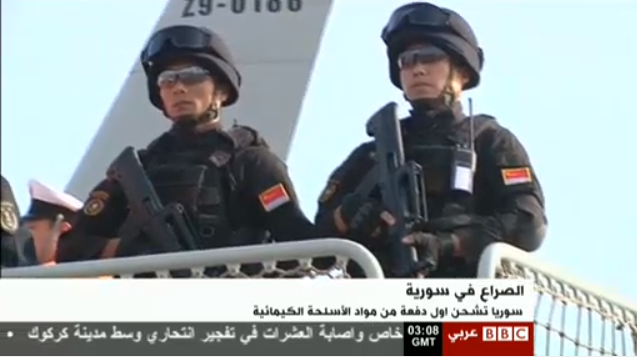
However, there are also Chinese and Norwegian ships coming and going, and maybe Russian; so I cannot really determine what nationality these ships belong to, especially when they kept showing clips like this:

And more pictures of more ships:


Danish ships are in Syria to pick up Syria's chemical weapons, and they were on the BBC Arabic.
However, there are also Chinese and Norwegian ships coming and going, and maybe Russian; so I cannot really determine what nationality these ships belong to, especially when they kept showing clips like this:
These are Chinese soldiers, I think.
And I really don't know what was happening here.
And more pictures of more ships:
Saturday, December 14, 2013
The UN, Denmark, Syria, and snow
(December 12, 2013)
The winter storm in Syria and Lebanon and Jordan and Palestine and Israel dominated a large chunk of BBC Arabic coverage on this day, especially as regards the refugees living in tents.
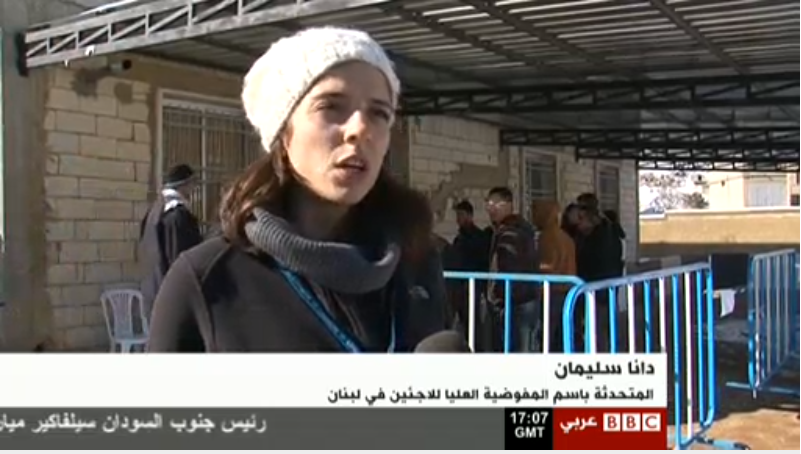
 This is Dana Sleiman, live from Beirut. She is a UNHCR spokesman. I think she is my age exactly, we graduated from high school and college in the same year. We even studied the same major in college.
Besides UNHCR, she mentioned UNICEF and the Danish refugee fund as key organizations helping Syrian refugees in Lebanon. So now you know all these names and places are being mentioned in a good way to Arab audiences.


 She is also a UNHCR spokeslady. Her name is Roberta Russo, and she is also working in Lebanon. She spoke in English, and it was translated.
Update, December 16, 2013
 Here is Dana Sleiman interviewed from the refugee camps a few days later.
More pictures of snow in the Middle East and amongst Syrian refugees here.
The winter storm in Syria and Lebanon and Jordan and Palestine and Israel dominated a large chunk of BBC Arabic coverage on this day, especially as regards the refugees living in tents.

Besides UNHCR, she mentioned UNICEF and the Danish refugee fund as key organizations helping Syrian refugees in Lebanon. So now you know all these names and places are being mentioned in a good way to Arab audiences.
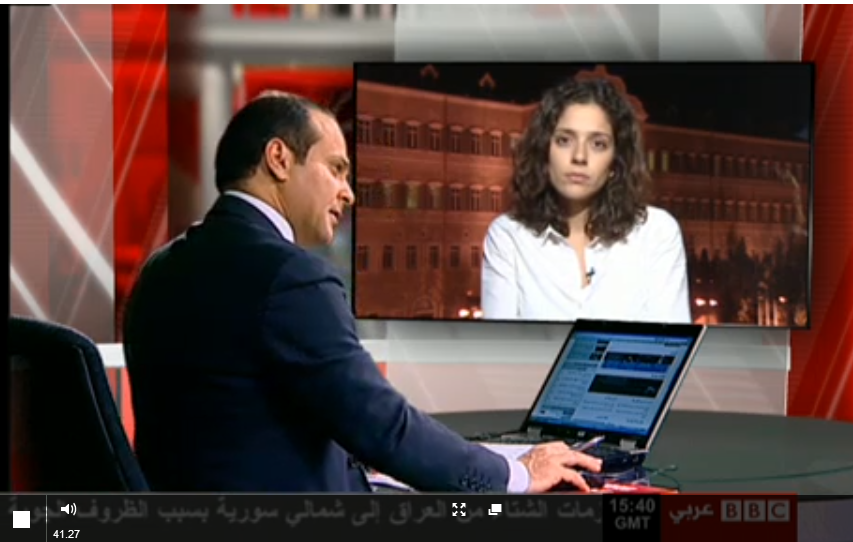
She was interviewed by Mekki Hilaal. I might have gotten his last name wrong. He is one of the BBC Arabic anchors, but I don't really like him. I forget what he did once. He's always kind of yelling at people. On this day, he just looked very disturbed about all the refugees in the snow.
The interview with Dana Sleiman was pretty long, and it was in Arabic. I think I have seen her on the BBC Arabic before. I took this screenshot in October of a lady standing in front of a UN tent or office and she was also describing the situation of the Syrian refugees. It's the same person, right?

There was a separate news clip that had a few words spoken by this lady:

Update, December 16, 2013
More pictures of snow in the Middle East and amongst Syrian refugees here.
Thursday, December 5, 2013
Corruption
Today the BBC Arabic did a call-in show on corruption. It was timed to coincide with the release of a report which ranked countries by their levels of corruption. I can attest that Denmark and Finland were both mentioned as having scores of 100%. I'm sure that Sweden was also mentioned, but I did not see the first part, I only got into it halfway through. That was when I heard Denmark and Finland.
But the show was not about Scandinavian countries, it was about all the corruption in the Arab world. The best-ranked Arab country was the UAE, and its ranking was 39 or 69 or something.
This lady was interviewed: she could give all the specifics about the report.
 Her name was Ms. Kinda.
She said that sometimes in Arab hospitals, you have to give the doctors a bribe before they will treat your family member, even in an emergency situation. But, in recent years apparently, there's some government ministries putting more oversight on hospitals; there is more awareness that this is something that must be stamped out.
I think she also said that in Europe, there's less corruption partly because the poorest people still have access to social services and benefits. I wasn't listening very carefully, so I'm not very firm of what exact link between social benefits and corruption she was mentioning.
And the BBC Arabic presenter who was running the show mentioned how when Arabs living in Europe return on vacation to their homelands, they get so annoyed when bribes and related ilk rear their heads again.
Wow, again, praise for the west coming from the BBC Arabic and Arabs at large. We are all going to get along so well now.
Since I've already mentioned Finland here, this is a good time to say that I meant to have a post about Finland earlier. There was an Iraqi man without any sort of passport who got stuck in an airport in Kazakhstan. He could not fly out and return to any country, and neither could he leave the airport and enter Kazakhstan proper, all because he did not have the proper paperwork. He basically lived in a tiny room in the airport for five months.
Now, since we Arabs and Muslims are always going on and on about how well we stand up for each other, please be understanding of the fact that not a single Arab or Muslim country would let grant the stateless man asylum or entry privileges. Of course not! If we Arabs and Muslims want to be united, we couldn't possibly do it be helping each other. So the man stayed at the airport until Finland took him in. Shout-out to Finland.
But the show was not about Scandinavian countries, it was about all the corruption in the Arab world. The best-ranked Arab country was the UAE, and its ranking was 39 or 69 or something.
This lady was interviewed: she could give all the specifics about the report.

She said that sometimes in Arab hospitals, you have to give the doctors a bribe before they will treat your family member, even in an emergency situation. But, in recent years apparently, there's some government ministries putting more oversight on hospitals; there is more awareness that this is something that must be stamped out.
I think she also said that in Europe, there's less corruption partly because the poorest people still have access to social services and benefits. I wasn't listening very carefully, so I'm not very firm of what exact link between social benefits and corruption she was mentioning.
And the BBC Arabic presenter who was running the show mentioned how when Arabs living in Europe return on vacation to their homelands, they get so annoyed when bribes and related ilk rear their heads again.
Wow, again, praise for the west coming from the BBC Arabic and Arabs at large. We are all going to get along so well now.
Since I've already mentioned Finland here, this is a good time to say that I meant to have a post about Finland earlier. There was an Iraqi man without any sort of passport who got stuck in an airport in Kazakhstan. He could not fly out and return to any country, and neither could he leave the airport and enter Kazakhstan proper, all because he did not have the proper paperwork. He basically lived in a tiny room in the airport for five months.
Now, since we Arabs and Muslims are always going on and on about how well we stand up for each other, please be understanding of the fact that not a single Arab or Muslim country would let grant the stateless man asylum or entry privileges. Of course not! If we Arabs and Muslims want to be united, we couldn't possibly do it be helping each other. So the man stayed at the airport until Finland took him in. Shout-out to Finland.
Saturday, November 16, 2013
Norway, Denmark, the Netherlands, and Syria
(November 15, 2013)
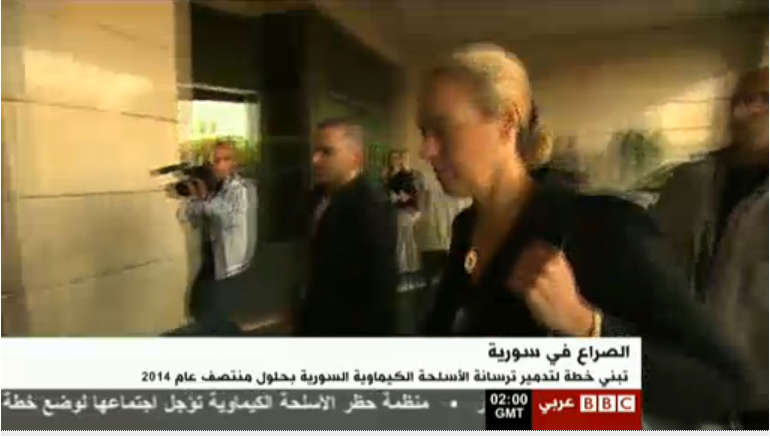
Syria was the top topic on the BBC Arabic today. They were talking about the international teams destroying Syria's chemical weapons. Then, I heard 'al-Norweeg' and 'Denimark' (Norway and Denmark), so that of course caught my attention. Then, I caught the video of this lady:

My screenshot is not very clear. But she was walking with purpose into a hotel in Syria, and looked grim and like she was on a mission, all at once. So I thought she must be a Danish or Norwegian lady organizing the destruction of Syria's weapons.
Here she is again, up close, but even less clear!

This lady was the top story on the BBC Arabic for the afternoon and stretching into the evening. After the first few runs, they stopped mentioning Denmark and Norway, however, and I still had not figured out exactly what was going on! And they never explicitly identified the blond lady. Clearly, this was a job for English. I googled 'Norway Denmark Syria' and got the full story: Norway and Denmark are sending ships to Syria to transport the chemical weapons out of the country.
And the lady is from neither of those countries. She is actually Dutch. Her name is Sigrid Kaag. She leads the Organization for the Prohibition of Chemical Weapons-United Nations joint mission to destroy Syria's stockpiles.
Syria was the top topic on the BBC Arabic today. They were talking about the international teams destroying Syria's chemical weapons. Then, I heard 'al-Norweeg' and 'Denimark' (Norway and Denmark), so that of course caught my attention. Then, I caught the video of this lady:

My screenshot is not very clear. But she was walking with purpose into a hotel in Syria, and looked grim and like she was on a mission, all at once. So I thought she must be a Danish or Norwegian lady organizing the destruction of Syria's weapons.
Here she is again, up close, but even less clear!
This lady was the top story on the BBC Arabic for the afternoon and stretching into the evening. After the first few runs, they stopped mentioning Denmark and Norway, however, and I still had not figured out exactly what was going on! And they never explicitly identified the blond lady. Clearly, this was a job for English. I googled 'Norway Denmark Syria' and got the full story: Norway and Denmark are sending ships to Syria to transport the chemical weapons out of the country.
And the lady is from neither of those countries. She is actually Dutch. Her name is Sigrid Kaag. She leads the Organization for the Prohibition of Chemical Weapons-United Nations joint mission to destroy Syria's stockpiles.
Friday, October 11, 2013
Arabs - the happiest people on earth!
(September 2013)
How do you measure happiness? According to Columbia University, you can measure it based on opportunities to work and go to school, healthcare access, social support, and I think levels of corruption. Then, they write a report in which they rank countries based on how well they meet all these criteria.
Guess who ended up at the top of the list: Denmark, Norway, Switzerland, the Netherlands, and Sweden. Finland was number 7, and Iceland was number 9. You know that some Arabs - the ones who style themselves as The Mighty Arabs - are not going to take this lying down. (No, we're the super-duper happy ones!) But lest I be unfair, let me say from the start that you will read thoughtful responses here, too.
Adding insult to injury is that, not only are Arab countries nowhere near the top, but in fact Arab rankings have gone down over the past year, presumably because of the usual and expanding set of crises in the Arab world. So the BBC Arabic hosted a debate as to causes for Arab happiness and unhappiness, and anyone speaking Arabic could phone in or email or Facebook or tweet. The host was a presenter called Mohamed al-Saif (I might have the last name wrong.) He was asking all the questions and keeping the discussion on track. He is kind of cute, as you can decide for yourself here, but he can be a little full of himself sometimes.

First, Ahmed from Gaza called in: are you happy?
Ahmed: Well, the problems in the Gaza strip are keeping me from being happy. Even if I was happy, then when I see all the unhappy people around me, I can't really be happy anymore.
Next, we go to Riyadh from Yemen: what causes you to be happy? and do you connect your happiness with the happiness of your family, society, and country?
Riyadh: I agree with Ahmed. How can people in Yemen be happy when there's political corruption and money corruption, and all other corruption, and 10 million people live below the poverty line? I have a family with 8 people. My dad was hurt while on the job and the government did not give us any sort of health insurance or help at all.
Question: if you moved to a western society and lived on par with the average, would you be happy then?
Riyadh: Maybe. Oh my brother, if there was justice and security of law, and health insurance, and a livable salary, and if you can live a live-and-let-live life, then yes, I would be happy.
Alaa from Syria:
He had a bad phone connection, but he said that his form of happiness would be to see peace again return to his country. "My country used to be the safest country of all the Arab countries! My country had high wages, people lived comfortably, you had good education. In the last ten years, there was a Syrian renaissance!"
Emaad from Algeria:
Emaad was a philosophizer. His theories spilled out one after the other:
1. Happiness is when you know you are doing what you should be doing, and you stick to that path, even if all the world and all the world's people are against you.
2. Happiness is a result, and not assets (am I translating this right?)
3. Happiness is to not oppose what happens to you, and to know how you should respond or act.
4. Happiness is the result in which you consider yourself to be on the right path, it is an expression of your plans to reach your goals.
Emaad wanted to give us many more definitions of happiness, but Mr. Mohammed the moderator finally stopped him.
Then they talked to another Yemeni, Abdul-Rahman. I think they kept talking to the Yemenis because Yemen ended up #102 on the list of happiness.
Abdul-Rahman from Yemen: Yes, I am happy on a personal level. Why? Because out of the goals I have so far set for myself, I have reached many of them. Of course, I will quote my fellow-countryman before me who said that personal happiness is connected to the happiness in your society. But even with societal problems, an individual person still celebrates when they graduate or succeed in their courses or accomplishes something.
Question: and what kinds of things have you personally achieved?
Abdul-Rahman: My personal success began by things like moving upwards to higher specialisations in my work. I was able to escape some of the negatives in our society, like (didn't understand what), so that made me happy, too.
Here is his picture:

Then came an Egyptian. I think the moderator Mr. Mohamed must be Egyptian himself, because all of a sudden when he started talking to the Egyptian, he switched over to the annoying Egyptian accent (I told you Mohamed was slightly annoying and pompous.) And when the Egyptian started talking, darned if I understood with all his haga's. He must have said haga seventy times in two minutes. Haga means 'thing'. So I'm not sure how specific he was being about anything. And his phone connection was bad.
Edit: haha, I have newly realized that 'haga' refers to a 'necessity'.
But I think understood that he was happy because he had accomplished 30% or 40% of his goals so far, and even if that's still less than half, it really is a big deal, so that makes him happy.
Mr. Mohamed asked him: why have the Arab countries regressed in their happiness?
I think the Egyptian answered: because the economic situation is bad. Yes, no doubt, no doubt.
At this point, Mr. Mohamed the moderator started speculating out-loud:
Most of the happiness indicators in the report have to do with economics, education, health (he forgot corruption). Are those the best ways to indicate happiness in Arab countries? When it comes to Arabs, should we judge based on other ways? (basically, the moderator is straight out saying, we Arabs suck on every single level, so shouldn't we magically come up with a new set of indicators, that will make us the kings of happiness and the rest of the world in the bottom - it will have to be kings, by the way, because as you can see, there are no women participating in this conversation. This is the good old boys' club.)
Mr. Mohamed directed this question back to Abdul-Rahman from Yemen. Abdul-Rahman disagreed. He said, yes, education, economics, health are still important indicators to look at in Arab countries. These are the things on which people's happiness is based and upon whose lack, fear of the future is built.
Mr. Mohamed: So, how can Arab countries be happier, even with all these problems?
Abdul-Rahman: Help out your society. I especially call out to young Yemenis like myself. There's so many poor segments of society. However, a lot of people, when they work, only think about their own welfare, or their family's, or their place of work.
Moving on to Yusuf from Saudi Arabia:
Question: do you agree that economics, education, and health should be the key things on which the happiness report is based? I ask you because Saudi Arabia was one of the countries that fell in its happiness rankings quite embarrassingly compared to last year's report, and all this even though the Saudi economy improved during the last year.
Yusuf says: the basis of happiness is satisfaction. Okay. Thank you.
Yusuf is actually a Yemeni, but he is working in Saudi right now.
Yusuf says that in his opinion, most Saudis seem happy, but they keep on seeing all the stuff that other countries have, and they are always wanting to have it. Ah! But he wasn't talking about material stuff. He meant to say that Saudis are looking at other societies where people have all their rights, and live in dignity and freedom - those things play a big role in your happiness.
Ali from Egypt now treated us to a monologue, but it was a nice monologue:
Happiness is not reaching your goals. You can never be happy if you only think about yourself. Happiness is helping others be happy, and seeing smiles on people's faces, and in spite of daily life and economic and political crises, being able to (do something) in spite of it all. Societies are happy when they become capable of dealing with their problems. Arab societies are in need of building more peaceful relationships within society, where the value of every person is recognized and affirmed and respected, in order to have the creation of a successful society.
Followed by Hosni, also from Egypt:
I am happy because I am from the sons of Egypt! Happiness is health.
He said other words like 'peace', but I didn't understand much except: Happiness is being able to earn enough money so that you don't have to ask other people for help.
Abdul Hakeem from Libya was on the phone line.
Question: do you think what makes Arabs happy is different from what makes other people happy?
But Abdul Hakeem is not interested in answering the question. All he says is: Libya makes it possible for all other people in the world to be happy.
This made Mohammed the moderator smile in amusement:

But Abdul-Hakeem stuck to his guts. "Libya makes all happiness in the world possible because it is providing oil." That's it. End of story.
Mr. Mohamed: So you are saying that you can buy happiness?
Abdul Hakeem: Yes, of course, because well-being - food, education, health - all this is purchased.
Mr. Mohamed: So, Libya makes happiness possible for all. Is Libya happy?
Abdul-Hakeem: Again, refuses to answer the question. I'm not quite sure where Abdul-Hakeem is going with this.
Mr. Mohamed (in conclusion): So, then, you would say that Arab societies agree with European societies in saying that economic development, well-being in health and education, etc., are the things that make people happy.
Two cents from Yunus from Morocco: In reality, even if you are happy, you still have problems. No person gets everything. If you get a job and a place to live, that is getting some of your wishes, but your happiness remains relative.
The moderator Mohammed has spent the whole session so far trying to get someone to say something bad about western countries, and no one has yet satisfied him. He's getting desperate, and tries to pull something out of Yunus.
Mr. Mohamed: Do you think that in western countries, they have more material measures of happiness? Do you think that here in Arab countries, we have different standards which can give us happiness, and what are they?
Yunus (willingly takes the bait): I think that in western countries, they think happiness is money and clothes. For Arab societies, there are more problems that hurt life, like lack of employment, and the young people being unable get married because they have no money. So these are some of the different things that determine happiness in Arab countries.
I just wanted to note that I think he is incorrect about this. All the Arab countries that have money (UAE, Qatar, Kuwait) and even isolated pockets of nice neighborhoods in otherwise struggling Arab countries (certain communities in Iraq) are chock-full of malls and people going around buying, yes, clothes, perfume, and make-up. From where have they plucked and sustained the myth that Arabs care less about material things? Just as Arabs committed to simple living do exist, so are there plenty of people in the west who also live simply and don't accumulate stuff just for the sake of accumulation. I think this is supposed to be especially true in countries with very high taxes, like my darling lovely Sweden.
Mr. Mohamed: Do other things in Arab countries help out with happiness, like close family ties? One of our previous callers from Libya said if he just sees his friend, this makes him incredibly happy. So could some of these factors cover up for the fact of having low economic development and lack of education and healthcare?
Yunus: Yes! These family ties are the only things that are keeping the Arab societies together. Of course, not having money is a serious problem, but when our children get jobs, they know their parents are poor and they help out. (well, Mr. Yunus, I'm pretty sure that children everywhere do that, but okay.)
Yunus: But when the child does not see any opportunities and cannot even help his afflicted family out, this is when you get to a catastrophe.
Finally, Mr. Mohamed turned to his colleague Hazem al-Khouri, who was monitoring the comments coming in through the Internet. This is the point where I got mad, and rued the fact that I was at work, had no access to an Arabic keyboard, and it was the end of the program and I wouldn't have had time to type up a snarky response.
Here are the comments as read out by Hazem:
1. Abu Khaled says on Facebook that, if the happiness report was correct, then the suicide rate would not be getting higher in the northern European countries, whereas the Muslim countries have the lowest suicide rates. There is no happiness without conviction, and the Muslims are the people in the world with the most convictions.
2. Abdul-Halim says that he lives in Sweden, and he doesn't see a single happy family around him.
3. Someone else wrote that he didn't believe the northern European countries are the happiest, because they have long winters and long periods without sunshine, and the suicide rates always go up during this time.
Here's what I think:
1. I think some Arabs believe that Arabs are the very best people on Earth. When they see peaceful, democratic societies with little poverty and lots of dialogue and lots of care for the poor and the sick and for children, they absolutely can't stand it, and they come up with every possible excuse to say something bad.
2. I don't at all think Muslims are the people in the world with the most convictions. If we have the any convictions, it must just be that we are allowed to kill really poor people in Darfur and get away with it (see this, this, and this.)
3. It is interesting about the suicides. I wonder if when they said suicide is almost non-existent amongst Muslims if they were including all the Arab and Muslim suicide bombers.
4. I think we can all agree that murder rates in the Middle East right now are sky-high, between protests, wars, explosions, massacres and chemical gas attacks. So why is it that a high suicide rate makes you "without convictions", but a high murder rate is something easily overlooked? Just another case of the annoying type of Arab who willfully ignores all the evidence and continues to build his or her faulty case for belonging to the best people on the planet.
5. When I was in Sweden, I remember distinctly coming across a little boy out walking with his grandfather, and thinking I had never anywhere seen such happy smiles on anyone's face. If only for this, Mr. Abdul-Halim is clearly lying. Is the man blind? Is there any place in the world where every single person is unhappy? Maybe on a sinking boat in the middle of the ocean, or a village under attack by chemical gas. You, Mr. Abdul-Halim, live in a country with peace, security, schools, food, clean water, clean air, and beautiful nature, and you are trying to convince us that there are no happy people there? You are either lying or you are just a vain Arab who sees and hears only what will make you feel more vain and grand about yourself.
In other words, Mr. Hazem, you are out of favor, you and Mr. Mohamed both. Your role is to critique these people's comments, not just read them off as fact.

At least Mr. Hazem's comments had the effect of cheering up Mr. Mohamed the moderator!
Towards the end of the program, Mr. Mohamed spoke with someone named Dr. Najwa from Jordan. Wow! To be treated to the sound of a woman's voice!
However, Dr. Najwa, knowing she is the lone female on the program, compensates by being as loyally Arab as possible during her interview.
Mr. Mohamed: Do you think it's fair to apply western standards of happiness in Arab countries?
Dr. Najwa: (without pause!) Of course not!
Dr. Najwa says the first key to happiness is an internal decision. The word in Arabic for 'internal' is 'dakhili'. This is one of the most Arab words that an Arab woman can say, because it artfully implies emotions, feelings, and the soul. It is a surefire way to win Arab good-favor points.
Dr. Najwa: You should not wait for others to give you happiness, or to help you out, but you have to decide for yourself to be happy and optimistic no matter what.
Then she says: Western standards cannot be applied to us Arabs at all, because we have a different environment, a different everything. The western world looks at happiness from a material perspective. Western countries only think of money, while Arabs think of happiness in terms of faith in God and having a peaceful soul.
I suppose Dr. Najwa is basing her views on the mistreatment of foreign workers in Qatar and the Emirates, this attack on the UN, these burning churches and mosques (ah, those peaceful souls!!!!), these Muslim women being assaulted and harassed in refugee camps, torture in Syria, and these lies and attacks in Darfur. She seems to be a very astute person.
Now, to be sure, she could have based her views these peaceful Iraqi prayers, this Algerian book-fair, this girl with a scholarship, and these girls studying technology. And, these kids helping other kids, this peace festival, and this brave lady.
But how can you look at one half, and then ignore the other half? Where are these generalizations coming from? There is absolutely no proof, no evidence even, that in general Arabs have more peaceful souls and think less of money. What the heck?
Mr. Mohamed asks Dr. Najwa: If you're right about happiness being an internal decision, and if happiness is an easy matter of just focusing and forcing yourself to be happy, then why anyways are Arab societies so unhappy?
Dr. Najwa: (gets all emotional) If you only focus on negative aspects of your life, and make them bigger and let them take over, then of course you will be unhappy! But you have to decide! you have to think your way through it! if you do all those things, then of course you will be happy! Thank you for the clear roadmap, Dr. Najwa!
(Can everyone agree that this internal decision is still much easier to make when you can go to school and you have ready opportunities to rise in society and get a meaningful job and make some sort of contribution?)
Final comments from the Internet read out by Hazem Al-Khouri:
An Iraqi: in Iraq, we will be happy if we have a single day without bombs and suicide bombs.
Omar: There is no happiness in Syria
Man from Libya: I'm super happy now that I can live with my kids in Libya without the dictator.
A last thought: I am happy when I go to sleep without having listened to the news.
How do you measure happiness? According to Columbia University, you can measure it based on opportunities to work and go to school, healthcare access, social support, and I think levels of corruption. Then, they write a report in which they rank countries based on how well they meet all these criteria.
Guess who ended up at the top of the list: Denmark, Norway, Switzerland, the Netherlands, and Sweden. Finland was number 7, and Iceland was number 9. You know that some Arabs - the ones who style themselves as The Mighty Arabs - are not going to take this lying down. (No, we're the super-duper happy ones!) But lest I be unfair, let me say from the start that you will read thoughtful responses here, too.
Adding insult to injury is that, not only are Arab countries nowhere near the top, but in fact Arab rankings have gone down over the past year, presumably because of the usual and expanding set of crises in the Arab world. So the BBC Arabic hosted a debate as to causes for Arab happiness and unhappiness, and anyone speaking Arabic could phone in or email or Facebook or tweet. The host was a presenter called Mohamed al-Saif (I might have the last name wrong.) He was asking all the questions and keeping the discussion on track. He is kind of cute, as you can decide for yourself here, but he can be a little full of himself sometimes.

First, Ahmed from Gaza called in: are you happy?
Ahmed: Well, the problems in the Gaza strip are keeping me from being happy. Even if I was happy, then when I see all the unhappy people around me, I can't really be happy anymore.
Next, we go to Riyadh from Yemen: what causes you to be happy? and do you connect your happiness with the happiness of your family, society, and country?
Riyadh: I agree with Ahmed. How can people in Yemen be happy when there's political corruption and money corruption, and all other corruption, and 10 million people live below the poverty line? I have a family with 8 people. My dad was hurt while on the job and the government did not give us any sort of health insurance or help at all.
Question: if you moved to a western society and lived on par with the average, would you be happy then?
Riyadh: Maybe. Oh my brother, if there was justice and security of law, and health insurance, and a livable salary, and if you can live a live-and-let-live life, then yes, I would be happy.
Alaa from Syria:
He had a bad phone connection, but he said that his form of happiness would be to see peace again return to his country. "My country used to be the safest country of all the Arab countries! My country had high wages, people lived comfortably, you had good education. In the last ten years, there was a Syrian renaissance!"
Emaad from Algeria:
Emaad was a philosophizer. His theories spilled out one after the other:
1. Happiness is when you know you are doing what you should be doing, and you stick to that path, even if all the world and all the world's people are against you.
2. Happiness is a result, and not assets (am I translating this right?)
3. Happiness is to not oppose what happens to you, and to know how you should respond or act.
4. Happiness is the result in which you consider yourself to be on the right path, it is an expression of your plans to reach your goals.
Emaad wanted to give us many more definitions of happiness, but Mr. Mohammed the moderator finally stopped him.
Then they talked to another Yemeni, Abdul-Rahman. I think they kept talking to the Yemenis because Yemen ended up #102 on the list of happiness.
Abdul-Rahman from Yemen: Yes, I am happy on a personal level. Why? Because out of the goals I have so far set for myself, I have reached many of them. Of course, I will quote my fellow-countryman before me who said that personal happiness is connected to the happiness in your society. But even with societal problems, an individual person still celebrates when they graduate or succeed in their courses or accomplishes something.
Question: and what kinds of things have you personally achieved?
Abdul-Rahman: My personal success began by things like moving upwards to higher specialisations in my work. I was able to escape some of the negatives in our society, like (didn't understand what), so that made me happy, too.
Here is his picture:

Then came an Egyptian. I think the moderator Mr. Mohamed must be Egyptian himself, because all of a sudden when he started talking to the Egyptian, he switched over to the annoying Egyptian accent (I told you Mohamed was slightly annoying and pompous.) And when the Egyptian started talking, darned if I understood with all his haga's. He must have said haga seventy times in two minutes. Haga means 'thing'. So I'm not sure how specific he was being about anything. And his phone connection was bad.
Edit: haha, I have newly realized that 'haga' refers to a 'necessity'.
But I think understood that he was happy because he had accomplished 30% or 40% of his goals so far, and even if that's still less than half, it really is a big deal, so that makes him happy.
Mr. Mohamed asked him: why have the Arab countries regressed in their happiness?
I think the Egyptian answered: because the economic situation is bad. Yes, no doubt, no doubt.
At this point, Mr. Mohamed the moderator started speculating out-loud:
Most of the happiness indicators in the report have to do with economics, education, health (he forgot corruption). Are those the best ways to indicate happiness in Arab countries? When it comes to Arabs, should we judge based on other ways? (basically, the moderator is straight out saying, we Arabs suck on every single level, so shouldn't we magically come up with a new set of indicators, that will make us the kings of happiness and the rest of the world in the bottom - it will have to be kings, by the way, because as you can see, there are no women participating in this conversation. This is the good old boys' club.)
Mr. Mohamed directed this question back to Abdul-Rahman from Yemen. Abdul-Rahman disagreed. He said, yes, education, economics, health are still important indicators to look at in Arab countries. These are the things on which people's happiness is based and upon whose lack, fear of the future is built.
Mr. Mohamed: So, how can Arab countries be happier, even with all these problems?
Abdul-Rahman: Help out your society. I especially call out to young Yemenis like myself. There's so many poor segments of society. However, a lot of people, when they work, only think about their own welfare, or their family's, or their place of work.
Moving on to Yusuf from Saudi Arabia:
Question: do you agree that economics, education, and health should be the key things on which the happiness report is based? I ask you because Saudi Arabia was one of the countries that fell in its happiness rankings quite embarrassingly compared to last year's report, and all this even though the Saudi economy improved during the last year.
Yusuf says: the basis of happiness is satisfaction. Okay. Thank you.
Yusuf is actually a Yemeni, but he is working in Saudi right now.
Yusuf says that in his opinion, most Saudis seem happy, but they keep on seeing all the stuff that other countries have, and they are always wanting to have it. Ah! But he wasn't talking about material stuff. He meant to say that Saudis are looking at other societies where people have all their rights, and live in dignity and freedom - those things play a big role in your happiness.
Ali from Egypt now treated us to a monologue, but it was a nice monologue:
Happiness is not reaching your goals. You can never be happy if you only think about yourself. Happiness is helping others be happy, and seeing smiles on people's faces, and in spite of daily life and economic and political crises, being able to (do something) in spite of it all. Societies are happy when they become capable of dealing with their problems. Arab societies are in need of building more peaceful relationships within society, where the value of every person is recognized and affirmed and respected, in order to have the creation of a successful society.
Followed by Hosni, also from Egypt:
I am happy because I am from the sons of Egypt! Happiness is health.
He said other words like 'peace', but I didn't understand much except: Happiness is being able to earn enough money so that you don't have to ask other people for help.
Abdul Hakeem from Libya was on the phone line.
Question: do you think what makes Arabs happy is different from what makes other people happy?
But Abdul Hakeem is not interested in answering the question. All he says is: Libya makes it possible for all other people in the world to be happy.
This made Mohammed the moderator smile in amusement:

But Abdul-Hakeem stuck to his guts. "Libya makes all happiness in the world possible because it is providing oil." That's it. End of story.
Mr. Mohamed: So you are saying that you can buy happiness?
Abdul Hakeem: Yes, of course, because well-being - food, education, health - all this is purchased.
Mr. Mohamed: So, Libya makes happiness possible for all. Is Libya happy?
Abdul-Hakeem: Again, refuses to answer the question. I'm not quite sure where Abdul-Hakeem is going with this.
Mr. Mohamed (in conclusion): So, then, you would say that Arab societies agree with European societies in saying that economic development, well-being in health and education, etc., are the things that make people happy.
Two cents from Yunus from Morocco: In reality, even if you are happy, you still have problems. No person gets everything. If you get a job and a place to live, that is getting some of your wishes, but your happiness remains relative.
The moderator Mohammed has spent the whole session so far trying to get someone to say something bad about western countries, and no one has yet satisfied him. He's getting desperate, and tries to pull something out of Yunus.
Mr. Mohamed: Do you think that in western countries, they have more material measures of happiness? Do you think that here in Arab countries, we have different standards which can give us happiness, and what are they?
Yunus (willingly takes the bait): I think that in western countries, they think happiness is money and clothes. For Arab societies, there are more problems that hurt life, like lack of employment, and the young people being unable get married because they have no money. So these are some of the different things that determine happiness in Arab countries.
I just wanted to note that I think he is incorrect about this. All the Arab countries that have money (UAE, Qatar, Kuwait) and even isolated pockets of nice neighborhoods in otherwise struggling Arab countries (certain communities in Iraq) are chock-full of malls and people going around buying, yes, clothes, perfume, and make-up. From where have they plucked and sustained the myth that Arabs care less about material things? Just as Arabs committed to simple living do exist, so are there plenty of people in the west who also live simply and don't accumulate stuff just for the sake of accumulation. I think this is supposed to be especially true in countries with very high taxes, like my darling lovely Sweden.
Mr. Mohamed: Do other things in Arab countries help out with happiness, like close family ties? One of our previous callers from Libya said if he just sees his friend, this makes him incredibly happy. So could some of these factors cover up for the fact of having low economic development and lack of education and healthcare?
Yunus: Yes! These family ties are the only things that are keeping the Arab societies together. Of course, not having money is a serious problem, but when our children get jobs, they know their parents are poor and they help out. (well, Mr. Yunus, I'm pretty sure that children everywhere do that, but okay.)
Yunus: But when the child does not see any opportunities and cannot even help his afflicted family out, this is when you get to a catastrophe.
Finally, Mr. Mohamed turned to his colleague Hazem al-Khouri, who was monitoring the comments coming in through the Internet. This is the point where I got mad, and rued the fact that I was at work, had no access to an Arabic keyboard, and it was the end of the program and I wouldn't have had time to type up a snarky response.
Here are the comments as read out by Hazem:
1. Abu Khaled says on Facebook that, if the happiness report was correct, then the suicide rate would not be getting higher in the northern European countries, whereas the Muslim countries have the lowest suicide rates. There is no happiness without conviction, and the Muslims are the people in the world with the most convictions.
2. Abdul-Halim says that he lives in Sweden, and he doesn't see a single happy family around him.
3. Someone else wrote that he didn't believe the northern European countries are the happiest, because they have long winters and long periods without sunshine, and the suicide rates always go up during this time.
Here's what I think:
1. I think some Arabs believe that Arabs are the very best people on Earth. When they see peaceful, democratic societies with little poverty and lots of dialogue and lots of care for the poor and the sick and for children, they absolutely can't stand it, and they come up with every possible excuse to say something bad.
2. I don't at all think Muslims are the people in the world with the most convictions. If we have the any convictions, it must just be that we are allowed to kill really poor people in Darfur and get away with it (see this, this, and this.)
3. It is interesting about the suicides. I wonder if when they said suicide is almost non-existent amongst Muslims if they were including all the Arab and Muslim suicide bombers.
4. I think we can all agree that murder rates in the Middle East right now are sky-high, between protests, wars, explosions, massacres and chemical gas attacks. So why is it that a high suicide rate makes you "without convictions", but a high murder rate is something easily overlooked? Just another case of the annoying type of Arab who willfully ignores all the evidence and continues to build his or her faulty case for belonging to the best people on the planet.
5. When I was in Sweden, I remember distinctly coming across a little boy out walking with his grandfather, and thinking I had never anywhere seen such happy smiles on anyone's face. If only for this, Mr. Abdul-Halim is clearly lying. Is the man blind? Is there any place in the world where every single person is unhappy? Maybe on a sinking boat in the middle of the ocean, or a village under attack by chemical gas. You, Mr. Abdul-Halim, live in a country with peace, security, schools, food, clean water, clean air, and beautiful nature, and you are trying to convince us that there are no happy people there? You are either lying or you are just a vain Arab who sees and hears only what will make you feel more vain and grand about yourself.
In other words, Mr. Hazem, you are out of favor, you and Mr. Mohamed both. Your role is to critique these people's comments, not just read them off as fact.

Out-of-favor and foolish Hazem Al-Khouri
At least Mr. Hazem's comments had the effect of cheering up Mr. Mohamed the moderator!
Towards the end of the program, Mr. Mohamed spoke with someone named Dr. Najwa from Jordan. Wow! To be treated to the sound of a woman's voice!
However, Dr. Najwa, knowing she is the lone female on the program, compensates by being as loyally Arab as possible during her interview.
Mr. Mohamed: Do you think it's fair to apply western standards of happiness in Arab countries?
Dr. Najwa: (without pause!) Of course not!
Dr. Najwa says the first key to happiness is an internal decision. The word in Arabic for 'internal' is 'dakhili'. This is one of the most Arab words that an Arab woman can say, because it artfully implies emotions, feelings, and the soul. It is a surefire way to win Arab good-favor points.
Dr. Najwa: You should not wait for others to give you happiness, or to help you out, but you have to decide for yourself to be happy and optimistic no matter what.
Then she says: Western standards cannot be applied to us Arabs at all, because we have a different environment, a different everything. The western world looks at happiness from a material perspective. Western countries only think of money, while Arabs think of happiness in terms of faith in God and having a peaceful soul.
I suppose Dr. Najwa is basing her views on the mistreatment of foreign workers in Qatar and the Emirates, this attack on the UN, these burning churches and mosques (ah, those peaceful souls!!!!), these Muslim women being assaulted and harassed in refugee camps, torture in Syria, and these lies and attacks in Darfur. She seems to be a very astute person.
Now, to be sure, she could have based her views these peaceful Iraqi prayers, this Algerian book-fair, this girl with a scholarship, and these girls studying technology. And, these kids helping other kids, this peace festival, and this brave lady.
But how can you look at one half, and then ignore the other half? Where are these generalizations coming from? There is absolutely no proof, no evidence even, that in general Arabs have more peaceful souls and think less of money. What the heck?
Mr. Mohamed asks Dr. Najwa: If you're right about happiness being an internal decision, and if happiness is an easy matter of just focusing and forcing yourself to be happy, then why anyways are Arab societies so unhappy?
Dr. Najwa: (gets all emotional) If you only focus on negative aspects of your life, and make them bigger and let them take over, then of course you will be unhappy! But you have to decide! you have to think your way through it! if you do all those things, then of course you will be happy! Thank you for the clear roadmap, Dr. Najwa!
(Can everyone agree that this internal decision is still much easier to make when you can go to school and you have ready opportunities to rise in society and get a meaningful job and make some sort of contribution?)
Final comments from the Internet read out by Hazem Al-Khouri:
An Iraqi: in Iraq, we will be happy if we have a single day without bombs and suicide bombs.
Omar: There is no happiness in Syria
Man from Libya: I'm super happy now that I can live with my kids in Libya without the dictator.
A last thought: I am happy when I go to sleep without having listened to the news.
Tuesday, July 9, 2013
Arabs praising the UN - Say what?!
This story ran maybe in April or in
May. They were interviewing Syrian refugees in Lebanon, who were praising
the UN to the skies in regards to the aid they were getting.
After talking about the UN, they
went on to some of the other NGOs helping out Syrian refugees. One was the
Danish Refugee Council. This Council is helping to pay the rent for 550
families in Lebanon (I think I remembered that number right.) They video-taped
one of the employees sitting with a refugee family and I guess explaining to
them the terms of the aid. The family was very enthusiastic in its on-air
gratitude.
I guess even the BBC Arabic
couldn’t deal with such heretical statements, because while they usually would
have run a short segment like this repeatedly throughout the day, this one only
played once, even though I waited like 11 hours for the repeat, so I could snag
some screen shots.
Also, I seem to remember that in
2006, Syrians were divided into 2 camps: those that were burning the Danish
embassy down, and the rest that were watching the embassy burn without protest.
But I see now that their tune has changed. How very sacrilegious of them. The
true Muslim ought to prefer starvation in the streets than accept aid from the
blasphemous Danes.
One more point is that the UN aid
is being disbursed as cash, so that families can buy whatever they decide they most
need – instead of being disbursed as food stamps specific for a certain
product. Which means that the Syrian refugees in Lebanon are being treated as
trustworthy adults to a greater extent than people on food stamps in the US.
Subscribe to:
Posts (Atom)