Tidbits of Arabic News translated into English

Showing posts with label Lebanon. Show all posts

Thursday, October 1, 2015

Young women discuss the Arab police during protests

The BBC Arabic hosted a discussion with some earnest young women from Iraq, Egypt, and Lebanon, talking about police treatment during protests. These are not necessarily the Arab Spring protests asking for an overthrow of the government, but rather protests asking for things as simple as a proper trash pick up service.


The lady on the left is Iraqi, the one in the center is Lebanese but studying in France, and the lady on the right is Egyptian.

The Egyptian lady started by saying: the police doesn't understand their role. They don't understand that they serve people. They just want to take advantage of the weapons they carry.

The moderator asked: well, you know, Egypt has outlawed protests. So what are the police supposed to do when they see protesters?

I'm sure the Egyptian lady gave a very competent answer, but I didn't understand it.

Then it was the Iraqi lady's turn. She said: Iraq has weekly demonstrations about politics (did you know that?) But there's not as much police violence during them as there used to be. Today, there's some collaboration, let's not say very strong, between the police and civil society. That doesn't mean everything is perfect. But yes, the violence against protesters has decreased. It was much worse in 2011 (I think that's the year she mentioned.)

When it was the turn of the girl from Lebanon, she showed us the spots on her elbow where she'd been hit by police in her home country. And actually, it was women police. She had been part of a protest that has something to do with the fact that the trash in Beirut has apparently not been picked up for months, and it's just sitting in the streets. I can't really figure out why, but the politicians need to agree on something, but they won't.

And they were also protesting that the government is trying to negotiate without getting the input of regular people. So how did they end up getting beaten up? I didn't understand that part! The Lebanese girl said something about how one of their members was a hemophiliac, and either they were trying to get him out of the protest so he wouldn't get hurt, or they were trying to explain his condition to the police, and somehow that led to the violence.

Besides the violence, the Lebanese girl explained that actually a few dozen human rights activists have been recently imprisoned, and that's also a strategy for frightening people out of protesting. And she said something, although I didn't really follow, about how the police had followed her home and they were asking questions.

The BBC Arabic moderator asked her: aren't you scared that you'll be arrested, too?

And the Lebanese girl gave some heroic answer about how she wasn't scared, and none of her friends were scared, and that the police couldn't stop them.

The Iraqi lady echoed that. She said that in the Iraqi province of Babel, protesters have been beaten by security forces, but the protesters keep coming out, it encourages them.

Again, the conversation was about harassment and whether protesting was a wise decision, and the Iraqi lady got fed up and said: You know, really, the protesters are protesting for simple things, just for human rights, stability. It's very similar to what the Lebanese and the Egyptians are asking for. We're not asking for anything complicated, we're tired of what's been happening.

Saturday, August 1, 2015

Trash in Lebanon

The trash pick-up workers have been on strike for the last two weeks. Or at any rate, the trash is not being picked up. So the BBC Arabic did a segment about the jokes people in Lebanon are making about it.

Alas, the jokes are all in some weird dialect, so I didn't get what was so funny.

But even Google got into the spirit:


Well, I don't know if the trash pick-up is on strike, or if the problem is that the landfills are all full:


And people are playing drums upon the rubble!

One man said: my friends from France came and they were amazed. They had never seen so much trash in their lives.

This man got very philosophical and deep about the situation:

He said that the Lebanese developed their humor during the dark days of their civil war to deal with the situation. Now, everyone jokes because everyone wants to prove that their jokes are better than everyone else's.


Sunday, July 19, 2015

Refugees and who is most unjust towards them

The BBC Arabic spent an hour discussing refugees in the middle of June.

First, they showed these pictures of Syrian refugees who I think were rushing over a fence on the Turkish border. The pictures are entitled: 'What more can be said?'


You can see in the next picture how the 'polis' fence gets knocked down.


They focused on Arab refugees, but they also talked about people fleeing in South Sudan:


They showed the boats that refugees are crossing on, and the shipwrecks, too:


And they talked about the persecuted Rohingya minority in Burma:


Then they started debating. This man was corresponding via video. He said: Europe is lying when it says it wants to help the refugees. Instead of helping, they are actually engaged in military operations in all these suffering countries.


This lady, though, put more of the blame on the Arab countries. She said: all these governments are just going to war and they are awfully corrupt.


The anchor probed her further. He said: Why is it always the West that is blamed? We always seem to blame others. What about our role in the problem?

That's exactly what I was saying, the lady said. But you know, we should also keep in mind that this world has a minority (the West) that has a lot and a majority (everyone else) who has very little.

There was another man in the studio with a bright blue tie:

He said: now that there's internet, Arabs see how other people live. They see the difference, so they want to go to these more modern places.

But, he added, the very dangerous boats that people are crossing the Mediterranean on, the ones that kill so many people - people never took that risk just because they wanted a more western life. They are taking that risk now because there are so many wars and people are desperate. Before all these crises, the people who just were seeking a better life did not take that route.

Then, it was the turn of the man on the video link-up again. He said: Well, it's the West's fault. They act like they are martyrs to all the illegal immigrants, but really, they deal with it in a military way rather than trying to help the people. The EU says it wants to defeat terrorism with their military operations; but they won't help countries like Nigeria and Chad that are suffering from the most of it.

So the BBC Arabic anchor put forth the question: Well, don't you think the EU wants to help, but they know those governments are corrupt and that the money won't go anywhere?


This made the man on the video very mad.

He said: Actually, the UN has said that they will take care of the money transfers, so there's no need to be worried. And also, what about all the refugees arriving in Bulgaria and Italy. Why won't the EU help them?

Then he got even more mad:

And he continued: plus, the total number of refugees in Europe has not reached 100,000 yet (either I misunderstood him, or he was making that number up. I think there's 80,000 Syrians in Sweden alone) and meanwhile, Jordan and Lebanon have millions of refugees each, and they're both poor countries.

Plus, the man on the video added, there's 4 million Syrian refugees total and the EU now says that they'll take 40,000 of them, and that's just not good enough. And the UN is taking care of a lot of people, but no one helps it.

Then it was the turn of the man in the bright blue tie again. He said: What about the supposedly Muslim countries of the Gulf. They haven't taken even one Syrian refugee. (That actually is not true, either. The bloated, baggy-eyed 60-year-old men of the Arabian Gulf have actually taken quite a few Syrian refugees - the 13-year-old girls that they are marrying.)

The BBC Arabic anchor was quite intrigued on this point. He asked: do the Arabic Gulf countries just hate the Syrians, what's going on?

I didn't catch exactly how the man in the blue tie answered him, but it might have been in the affirmative, because he tacked on to the end: there's always been Syrian laborers working in the Arabian Gulf, from even before the war starting. But those laborers aren't even allowed to bring their families over.

Then, the man in the bright blue tie started piling it on:


He said that in Turkey and Lebanon (and maybe Jordan, I'm not sure), they don't even refer to the Syrian refugees as 'refugees'. That's a problem, because designating someone has a 'refugee' comes with certain obligations of having to take care of them and help them. But Turkey and Lebanon just call the Syrians 'guests' or 'displaced people', so they really have no permanent rights. If a new government comes into power in Turkey and has new politics, they can choose to kick all their 'guests' out, because they never labeled them officially as refugees.

Meanwhile, the man on the video link up sat with his head cast down as he listened to bad Muslims who won't treat their fellow Muslim refugees properly:


The lady in the black and white dress added a word about Iraq. She mentioned how in Iraq, the Iraqi citizens of Anbar have been blocked from fleeing to other parts of the country at the very moment when Daa-esh (ISIS) was taking over their towns. So actually the movement of the refugees was restricted inside of the country. And she added that for those who are internally displaced in Syria, they face the same problems that different sects will bar each other from coming into their territories.

And then the lady reminded everyone that 'really, Africa is the forgotten continent'. Apparently, five of the countries with the most refugees are in Africa, and there's no plan and no help for them.

The man in the bright blue tie came back in: It's not just the right-wing parties in the EU who are against helping refugees, but actually, there's really bad movements against refugees in Lebanon, Jordan, and Egypt. And for example, Jordan still has not provided electricity for its largest refugee camp, the one in Zaatari.

Well, the BBC Arabic anchor challenged him, you know that Jordan is a very poor country.

Sure, said the man in the bright blue tie. But so is Lebanon, and Jordan has fewer refugees than Lebanon. Not to mention that the refugees in Lebanon and Jordan are not even going to school. We must do something so that going forwards, this crisis does not explode into the future.

And the lady in the black and white dress had more stories about bad treatment: It's true that Turkey has taken in lots of refugees, but two months ago they shut the borders and the police were very brutal to those who ended up coming illegally, anyways.

Looks like the man on the video link-up was too embarrassed to say any more. Naw, it was just that he couldn't stay any longer - his spot on the TV is empty!


A refugee is a refugee, the two guests remaining explained: you're not allowed to stop them from coming, like what was done in Iraq with those fleeing from Daa-esh.

Now it was coming towards the end, and they were very despairing at this point, so the question was: Why does all this happen in the Middle East?

Well, said the lady in the black and white dress, because there's no justice in the whole region. It's all corruption, governments don't care. Add to that the religious and political conflicts and there you go.

If that's the case, the BBC Arabic anchor asked her, why should anyone else care?

Because, the lady said, we are all partners on this planet. It's just like with global warming. What affects one affects all. What happens in the Middle East will affect everyone.

And the man in the bright blue tie closed the conversation by saying: if we'd given a strong role to the UN at the very beginning to forge a solution, then we wouldn't have reached this point of four million Syrian refugees.


Monday, October 6, 2014

Should there be strikes againt Da-esh?

In September, the BBC Arabic had a call-in show. Everyone got to air his or her opinion as to whether or not they support the American air-strikes against Da-esh (ISIS), even though the Syrian government had not approved of them. And even though the UN Security Council has not okay-ed those strikes either.

The show started by reading out some comments people had posted on Facebook:

One person wrote: Da-esh is dangerous for the whole world, not just Iraq and Syria, so I support military strikes, with or without UN approval.

And another person wrote: these strikes are just going to kill Syrian soldiers and make Arabs weaker.

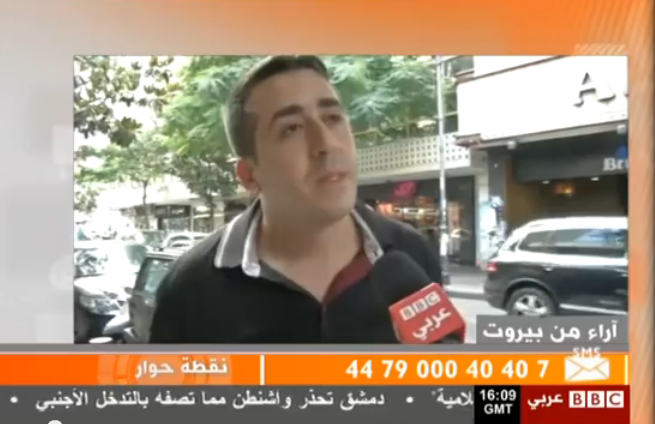
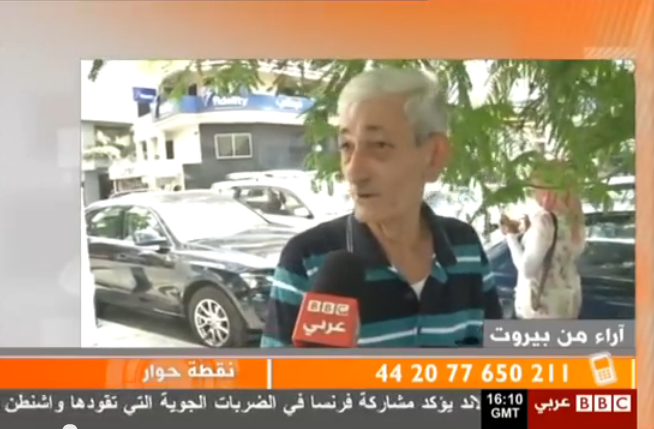
Then, the BBC Arabic took their camera around the streets of Beirut, Lebanon, and asked random people what they think.

This man said: Yes, I support the strikes, with or without UN approval, especially after what happened to our soldiers. (Apparently, Da-esh has beheaded a couple of Lebanese soldiers.)


Without Syrian approval, it's wrong, says this man.

They have to hit Da-esh, says this man. Whether for the sake of the people of Lebanon or Syrian soldiers, hit them, hit them!

This super-annoying lady, with a super-annoying way of talking, said in a slurred, drawling way: of coooouuuurse not. Someone coming into your house without permission. Would you allow it? (swings her purse violently.)

 100% yes I agree with the strikes, because they [Da-esh] are criminals.

Strike them? Of course! Not just in Syria, but in Lebanon and Iraq, wherever they are.

No! Because this is an attack on Syria, not on Da-esh. They need Syria's approval first. 

Today you hit Da-esh and tomorrow you strike Syria herself, and there's no limits.

I support striking Da-esh in Syria because it's a terrorist organization, with or without Syria's approval. 


 After that stroll through Beirut, we returned to the BBC Arabic studio in London where the moderator, Resha Qandeel, was taking calls. First she spoke to Abdullah, a Syrian man living in the UAE.

Abdullah started by saying: the US had a red line over the use of chemical weapons, in which many women and children died.

That was where he started. Before I knew it, he was talking about Oman and Iran. I'm not sure how he ended up there. But he concluded by saying:

The US just wants to arm the Shias against the Sunnis in Syria. American planes operated just the other day in a conspiracy with Hezbollah, and you all don't report that news. They are conspiring with the Shias in Syria. I ask you all to be honest! I ask you one thing only: why is Hezbollah not on the listed groups of terrorists!? Why is it just Da-esh and Jebhet el Nusra!? It's not just the beheadings and the killings that is terrorism! The media is also terrorists! The killers are terrorists! The silence is terrorism!

BBC Arabic Reporter reacts to Abdullah: the US wants to arm the Shias against the Sunnis!

Next, Resha talked with Aziz Kathem from Britian. He said: I think the US involvement came too late. Because the crisis has been going on for a long time. 

Resha asked a question to her callers: many Arabs think that the US had a role in creating Al Qaida, a a role in creating Da-esh, and therefore is reaping what it's sown, and thus that the US should take the primary role in defeating Da-esh, although with the help of Arab countries. What do you think?

Mohamed Gherbi answered. He said: look, I'm against any foreign involvement in Arab affairs. The whole world is saying that these extremist groups are supported by the US, were created by the US, the foreign minister of the US Hilary Clinton said that yes, we made Da-esh. I call upon the US and the western countries to stop supporting these extreme groups with money and arms. 

Resha: yes, but you know, what you're suggesting is that Da-esh is purely a business, and that they just need money and weapons to keep going. However, many of the fighters in Da-esh are not fighting because they get paid and such, they are fighting because they believe in a cause. So even if monetary support was withdrawn, that would not stop them from fighting. 

Mohamed Gherbi: But these groups are actually benefiting the US. Because the US wants the Arab world to be ruined. 

Resha: mmmmmm.

Gherbi: all the Arab countries now supporting American strikes against Da-esh are the same ones who also supported the strikes against Iraq and the destruction of Iraq. 

Resha: but it's also in the interests of the US to have a stable Middle-East, and I say 'stable' between quotation marks because this is a concept that varies widely in its meaning between the US and how Arabs see it. What is the benefit to the US if the Middle East is taken over by extremist groups?

Gherbi: no, no, the US does not want any stability (Resha nods her head) because it really just wants the collapse of the Arab world and its soldiers and people and civilization. It wants the Arab world to be weak, and it wants to be the hegemony, the only power in the region. And it wants Israel to stay occupying Palestine! Now, the US wants Syria to be weaker and weaker. They don't care whether Bashar stays or not, but they just want Syria to get weaker and weaker and for its soldiers to get weaker, too. 

Next, Resha turned to a professor at the National Defense College in Washington, DC, and had a little interview with him. His name was Walid Faris. 

Faris: the US has no other choice. Da-esh is completely dangerous for the US, and it's dangerous for the region, too. It's not a question of having a business or cooperation with terrorist organizations. 

Resha: look, the US armed fighters in Afghanistan. Then the US said that Iraq was a threat, and attacked it without legal world approval through the UN. Now the US says we have to strike Syria, even though so far Russia and China have opposed this and it's pretty certain that they will continue to oppose this in the Security Council. So, should the US still talk about striking Syria in light of their previous non-approved experiences?

Faris: actually, it's different, because we are talking about an organization, Da-esh, that is a threat to each of the five countries on the UN Security Council, and in Russia's case, some of these fighters may end up in Chechnya. Right now the coalition against Da-esh consists of the world powers and the Arab countries, and this is what Obama will lean upon as he makes his case. 

That was only 19 minutes out of 51 total minutes, but it started getting boring. 

But if you want to watch the whole show, do so by clicking on the YouTube link here.


Wednesday, July 16, 2014

Obey your husband

Back in March or April, the BBC Arabic had a show on obedience. That is, a wife obeying her saintly, oh-so-deserving, ugly slobby husband. They went to Lebanon and asked random people on the street what they thought:

This handsome stud says:
 A wife should do what's best for her family. Yes, she should be convinced of what I say.


If when a married couple differs, the man always thinks he's right. But if we can sit down and talk, maybe I'll find out I'm wrong. 


My husband is always telling me what to do. 

This man mumbled the whole time, so I've no idea what he said. 

Obedience will lead to violence.

Of course, religion tells us that ... didn't understand her accent.

I think someone else said:

The man is a friend of the woman, and they need to work together. The man should not be so dictatorial like so many Arab men are.

Friday, June 27, 2014

Syrian Refugees and Who Is Really Racist?

Back in March or April, the BBC Arabic did a call-in show about how Lebanon was treating Syrian refugees.

At the time of the program, there were 1 million refugees in Syria and they comprise 25% of Lebanon's population.


And they need help now! say refugee activists.

Some of the refugees, like this little lady, comment: the Lebanese care about us a lot.


Whereas this lady asks: why are we living in the gutters?? Why do we have to be back home before 7 pm?? (The Lebanese government has put a 7 pm curfew on Syrian refugees.)


An Lebanese activist who works on behalf of Syrians and against racism called in to say: there is no logic at all at decreeing that all refugees must be home before 7 pm.

And the BBC Arabic moderator of the program, Samir Farah, said the complaints went beyond a curfew. He said that there was anti-Syrian graffiti being scrawled all over Lebanon, in such vulgar language that he can't repeat it on the air.

And the other thing making people mad is that a minister in Lebanon's government has suggested that instead of letting Syrian refugees flow over the border in Lebanon, he would rather create an isolated camp inside of Syria itself to host everyone.

But this lady says: it's good here in Lebanon. If we'd stayed in Syria it would be much worse for us.


And this Syrian man says: I would like to thank Lebanon a lot for taking us in and helping us.


But this next Syrian man is having none of it. He says that no one is more racist than the Lebanese!


That's a nice sentiment. And I can add some of my own. In 2008, I heard an Iraqi refugee in Syria proclaim that Syrians are - not the most racist people in the world - but just the worst people in the world.

Next, an indignant Syrian living in Greece called into the program to say: We opened up our hearts and our lives for the Lebanese when they were in trouble without any international help, without even the UN's help [maybe he is talking about Lebanon's civil war in the 1970s? maybe lots of Lebanese refugees fled to Syria at that point.]

Then all of a sudden, the Syrian man in Greece started yelling into the phone: What's the reason now that the government in Lebanon and Hizbollah refuse to support us Syrians!!!????

Samir Farah, the BBC Arabic moderator, said: maybe it's because the numbers of Lebanese refugees in Syria never reached such an overwhelming point as Lebanon is experiencing now.

A person from Lebanon called in to offer their views: we actually have opened up our doors to the Syrians, and we really don't understand their attitudes!

They showed clips of UNHCR people registering refugees:


Thursday, June 26, 2014

Al Arabiya reports on Iraq and Syria

I am not watching the BBC Arabic while in Jordan, but I am seeing a lot of Al Arabiya's special in-depth news channel called 'Al Hadeth'. That means, 'the events.'

I've never really watched Al Arabiya before. But someone told me that during the coup in Egypt last year, Al Arabiya took the side of the Egyptian army. On the other hand, Al Jazeera took the side of the deposed president Mursi.

Al Arabiya is owned by a rich Saudi guy - but not by the Saudi government. And it is headquartered out of Dubai.

These days, the only thing Al Arabiya's special 'Al Hadeth' channel ever talks about is what is happening in Iraq. Well, every once in a while they'll sneak in something about Syria, too.

Al Arabiya takes the side of the Sunni revolutionaries in Iraq, and is very clearly against the current Iraqi president, Al Maliki.

In fact, they don't really fully recognize his claim as head of state. Instead of talking about the 'Iraqi army', they'll just talk about 'Al Maliki's army'.

I don't think, however, that they are on the side of 'Daa-ish'/ISIS/ISIL, or whatever they are supposed to be called. But they probably put the blame for their appearance squarely on the head of Al Maliki.

Moving on from all the Al Maliki's, Al Jazeera's, and Al Arabiya's, I would like to tell you that Al Arabiya does also highlight the UN's role in what is happening.

For example, I think two days ago Syria's last stockpiles of chemical weapons were shipped out. So Al Hadeth did very long interview with Sigrid Kaag. I saw her last year on the BBC Arabic. She is the lady in charge of the UN mission to remove all of Syria's chemical weapons.

The Al Arabiya moderator asked something like: how does it feel to be leaving Syria while it is in such a shambles?

Sigrid Kaag: I came to do a job for the UN, and beyond that, I can't comment.

The Al Arabiya moderator: what do you make of reports that you are being considered as the successor to Lakhdar Brahimi as the special envoy trying to bring peace to Syria?

Sigrid Kaag: I don't know anything about that.

The Al Arabiya moderator: you don't know anything about it? I'm not asking you that, I'm asking how you feel about that.

Sigrid Kaag: I have nothing to say about that.

Yesterday, all the Syrian refugees in Lebanon and Jordan were back in the news, and Al Arabiya showed a clip of Valerie Amos speaking about the terrible situation. Valerie Amos is something like chief of humanitarian operations at the UN.

Then Al Arabiya showed a UN spokesperson, who said: we know that Lebanon and Jordan are overwhelmed, and we are doing everything we can to support them (or something like that.)


And then, Al Arabiya even showed a clip of the current president of the World Bank speaking about Syrian refugees. The current president of the World Bank is an American with roots I think in South Korea. Any case, he was talking about how the World Bank is doing everything it can to support Jordan and Lebanon.

This morning, Al Arabiya aired a commercial from Unicef, trying to get people to donate to the Syrian refugees. It was full of crying, miserable-looking kids. I'd heard before that Unicef does not show crying kids in its commercials, but maybe that is a policy just in place for western audiences.

Any case, at least Al Arabiya audiences don't have to suffer through that actress who does a Unicef commercial every Christmas in the US, with a really cheesy trembling voice. I guess Unicef must have monitored the results of that Christmas commercial and found it successful, because I see it year after year.

Sunday, May 25, 2014

Domestic violence law in Lebanon

Back in March or April of 2014, Lebanon passed a law that I think put some more harsh penalties upon those who are convicted of domestic violence. It sounded like many activists, however, were unhappy with the law because it did not outlaw martial rape, and maybe even legalized martial rape.

The BBC Arabic did several call-in shows and discussion segments concerning the law.

For one of the shows, a lady with four kids called in. Several years ago, her husband caused her a new problem everyday. She says she never complained because people don't really care - there's no one to complain to. Finally, her husband started shooting at her with a gun. She said, khalas, that's enough. She went to the courts and requested a divorce. The courts subjected the ex-husband to some trivial formalities, but no real punishment.

The BBC Arabic moderator asked the lady what she thought of the new law. Did she think it would be beneficial to women who found themselves in the situation she once had? The lady said: no, I don't think the new law will work. I think it's all just play-acting. It's not a wrong step, it's a step forward; but I cannot put any faith or optimism in it.

Then, they talked to random people on the street around Beirut. I really don't understand the accent of the Lebanese, but here it goes:

This lady says that Lebanon is a patriarchal society and boys learn this from a young age. They carry on as they grow older.

This lady says that the new law is very good, and that the men will now be scared! (scared to be brutal I guess.)


Thursday, February 13, 2014

Lebanese priorities

(February 13, 2014)

Topless pictures have been revealed of a Lebanese female Olympian at the Sochi games. The name of the athlete is Jackie Chamoun.

The BBC Arabic's Malak Jaafar announced she was going to do an in-depth segment about it, which surprised me. This sounded like such a fluffy, entertainment story to me.

Little did I know.

I think that Malak Jaafar herself is Lebanese. First, she ran a clip of a Lebanese woman saying: All the newspapers, radios, television stations have Jackie Chamoun plastered all over them. Meanwhile, we have bombs going off all the time, and women are being attacked. And we have three pages in the newspaper dedicated to Jackie Chamoun!

Some people in Lebanon are upset, because they have family values and don't want a woman with naked pictures representing them. If a naked picture is released of one Lebanese woman, then people get to thinking all Lebanese women are like that, and that is a troubling idea if you want to be modest.

Other people in Lebanon think that Ms. Chamoun can express herself as she wishes. So Malak showed footage from a photo shoot arranged by some young Lebanese. They were stripping in support of Jackie Chamoun. I don't think that's such a good idea. They are definitely not going to get the conservative, family values types people to respect them any more that way.

And the last clip that Malak showed was of a car. Just an ordinary car found in Lebanon today, and packed full of explosives. But I think they caught it before it went off.

Malak ended with: some people say it is really strange that everyone is concerned with Jackie Chamoun when exploding cars are being rigged up.

Then, it was time for discussion. Malak had this man on via video link to Beirut:


Malak asked him: The Lebanese tourism ministry has always promoted Lebanon by showing women in scanty bathing suits on the beach. You can see images like this in all the promotional videos the ministry publicizes. This is public information, and the images are presented as a stereotypical image of Lebanese women. These images also represent Lebanese women in an immodest way. So why is there all of a sudden an uproar now that Jackie Chamoun has done the same thing, albeit through a personal whim rather than through official tourism videos?

Man in Beirut: You know, that's a different problem, because it's also not a good thing for the tourism ministry to be showcasing women's bodies in that way, trying to use that to attract visitors.

Malak: Yes, but why is the country upset over Jackie when the tourism films are full of the same thing? They've been making films like that since the 70s.

Man in Beirut: I don't know what he said.

Malak: There's very religious people in Lebanon, and then there's more liberal people who don't see anything wrong with a beautiful, athletic woman doing what she wants. How can the country be reconciled with such a crisis in opposing opinions.

Man in Beirut: no, yes! Yes, there's different opinions, but everyone in Lebanon understands that you respect other people's choices, and that's different from other Arab countries, and that's why Lebanon is so much better and it has been like this for decades!

Malak: right, so with all the explosions and crises in Lebanon, and the other day a wife was killed by her husband, why are we focusing on this topic?

Man in Beirut: my dear Malak, your question is set up for the answer. Obviously, it is all a little strange!