Many churches in Eygpt have been blown up by militants, and many Christians killed in the process.
So, they just built a massive new church. When I listened to the report on the BBC Arabic, I thought they were saying that this church was a replacement for a church that had been blown up a year ago, during which 13 people died.
But maybe it's just a catch-all church supposed to uplift the morale of Egypt's Christians.
Either way, I think it's the largest church in the Middle East:
Here, the people are streaming in, and cheering as they do (lady with the open mouth):
The BBC Arabic also visited this lady in her home:
That is Jesus behind her. I think one of her loved ones was killed in a previous attack.
And this lady said: it's a very nice church, we really thank President Sisi.
President Sisi is like a dictator ... but I feel bad pointing out his bad side if all these people feel he did something nice to them. What's the morally correct way of addressing this?
Showing posts with label Egypt. Show all posts
Saturday, February 17, 2018
Valentine's Day in Egypt
Apparently, it's become a really big deal in Cairo, so the BBC Arabic visited a market which becomes flooded with pink and red every February.
It wasn't always like this. This shop-owner says it was only in the last few years that there became such a demand.
This lady says she's out shopping for her friends. Just your friends? the BBC Arabic person asked. Not a "Significant Other." She just smiles and laughs.
A lot of the people out shopping are young couples in love for the first time:
This kid was reciting everything he'd bought and was doing for his sweetheart. It was a long list, I just didn't understand it.
And even though prices have been going up at the Valentine's market, people are still out shopping:
Arab and Norwegian women in sports
The BBC Arabic has a program where they talk about high-performing women in sports the world round. They talked about a horse-back rider from Egypt who does a sport called equestrian sport called 'Kalla', at least in Arabic, which she won some competitions in.
She was saying how when the sport was first introduced, men and women trained separately; and the courses for women were made easier. But since then, things have equalized.
She says the sport taught her concentration in a whole new way.
They talked about another young Arab woman who is really good at jiu jitsu. She now teaches classes to young girls to get them involved. She talked a whole lot about how even if it's a small thing, she's going to do the best she can to make a difference and inspire young people.
But they don't only talk about Arab women in sports. They mentioned this Norwegian lady who has gotten more Olympic medals than any other:
Thursday, October 1, 2015
Young women discuss the Arab police during protests
The BBC Arabic hosted a discussion with some earnest young women from Iraq, Egypt, and Lebanon, talking about police treatment during protests. These are not necessarily the Arab Spring protests asking for an overthrow of the government, but rather protests asking for things as simple as a proper trash pick up service.
The lady on the left is Iraqi, the one in the center is Lebanese but studying in France, and the lady on the right is Egyptian.
The Egyptian lady started by saying: the police doesn't understand their role. They don't understand that they serve people. They just want to take advantage of the weapons they carry.
The moderator asked: well, you know, Egypt has outlawed protests. So what are the police supposed to do when they see protesters?
I'm sure the Egyptian lady gave a very competent answer, but I didn't understand it.
Then it was the Iraqi lady's turn. She said: Iraq has weekly demonstrations about politics (did you know that?) But there's not as much police violence during them as there used to be. Today, there's some collaboration, let's not say very strong, between the police and civil society. That doesn't mean everything is perfect. But yes, the violence against protesters has decreased. It was much worse in 2011 (I think that's the year she mentioned.)
When it was the turn of the girl from Lebanon, she showed us the spots on her elbow where she'd been hit by police in her home country. And actually, it was women police. She had been part of a protest that has something to do with the fact that the trash in Beirut has apparently not been picked up for months, and it's just sitting in the streets. I can't really figure out why, but the politicians need to agree on something, but they won't.
And they were also protesting that the government is trying to negotiate without getting the input of regular people. So how did they end up getting beaten up? I didn't understand that part! The Lebanese girl said something about how one of their members was a hemophiliac, and either they were trying to get him out of the protest so he wouldn't get hurt, or they were trying to explain his condition to the police, and somehow that led to the violence.
Besides the violence, the Lebanese girl explained that actually a few dozen human rights activists have been recently imprisoned, and that's also a strategy for frightening people out of protesting. And she said something, although I didn't really follow, about how the police had followed her home and they were asking questions.
The BBC Arabic moderator asked her: aren't you scared that you'll be arrested, too?
And the Lebanese girl gave some heroic answer about how she wasn't scared, and none of her friends were scared, and that the police couldn't stop them.
The Iraqi lady echoed that. She said that in the Iraqi province of Babel, protesters have been beaten by security forces, but the protesters keep coming out, it encourages them.
Again, the conversation was about harassment and whether protesting was a wise decision, and the Iraqi lady got fed up and said: You know, really, the protesters are protesting for simple things, just for human rights, stability. It's very similar to what the Lebanese and the Egyptians are asking for. We're not asking for anything complicated, we're tired of what's been happening.
UN Summit
The BBC Arabic interrupted their coverage often this week to bring the live speeches coming from New York.
I'm just so sad that last Friday I didn't have a chance to watch anything, and I missed the adoption of the Global Goals. I just caught a part of a report in which the Pope was talking about them:
Any case, they showed the Egyptian president, Sisi, who began his speech by saying: Greetings to the great state of Egypt. Gross!
On Monday, the UN was also holding the UN Peacekeeping Summit, so the BBC Arabic covered that, too. They showed Obama speaking at it:
Then, when the BBC Arabic live correspondent was done talking, he would say (in Arabic): Luqman Ahmed, for the BBC Arabic, at the United Nations, in Niue Yorrrrrrrk.
Labels:
Arabs,
BBC Arabic,
Egypt,
Muslims,
UN,
United States
Sunday, August 2, 2015
Daaesh gets talked over by Serious Men with Beards and Voila! Ladies with Make-up
Lively discussion on the BBC Arabic ...
They were talking about why young Muslims in the west go join Daa-esh (ISIS).
First, this guy gave his opinion:
He said: there's so much Islamaphobia, so much racism, kids grow up in this environment and of course they end up feeling: this western society is not for me.
Said the BBC Arabic moderator: Okay, there's Muslims in Europe who are now government ministers, are you saying they all need to become Daaesh's suicide bombers tomorrow?
Serious Man with the Beard: No, of course not, you know, and it's important to say that most Muslim youth in Europe are just fine, they are not radicalized, they are living okay, these extremists are a very very small part.
Then the Serious Man with the Beard started going down a different tack:
The reason Muslim youth join Daaesh is because all the moderate Muslim groups have been repressed. So they don't have a venue to express themselves and you end up with people who take to extremism to get their points across. You know, there's been a lot of moderate Muslim organizations that have been put down.
The BBC Arabic moderator: Wait, who exactly are you talking about?
Serious man with the beard: Well, you know, the Muslim Brotherhood in Egypt for one. They were moderate. Can you say that they were like Daaesh?
BBC Arabic moderator: No, we can't say that.
Serious man with the beard: Well, so when the Muslim Brotherhood was legal in Egypt, things were fine. Now that they have been outlawed, it's now that we see the new and dangerous actors come out, the ones who are blowing things up every few days.
There was a lady who was also part of the conversation. I didn't get a chance to take a screenshot of her, which was too bad. She was speaking from Lebanon, and she kept interspersing her Arabic with random French words, like 'voila!' and 'justeeees', and probably making all the Arab grandmothers watching at home get really indignant.
Said the Voila! Lady: You know, kids wouldn't get drawn towards Daaesh if that fertile ground wasn't already there, and honestly, it was the political Islam groups just like the Muslim Brotherhood in Egypt that planted that ground, they are the ones who led to those ideas, where you first have extremist thoughts, and then you move to extremist actions. They make it possible.
The Serious Man with the Beard was not happy about this, but unfortunately, there was a white-haired man sitting right next to him in the studio, and he piled right on:
Said the White-haired Man: You know, the Muslim Brotherhood have it right in their motto. Their motto says: "Jihad is our way, Death for the sake of God is our wish."
BBC Arabic Moderator: Okay, but you know, they carried that motto out in a different way than Daaesh does.
White-haired Man: Nope, the thoughts are exactly the same.
The Serious Man with the Beard: Nope, not the same at all, And you know what, 'Jihad' can mean many many things. It can mean jihad in a personal sense, that you're trying to make yourself a better person. It doesn't mean you have to do anything violent.
Then the Voila! Lady got in on it again:
You know, it's always the case with men like your guest here representing the Muslim Brotherhood, that as soon as we start talking about identity, he has to take it straight to, oh, Muslims in the west have no rights, and so on. Actually, Europe has given us tons of rights.
The Voila! Lady left, and the White-haired Man left, and this lady with a lot of make-up replaced them:
She said: You know, it's the fault of all the sheikh's at the mosques, they sit and stir up all the youth, and you know, they are supposed to be talking about things like love and peace.
BBC Arabic Moderator: Don't they do that?
Make-up Lady: Well, I'm not saying that they don't, but all of them need to do it. I don't want to generalize. But the sheikhs in the mosques need to take up the responsibility of distinguishing true Islam and pointing out the wrong things that Daaesh says.
BBC Arabic: Well, what about the Internet? It might not be the sheikhs in the mosques at all, it could just be that youths read extremist things on-line.
Make-up Lady: Right. There's actually an initiative that was started in London about this. Two youths try to chat with kids online and get them to see the error of Daaesh's ways. They are actually using Daaesh's ammunition - trolling around the internet - to get back at Daaesh.
BBC Arabic Moderator: It sounds great, but what can two kids do?
Make-up Lady: Exactly, and this is why the British government needs to help and support these kids. They need to put forth resources so that they can develop these initiatives and make them stronger.
Friday, June 19, 2015
ADHD - It affects Arab kids, too - A BBC Arabic Report
The BBC Arabic has been running an hour long program about ADHD among Egyptian kids this week. I think the report said that an estimated 6 million Egyptian kids have Attention Deficit/Hyperactivity Disorder. There are over 80 million Egyptians in total.
So they were talking in the report about how these kids are sometimes rude and aggressive, and can't still. They interviewed a couple of families, showed a mother with her face in her hands.
But they also showed this little kid being helped with his homework by his mother, as his sister looks on:
The homework is practicing how to count in English! The mother was reviewing with him: fourteen, fifteen, sixteen ...
I liked this segment because it was like being invited into someone's home and getting to see people and a family care for each other, and all the things they've put in their house to make it bright and comfortable.
Here's the homework:
And then the kid went back to his room to play:
Friday, June 27, 2014
Why Al Arabiya is so boring!
Whenever I watched the BBC Arabic, they would forever and anon turn to Dr. Edmund Ghareib when discussing political issues in the Middle East. Dr. Edmun Ghareib is an analyst based out of Washington DC, but he is originally Arab.
Yesterday, I was watching Al Arabiya, and who do they suddenly announce but Dr. Edmund Ghareib himself! They do the exact same thing as the BBC Arabic: he shows up via a live video connection, with the Washington Monument in the background over his shoulder.
Turns out he is a very busy man, because I was watching Al Arabiya with someone else, and she said that Dr. Edmund is forever showing up on Al Jazeera, too. So he is apparently not picky, he likes to be on all the news channels, and they all love him.
However, I think they do themselves a disservice. Whenever he comes on the air, I can't help but tune him out. I think he's kind of dull. Then again, I can never really catch what he's saying.
I learned some more things about Al Arabiya: during the coup in Egypt, they took the side of the Egyptian army. A lady who watched the coverage at the time told me that Al Arabiya actually didn't even present the side of the Muslim Brotherhood and Mursi.
Well, they are doing the same thing now with Iraq. Al Arabiya takes the side of the Sunnis in Iraq. All the time I've been watching Al Arabiya these days, I've never seen them interview anyone who represents the side of Al Maliki's Shia government.
For example, yesterday evening's program featured two guests: one was Dr. Edmund, an independent analyst, and the other was an Iranian guy, who lives in Britain and despite the fact that he is Iranian really doesn't like Al Maliki. They ought to have had a third guest, someone who took the opposite view of the Iranian. That is what the BBC Arabic always does: they have an independent person, and then they'll have two or even three other people who represent various opposing points of view. And honestly, that makes it more interesting, because everyone starts fighting! But at least they're just fighting with words.
Al Arabiya really should think about this, because their little conversation yesterday with Dr. Edmund and the Iranian guy was quite simply boring.
As for Al Jazeera, I've not been watching them; but I've just heard that although they sided with the Egyptian Muslim Brotherhood and Mursi during the coup, they did at least present the side of the Egyptian army.
Labels:
Al Arabiya,
Al Jazeera,
Arabs,
BBC Arabic,
Egypt,
Iran,
Iraq
Monday, April 28, 2014
Energy in Egypt
(April 8, 2014)
Egypt, or some people in Egypt, are worried about the effect of all their coal-fired energy plants on the environment.
So I think they've built a non-coal powered plant:
And I think this guy is running it:
Though he is not Egyptian. He was interviewed through translation.
Egypt, or some people in Egypt, are worried about the effect of all their coal-fired energy plants on the environment.
So I think they've built a non-coal powered plant:
And I think this guy is running it:
Though he is not Egyptian. He was interviewed through translation.
Sunday, March 23, 2014
Freedom to Broadcast Hate
I was traveling last week, and didn't put aside time to listen to the Arabic news. When I got back, I checked the BBC Arabic's YouTube page, where they post their short news clips from the last month, but I didn't see anything about the hotel attack in Afghanistan that killed journalists and humanitarian workers and kids.
They did, however, have a 50-minute long piece of investigative reporting about hateful religious channels in the Arab world. It's actually suspenseful and like a mystery to watch. Plus, there's the original version in Arabic, and a version translated into English with subtitles. The main guy doing the investigation speaks both Arabic and English fluently, so no matter which version you watch, it's his voice that you'll hear: he did the talking for both versions. That's impressive!
The version in English:
And the original version in Arabic:
Once you've finished watching the video, you probably won't like Arabs anymore (I sure didn't) so then you can watch this video about musicians and environmentalists and creative people in Eygpt:
It must be so sad to waste your life imploring God to grant your enemies with cancer, when you could instead have been playing an instrument, helping the planet, and making people smile and kids dance!
Friday, February 7, 2014
Cancer in Egypt
(February 4, 2014)
A new report by the United Nations warned of a tidal wave of cancer in the future. So the BBC Arabic did a feature on cancer in Egypt.
Recently, Egypt built a cancer treatment hospital, apparently funded entirely by donations. It is a very modern building:
A new report by the United Nations warned of a tidal wave of cancer in the future. So the BBC Arabic did a feature on cancer in Egypt.
Recently, Egypt built a cancer treatment hospital, apparently funded entirely by donations. It is a very modern building:
BBC Arabic reporter presents the Egyptian cancer hospital
To get donations, they use sick children in the commercials, crying. The man in charge of the appeal was asked: do you think it is exploitative?
He said no, they're only trying to raise money.
However, the center can take only 30% of cancer patients. Everyone else ends up in very under-resourced local clinics where it sounds like the staff doesn't know how to deal with cancer.
And this lady, who is in charge of the shiny, state-of-the-art hospital, says the lack of space for all is unfortunate. But they don't have room to take everyone:
What happens when girls ride donkeys?
(February 7, 2014)
Every so often, the BBC Arabic does a segment about female circumcision. It is called al-khitaan in Arabic. Today, this was induced by a UNCEF report that came out.
BBC Arabic presenter Malak Jaafar was directing.
First, they showed which Arabic countries had landed on the report. Iraq was on the list with the lowest rate of female cutting (8%). Well, I think most Arab countries have a rate close to zero, but this report just ranked countries with a problem.
Next came Yemen, with 23%. Yemen passed a law against al-khitaan in 2001:
Egypt was the focus for the rest of the segment. Malak showed some opinions of random people on the Egyptian street, mostly men, and all of whom said the 2008 law against FGM needs better enforcement.
And then, Malak did an interview with a twinkly-eyed Egyptian doctor, who was a riot:
Basically the bluntest conversation I've heard on the BBC Arabic, so blunt I blush to transcribe it all.
Malak asked something like: why is female circumcision so prevalent in African nations?
Egyptian doctor: it's not because they're Black! It's because of the old ways of patriarchy.
Malak: In Islam, men can marry four wives, but women can marry only one man. Isn't al-khitaan just another way that Islam controls women?
Egyptian doctor: No! It is not about Islam. In Judaism, female circumcision is written into the Torah [I don't know if that's true]. There are Christian Copts here in Egypt, and they practice al-khitaan. They're Christian, not Muslim!
Malak: your activism against al-khitaan is such a liberal idea. Don't you get push-back when you go to rural villages and try to convince them not to cut their daughters?
Egyptian doctor: actually, we can talk to them about it. They tell us, "if we don't cut our girls, it will open up a can of worms: because, we don't want our girls to ride donkeys and feel any sort of anything." So we tell them, "when boys ride donkeys, don't they feel something? and therefore, why don't we cut them?"
Continues: Then the villagers we speak with say, "oh!"
Malak: well, if there's a law in Egypt against al-khitaan, why is it that 91% of the female population is cut (and this figure has been steadily increasing.)
Egyptian doctor: the law is just symbolic, something the government did to shut up the international community. It's been this way ever since Sadat and Mubarak. I've been blocked many times from speaking about the bad effects of female cutting on TV. My books have been banned. I was kicked out of the Health Ministry [I think that's what she said] because I spoke out about it!
Every so often, the BBC Arabic does a segment about female circumcision. It is called al-khitaan in Arabic. Today, this was induced by a UNCEF report that came out.
BBC Arabic presenter Malak Jaafar was directing.
Malak and UNICEF
First, they showed which Arabic countries had landed on the report. Iraq was on the list with the lowest rate of female cutting (8%). Well, I think most Arab countries have a rate close to zero, but this report just ranked countries with a problem.
Next came Yemen, with 23%. Yemen passed a law against al-khitaan in 2001:
And you thought you couldn't read Arabic!
Next came Sudan:
Egypt, always causing trouble, where 91% of women are cut, although a law was passed against it in 2008. Malak discussed that later with an Egyptian doctor ...
And Somalia, with a 98% rate. Egypt was the focus for the rest of the segment. Malak showed some opinions of random people on the Egyptian street, mostly men, and all of whom said the 2008 law against FGM needs better enforcement.
And then, Malak did an interview with a twinkly-eyed Egyptian doctor, who was a riot:
Basically the bluntest conversation I've heard on the BBC Arabic, so blunt I blush to transcribe it all.
Malak asked something like: why is female circumcision so prevalent in African nations?
Egyptian doctor: it's not because they're Black! It's because of the old ways of patriarchy.
Malak: In Islam, men can marry four wives, but women can marry only one man. Isn't al-khitaan just another way that Islam controls women?
Egyptian doctor: No! It is not about Islam. In Judaism, female circumcision is written into the Torah [I don't know if that's true]. There are Christian Copts here in Egypt, and they practice al-khitaan. They're Christian, not Muslim!
Malak: your activism against al-khitaan is such a liberal idea. Don't you get push-back when you go to rural villages and try to convince them not to cut their daughters?
Egyptian doctor: actually, we can talk to them about it. They tell us, "if we don't cut our girls, it will open up a can of worms: because, we don't want our girls to ride donkeys and feel any sort of anything." So we tell them, "when boys ride donkeys, don't they feel something? and therefore, why don't we cut them?"
Continues: Then the villagers we speak with say, "oh!"
Malak: well, if there's a law in Egypt against al-khitaan, why is it that 91% of the female population is cut (and this figure has been steadily increasing.)
Egyptian doctor: the law is just symbolic, something the government did to shut up the international community. It's been this way ever since Sadat and Mubarak. I've been blocked many times from speaking about the bad effects of female cutting on TV. My books have been banned. I was kicked out of the Health Ministry [I think that's what she said] because I spoke out about it!
Sunday, February 2, 2014
Fida and women
(November 18, 2013)
Back in November, the BBC Arabic did another show all about women. It was 'hÃĪrligt', because all the participants were women. That meant that no one started yelling, no one interrupted, there were hardly even any pointed fingers! Different opinions, yes, but no one chomping at the bit and insulting others for thinking a different way. Ah, peaceful!
The show was helmed by the very capable Fida Bassil.
The basis for the show was a poll which had ranked Arab countries based on how women are treated. Egypt ended up really low in the poll.
This is an Egyptian activist for women's rights.
She says: probably the reason Egypt fares so badly in the poll is because it focused on violence. Maybe in other areas related to women's rights Egypt does pretty well, but when it comes to violence, it's really bad.
Fida: not so fast. The report did not just focus on violence. It looked at violence, but also at the role of women in families, involvement in politics and economics; and also besides violence, it also focused on sexual harassment.
Lady in the blue sweater: yes, the report did also focus on early marriages for girls, female genital mutilation, harassment and sexual assault. Yes, Egypt is right now seeing lots of these violations against women. And yes, I agree that we are not involved enough in political arenas, though we are present.
Fida: the report looked at four areas: violence towards women; how much of a choice a woman has in her reproductive rights; how women are treated inside a family, and the inclusion of women in politics and economics. Do you agree that those were the right metrics?
Lady in the blue sweater: I agree that these were the right standards to go by, and they follow what the UN and what Unicef would say the standards are. However, I think we should remember that the research team behind the report ignored political movements that are in fact happening. But when it comes to violence, the report is entirely correct; yes, we Egyptian women do suffer from violence.
Next a Tunisian lady, Ms. Fatoom, joined the conversation. She is a member of the political assembly in the Tunisian Nahda party.
Ms. Fatoom: We say that in spite of some things, the Arab Spring helped the status of women, because women were actors in the revolutions, part of the protests, and it is our right to enjoy our accomplishments of overturning the governments. I think this report revealed the fears that perhaps in the years to come, women won't continue to progress, but when it comes to Tunisia, Tunisia was ranked pretty high amongst all the Arabs, and was the first out of the North African countries, so we think we're doing pretty well, especially compared to the other countries who recently had revolutions.
Fida: what do you make of the fact that the role of women in society went backwards in some cases under the Arab Spring, for all that women participated in the revolutionary process?
Ms. Fatoom: it is a basis of Middle Eastern societies to revere men at the expense of women; and to be lacking in giving women true opportunities to distinguish themselves.
Friday, January 24, 2014
Arab information graphics
(January 21, 2014)
The BBC Arabic did an interview with Amro El-Eraqi. That translates into "Amro The Iraqi," but he is not Iraqi. He is Egyptian.
The BBC Arabic interviewed him because he has started the first Arabic website on information graphics - the cool pictures side by side with the news that summarize an article in a colorful way, or point out interesting facts, like so:
This was, I think, the highlights of the life of a man who had just died.
Mr. El-Eraqi explained that he started a website in December 2012, so that he can make these sorts of graphics, and encourage the Arab media at large to join the fun, as well (because so far, they don't.)
The lady doing the interview asked: but an information graphic takes a lot of time to make, so how do you keep up when the news is so fast these days?
Amro said: that doesn't bother us, because these graphics are more for analysis and go in-depth. They are meant for taking a step back and looking at the whole picture. So you are much more flexible when it comes to time.
The website, http://www.infotimes.org/, is all in Arabic, but you should go to it anyways, because it's pretty nifty, and because Norway's flag is on it. Just click on any of the rectangular exhibits, and the graphic will pop up. Some of them have glossy animation or interaction, so it's fun.
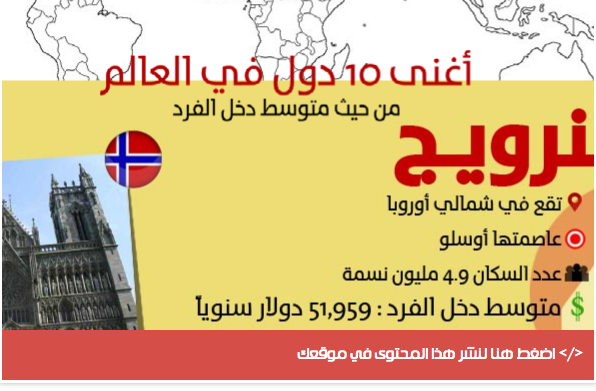
If you scroll down to the third row of exhibits, you get to the one with Norway's flag. It is entitled, "The ten richest countries in the world, per capita." (but in Arabic)
Open up that graphic, click on Norway's flag, and you get this:
It says:
Norway (El-Nurweej) (like Norwegian without the 'ian')
Lies in the north of Europe
Her capital is Oslo
Population size: 4.9 million (see if you can find 4.9 in the graphic!)
Average income per person: $51,959 annually
And here is the man himself, speaking to the BBC Arabic:
Pottery shop
(January 21, 2014)
This is a pottery shop, spinning its magic, in Egypt:
It was featured on the BBC Arabic as part of the weekly series called "I am the witness." People send in videos of problems or triumphs in their lives or their community's life, and narrate it for all of us.
Here's some more of the shop's wares.
According to the video, this shop is renowned because of its inventive architecture and its delicate handiwork. They make useful things and ornaments for beauty, bowls for eating and trays of silver. Everything is painted and stenciled with careful designs. Indeed, this shop is the last word in taste, the narrator assures us; but of course, he is a little biased.
The shop-owners were recounting how packed the shop used to be, and bemoaning how empty it is these days, since people are too scared to visit Egypt in the midst of turmoil.
I say, count your lucky socks that you're not in Iraq, then maybe really nobody would be visiting you.
At the end, the narrator was telling about how famous the shop is. And the "most distinguished visitors the shop ever had" were the King and Queen of Sweden in 1986, the narrator informs us! The shop has a gold frame hanging in the place of honor to prove the fact, and below the picture is a hand-written note; I guess it must be the handwriting of the King and Queen:
Must be nice memories for everyone!
Then the narrator also mentioned that Egypt's last Minister of Culture had visited, and famous artists and the like.
You can watch the full 5-minute clip here, via YouTube.
Labels:
Arabs,
art,
BBC Arabic,
Egypt,
Special in Sweden,
Sweden
Saturday, January 18, 2014
Oscars and Arabs
(January 17, 2014)
Three Arab films have been nominated for Arabs this year. That's not bad at all! They talked about all three on the BBC Arabic.
First, there was a Palestinian film called "Omar". It's a love story:
Now, my mom says that Arab girls are the purest in the world, so I really can't believe my eyes here...
... and here is the film-maker. Her name is Jehane Noujaim.
This film also deals with the revolutions. The film-maker is called Sara Ishaq. She was interviewed both on the BBC in English, and then we saw her live through a video link-up on the BBC Arabic. Here she is:
She couldn't hear the questions of the BBC Arabic presenter very well ...
... and the BBC presenter sure got worked up about it. It was Makki Helal. He's usually worked up about something.
Good luck to everyone on Oscar night!
Three Arab films have been nominated for Arabs this year. That's not bad at all! They talked about all three on the BBC Arabic.
First, there was a Palestinian film called "Omar". It's a love story:
Now, my mom says that Arab girls are the purest in the world, so I really can't believe my eyes here...
Gazing adoringly into each other's eyes - what a scandal!
Hand in her hair - oh, no!
Hand on his cheek - repent, child, repent!
The second film was a documentary of revolutionary events in Egypt. Here is a clip ...
... and here is the film-maker. Her name is Jehane Noujaim.
The film is called "The Square." The film-maker was interviewed on the regular BBC in English, so the BBC Arabic just summarized that.
The third film was a Yemeni documentary called "Dignity has no walls," the first time a Yemeni film has been nominated. Here's a screenshot from it:This film also deals with the revolutions. The film-maker is called Sara Ishaq. She was interviewed both on the BBC in English, and then we saw her live through a video link-up on the BBC Arabic. Here she is:
She couldn't hear the questions of the BBC Arabic presenter very well ...
... and the BBC presenter sure got worked up about it. It was Makki Helal. He's usually worked up about something.
Good luck to everyone on Oscar night!
Subscribe to:
Posts (Atom)