The BBC Arabic did a call-in show about the sexual assaults and child abuse occurring in refugee camps in Syria.
The British newspaper, the Guardian, is the one who had documented the abuse, and the BBC Arabic was just getting people to express their opinions.
They spoke to some refugees living at the camps right now. Mostly, they spoke to Syrians. The first Syrian man said things like: Yes, I know of little girls who have been attacked. And you know what, really, unfortunately, it's really not the Syrian men doing it. It's the Afghanis. I hate to say it, but it is the Afghanis.
The second man to call in from a camp backed up the first: it's the Afghanis, and the Pakistanis, too.
One dad called in and said: I am here in the camps with my kids, I have a little girl, I go with her everywhere, I never let her go anywhere alone, I'm just doing what I have to do to protect my kids.
What a lot of the people calling in said was: the Greek authorities are the ones in charge of keeping the camps safe, like the Greek police. However, when people go to them to report assaults, the police will say: well, what's the evidence, and we didn't see it happen, and where's the proof? Usually, nothing happens to the criminals.
One Syrian called in to say that he saw an attack on a little girl by a gang, he was there as it took place. He added: these gang men were Iraqi, Syrians, and from North Africa. And even though it happened right in front of me, what could I do? They were all armed.
Someone mentioned they knew an Iraqi family whose little girl had been attacked, and they went to the police, who did nothing. Now that family has returned to Turkey, they didn't know what else to do for their daughter. The person telling the story didn't know anything else about it, just that the family had returned to Turkey.
They interviewed a lady who I think works for the UN about the situation. They asked her, what can you all do? And I think she said that they really had already achieved some success on this issue, at least in Jordanian refugee camps. I didn't catch all the details, but apparently they have a pretty sturdy operation there. As far as the Greek camps, I think she said they are still gearing up the programs, and in the meantime, they would urge that there is more community-based approaches, a better recognition of the problems and making sure men understand they should not behave as brutes. The BBC Arabic anchor said to that: I don't think people are interested so much in community awareness, I think they want an official response.
Finally, they also talked about the fact that for the kids getting abused, there is no counseling, there's no trained staff who can help.
Showing posts with label Men. Show all posts
Showing posts with label Men. Show all posts
Wednesday, August 24, 2016

Saturday, March 21, 2015
Iraqi man running his mouth
May God help us all. The BBC Arabic is currently running a panel discussion. It's called 'Duniyana', which I guess translates into "Our World." Our only misfortune is that this time around, an Iraqi man has been invited on to it.

Blah, blah, blah, I'm not against the Shia! he says hastily, while everyone else rolls their eyes.

He's the kind of man who talks fast, mumbles, lets his words roll out like oil, and takes the conversation from left to right so fast that you have no idea what he's saying.
Monday, August 18, 2014
Gazi Camp in Jordan
Gazi camp for Palestinian refugees
This is a camp full of maybe 1,000 Palestinian refugees. I think millions of Palestinian refugees arrived in Jordan around 1950, and they were all given Jordanian citizenship. But the people in Gazi camp maybe came a few decades later, so they do not have Jordanian citizenship.
The camp is really poor. There's a lady called Sofia there who tries to coordinate relief efforts. She said that the people in the camp don't actually get running water except for once every 3 weeks, and even then, the water flow is weak, and the water is dirty and full of bugs. As far as I was able to gather, since Gazi camp is not comprised of Jordanian citizens, the Jordanian government doesn't necessarily take responsibility for providing a good water supply. To them, it is the responsibility of the UN. But I'll get the real reason (maybe) is that neither the UN nor the Jordanian government has money to drill a water system.
People in the camp have tanks that store the little water they get. Or, if a family has money, they can buy water from a private company and fill up their tank that way.
Well-to-do Jordanian families contact Sofia and ask: who are the orphans in the camp, or the kids with no father, and how can we help them?
Then, Sofia keeps a list of every time a family receives help, so that she is able to distribute things as fairly as she can. You can buy your adopted family lunch or dinner, or school clothes for the kids, or maybe even pay for them to fill their water tanks with clean water from the private companies. Or you can buy baby formula for their babies.
There's an UNRWA school at the camp that the children attend.
The camp is just outside of the city of Jerash, where you can find lots of archaeological ruins. It is less than an hour from the capital, Amman. Young people from Amman from time to time gather up money, especially during the holy month of Ramadan, and buy presents for kids at the camp, or cater a dinner for them. But the problem is that there's hundreds of kids at the camp, so it's hard to invite everyone.
One time, a group of young people from Amman hosted a Ramadan dinner for about 50 kids at the camp. The same group of young people came back a few weeks later, and in the desert heat, during a water-prohibited Ramadan day, cleaned out the camp school. The school was full of glass and trash that they swept out.
Just a few days after all that hot, sweaty work, a group of camp boys came and wrecked the school all over again. They went and broke glass everywhere. It is believed that those boys are amongst those who did not get to attend the Ramadan dinner, so they were mad about that.
A lot of the girls at the camp get married young, and then have baby after baby after baby - even in cases where the mother has no money, no income, no milk, no water even, to care for that baby. I think there is a lack of birth control at the camp, and also I think the girls believe they have to serve their husbands all the time, even the ones who are beating them up.
For example, there is a lady there whose husband beats her up. Then he abandons the family and all his kids. Then he comes back for a while. Then he abandons them again. Well, in the brief period of their reuniting, the wife becomes pregnant with child number 8. But the husband doesn't care. Word is that he has now supposedly left the family for good to go live with a new wife in Amman. Ewwww. What kind of stupid woman is his latest bride?
When the first wife delivered her eighth baby, her little seven-year-old son helped find the taxi and took her to the hospital!
And the oldest 13-year-old boy works at least during the summer.
I don't think that the newest baby girl (child number 8) has anything like diapers. She just lies in her leaking bundles and blankets.
Wednesday, July 16, 2014
Obey your husband
Back in March or April, the BBC Arabic had a show on obedience. That is, a wife obeying her saintly, oh-so-deserving, ugly slobby husband. They went to Lebanon and asked random people on the street what they thought:
This handsome stud says:
 A wife should do what's best for her family. Yes, she should be convinced of what I say.
 If when a married couple differs, the man always thinks he's right. But if we can sit down and talk, maybe I'll find out I'm wrong.
 My husband is always telling me what to do.
 This man mumbled the whole time, so I've no idea what he said.
 Obedience will lead to violence.
 Of course, religion tells us that ... didn't understand her accent.
I think someone else said:
The man is a friend of the woman, and they need to work together. The man should not be so dictatorial like so many Arab men are.
This handsome stud says:
I think someone else said:
The man is a friend of the woman, and they need to work together. The man should not be so dictatorial like so many Arab men are.
Sunday, June 15, 2014
Child Rape in Sudan
Back in March or April, the BBC Arabic did a report on child rape in Sudan.
The hard questions were asked by Malak Jaafar:

The hard questions were asked by Malak Jaafar:
Malak Jaafar
Malak spoke with two guests via telephone or video. The sound was blurry, or maybe I am unused to the Sudanese accent, so I only caught bits and pieces.
One of the guests was called Mr. Suliman. He represented Sudan's government. The other guest was Ms. Amil. She is an activist for children's rights.
Mr. Suliman started off by saying, in response to one of Malak's questions: No, we do not treat rape victims as adulterers. We are talking about a nine-year-old girl who's been raped.
Then he mentioned a special law that protects kids.
Malak turned next to Ms. Amil.
Malak: if a child has been raped, what happens when the parents turn to the courts or try to find lawyers?
Ms. Amil: they face many problems.
But I didn't catch the details. I only caught her saying that before the new law was passed in 2010, a rapist's punishment could not exceed a seven-year jail term, and a 14-year-old girl who had been raped was tried for adultery.
Ms. Amil said that rapists were protected by societal norms, or something like that.
Malak: but how can you claim society protects the rapists? Mr. Suliman said the law does not protect rape, nor does it allow girls to be tried for adultery. How does the law get twisted around from its original intent?
Whatever Ms. Amil said, I didn't understand.
Then Malak turned back to Mr. Suliman.
Malak: There have been 3000 cases of child rape recorded by the courts (I didn't catch the time period referenced.) Why is this number on the rise?
Suliman: Sound too blurry. I think he said: you can't trust those numbers, and we've taken many protective measures.
Malak: so you doubt the numbers from your courts?
Suliman: no!
Malak: you know, Suliman, if there's hundreds of rape cases recorded, that means there's many more that go unrecorded because parents are afraid their daughters will get a bad reputation. This happens in conservative societies like Sudan. So what guarantees do parents get that they can go to the courts and be treated fairly?
Suliman: ehhhhhhhhhhhhhhhhhhhhhh.
Sunday, March 9, 2014
Anna Lindh and Arab Debates
(March 3, 2014)
Apparently, there's a whole array of spaces for young Arabs to debates. There's something called Young Arab Voices behind the movement, and the BBC Arabic supports them as well, as it often broadcasts these debates. And they even get a BBC Arabic presenter, Samir Farah, to moderate them.
The other day, I was watching on of these debates, and I was so happy because I noticed that the Anna Lindh Foundation is also supporting these debates:
 The Anna Lindh Foundation is a Swedish organization named after Sweden's former foreign minister. Every time the camera focused on the guy in the photo above, who was one half of the debate, I saw Anna Lindh's name. It was very nice!
The debates are about all sorts of things. This debate took place amongst Tunisian college students. The first debate questioned: should Tunisian workers be allowed to strike or not?
One girl said: yes, because strikes are a democratic way for workers to have power.
The opposing guy said: no, because strikes disrupt the economy.
An audience was watching. At the end, the audience voted that the girl was far more eloquent in her presentation; but, as for the audience's convictions, it was split evenly between those who agreed that workers can strike, and those who disagreed.
The second debate question was: should there be a quota in the Tunisian Parliament for women. Here they are going at it:

A girl called Rania presented a case for the quota, and a guy called Hamza presented a case against.
Hamza said: there's already equality amongst Tunisian men and women, so the quota would be an unfair advantage for women, something they don't need. Women in Tunisia have all the rights and freedoms that men have.
Rania said: no, there's not yet equality.
Hamza said: you just finished telling us how Tunisian women are equal to men, and also, if you are so interested in the democratic process, then note that no other established democratic countries have quotas for women.
The girl choked on this. Then the moderator, Samir Farah, told her: you could have responded by saying: those more established countries used to have quotas, until women's rights had become more and more guaranteed by social norms and the laws.
In Tunisia, there's a law that says half the candidates on the election sheet must be women, and half must be men. So Hamza said: even with this special provision, still not nearly as many women were elected as men! I think he used that to show that people don't want to vote for women in the first place, so there ought not to be a quota.
But a girl from the audience said: yes, and when they made the election sheets, they put all the men's names at the top (!). We are in a eastern society, we have to acknowledge that there are obstacles fronting women that men don't face. So we have to have a quota.
Then another girl from the audience got up with her question:
 She said to Rania: my valued madam, you said that Tunisian women have accomplished a lot. I agree with you whole-heartedly, and this is why I don't think a quota is to the advantage of women. Why? Because women are capable of reaching high positions based on their skills alone. When we have a quota, it gives the impression that women are weak and unable to compete on their own against men. It should be a fair competition between men and women, and whoever is more qualified should be the person chosen.
"My valued madam" Rania said: well, the current government only has three women ministers. That's not even a tenth. So where is the equality?
The girl from the audience said (I think): well, a quota is not going to help. It has to be a whole change in the society.
In this case, the audience voted at the end with a very slight majority in favor of not having a quota; and they also voted for Hamza being more eloquent in handling the debate than Rania, though in my opinion, he was all that good, either.
Apparently, there's a whole array of spaces for young Arabs to debates. There's something called Young Arab Voices behind the movement, and the BBC Arabic supports them as well, as it often broadcasts these debates. And they even get a BBC Arabic presenter, Samir Farah, to moderate them.
The other day, I was watching on of these debates, and I was so happy because I noticed that the Anna Lindh Foundation is also supporting these debates:
The debates are about all sorts of things. This debate took place amongst Tunisian college students. The first debate questioned: should Tunisian workers be allowed to strike or not?
One girl said: yes, because strikes are a democratic way for workers to have power.
The opposing guy said: no, because strikes disrupt the economy.
An audience was watching. At the end, the audience voted that the girl was far more eloquent in her presentation; but, as for the audience's convictions, it was split evenly between those who agreed that workers can strike, and those who disagreed.
The second debate question was: should there be a quota in the Tunisian Parliament for women. Here they are going at it:
A girl called Rania presented a case for the quota, and a guy called Hamza presented a case against.
Hamza said: there's already equality amongst Tunisian men and women, so the quota would be an unfair advantage for women, something they don't need. Women in Tunisia have all the rights and freedoms that men have.
Rania said: no, there's not yet equality.
Hamza said: you just finished telling us how Tunisian women are equal to men, and also, if you are so interested in the democratic process, then note that no other established democratic countries have quotas for women.
The girl choked on this. Then the moderator, Samir Farah, told her: you could have responded by saying: those more established countries used to have quotas, until women's rights had become more and more guaranteed by social norms and the laws.
In Tunisia, there's a law that says half the candidates on the election sheet must be women, and half must be men. So Hamza said: even with this special provision, still not nearly as many women were elected as men! I think he used that to show that people don't want to vote for women in the first place, so there ought not to be a quota.
But a girl from the audience said: yes, and when they made the election sheets, they put all the men's names at the top (!). We are in a eastern society, we have to acknowledge that there are obstacles fronting women that men don't face. So we have to have a quota.
Then another girl from the audience got up with her question:
"My valued madam" Rania said: well, the current government only has three women ministers. That's not even a tenth. So where is the equality?
The girl from the audience said (I think): well, a quota is not going to help. It has to be a whole change in the society.
In this case, the audience voted at the end with a very slight majority in favor of not having a quota; and they also voted for Hamza being more eloquent in handling the debate than Rania, though in my opinion, he was all that good, either.
Thursday, February 13, 2014
Shaking hands
(February 7, 2014)
A Tunisian politician has visited the Gaza Strip and met with the government. In fact, he was welcomed with flowers, and everyone lined up decorously to shake hands.
 Now, we all know that the government in Gaza is very conservative, but the Tunisian politician is shaking the hands of a woman - the woman in red.
A Tunisian politician has visited the Gaza Strip and met with the government. In fact, he was welcomed with flowers, and everyone lined up decorously to shake hands.
Saturday, February 8, 2014
You're Beat by the Middle East
(February 7, 2014)
Throughout the world, the share of female internet entrepreneurs is 10%, but in the Middle East that number jumps to 35%. This is the highest rate in the entire world!
So the BBC Arabic did a segment where they interviewed women technology students and business owners throughout the Middle East. The over-riding consensus is that this unexpected turn of events is great for breaking down stereotypes regarding the poor, pitiable, helpless Arab woman (some of which I indulge in myself!)
These statistics were released by a company - that is, a firm - called Startup Compass.
 This scene is from a technology college in the United Arab Emirates. Yes, all you see are male students at first, but that's just because the men/women are separated. The other side of the room is female, and in fact, the female tech students out-number the men.
 Even the instructor is female!
This is what the college grounds look like:


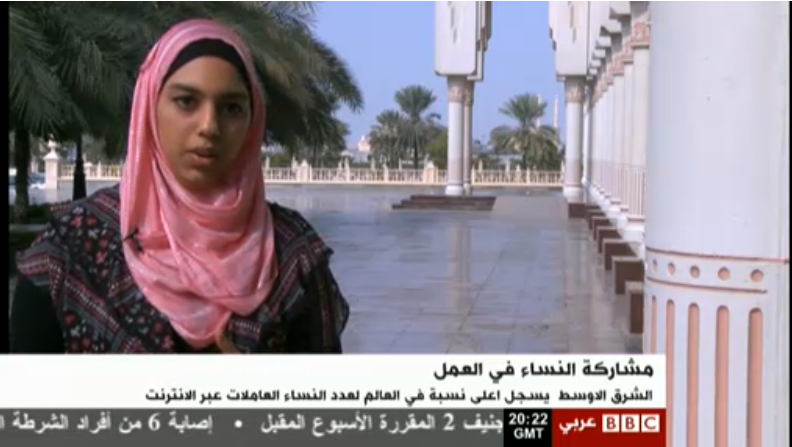
And it's not just internet-based fields, but all sorts of engineering matters, such as this lady studying robots:
 They said this robot is supposed to help kids with 'tawahid'. I'm not sure what that means. It might have something to do with loneliness or unity.
In the US, for sure, there's sometimes a bit of a slant against girls studying hard sciences, but this lady was saying that experience is completely opposite in the Middle East. There's no unspoken rule that women should not be engineers:

To be sure, there's other limitations placed against women working, but science and technology are preferred because they are seen as safe, flexible fields. When it comes to internet-based firms, the fact that you can work at home is an advantage.
There was a competition in the Middle East crowning the best new internet business, or something along those lines, and a girl called Lulu won it. I think they said she was 14!

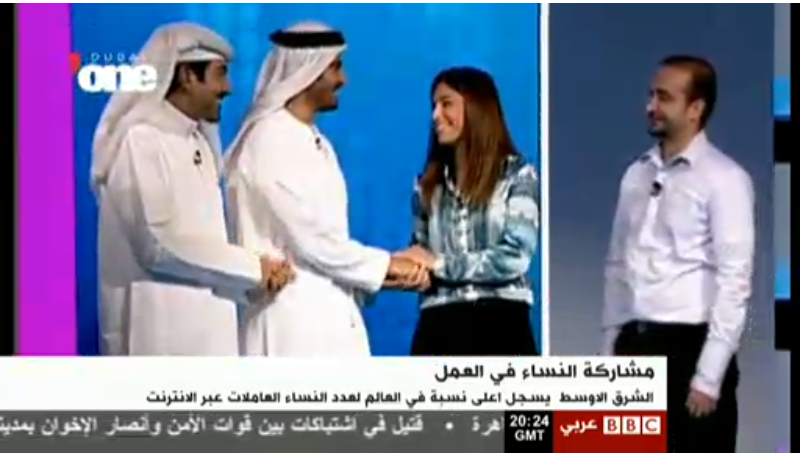

And a final picture of everyone chilling in the start-up center. If I had not context, I'd think this was in the US somewhere.

Throughout the world, the share of female internet entrepreneurs is 10%, but in the Middle East that number jumps to 35%. This is the highest rate in the entire world!
So the BBC Arabic did a segment where they interviewed women technology students and business owners throughout the Middle East. The over-riding consensus is that this unexpected turn of events is great for breaking down stereotypes regarding the poor, pitiable, helpless Arab woman (some of which I indulge in myself!)
These statistics were released by a company - that is, a firm - called Startup Compass.
This is what the college grounds look like:
I can't tell if the columns are Doric, Ionic, or Corinthian; or maybe there are column types that are not Greek.
This student says: I think tech work is really good work for women.
This lady says that they really support their female students. There's even scholarships:


In the US, for sure, there's sometimes a bit of a slant against girls studying hard sciences, but this lady was saying that experience is completely opposite in the Middle East. There's no unspoken rule that women should not be engineers:

Nice chalkboard whirls, by the way!
To be sure, there's other limitations placed against women working, but science and technology are preferred because they are seen as safe, flexible fields. When it comes to internet-based firms, the fact that you can work at home is an advantage.
There was a competition in the Middle East crowning the best new internet business, or something along those lines, and a girl called Lulu won it. I think they said she was 14!
Look at the gracious male losers congratulating her. I'll be jiggered!
These two women run an internet firm. I think they said most of their employees were women, and I think they said their female workers were better than the males (obviously), and they definitely said that a Saudi woman was working as a consultant or adviser for them, remotely.
And a final picture of everyone chilling in the start-up center. If I had not context, I'd think this was in the US somewhere.
Sunday, February 2, 2014
Women in Basra
(January 30, 2014)
An Iraqi man shot a video of two of his friends in Basra. Basra is the southern-most city in Iraq. After shooting the video of their travails, they sent it to the BBC Arabic, and all of us got to see it!
These women are university students, and they say they get a lot of flak for not wearing a hijab.
 If you don't wear a hijab, people think you are rich and stuck-up.
Of the harassment, one of the women says: there's no law, that's the problem. There's no constitution or law to defend me, so I can't complain to anyone.

One day a man came up to her and told her she was behaving against God. She told me: are you God? He said, well, no, of course not. She said, then you can't judge me and I am going to go complain about you.
But, she added, of course she did not complain because there's no one to put the complaint to.
Then she said: the guys take pictures of us and pass them around, and sit and look at us.
This lady in pink says: every time I have a marriage prospect, the guy tells me: I am going to need you to wear a hijab, and you can't wear pants, and this and that. So she asked one of the men, do you want me to wear a tent?
 She concluded thus: so there's no guys in my life, and thank God for that, I live well without them. Everyone just judges us based on what we look like, they think we have ten boyfriends on each side (if I understood that last sentence correctly!)
You can watch this clip on the BBC Arabic's YouTube channel here.
An Iraqi man shot a video of two of his friends in Basra. Basra is the southern-most city in Iraq. After shooting the video of their travails, they sent it to the BBC Arabic, and all of us got to see it!
These women are university students, and they say they get a lot of flak for not wearing a hijab.
Of the harassment, one of the women says: there's no law, that's the problem. There's no constitution or law to defend me, so I can't complain to anyone.
One day a man came up to her and told her she was behaving against God. She told me: are you God? He said, well, no, of course not. She said, then you can't judge me and I am going to go complain about you.
But, she added, of course she did not complain because there's no one to put the complaint to.
Then she said: the guys take pictures of us and pass them around, and sit and look at us.
This lady in pink says: every time I have a marriage prospect, the guy tells me: I am going to need you to wear a hijab, and you can't wear pants, and this and that. So she asked one of the men, do you want me to wear a tent?
You can watch this clip on the BBC Arabic's YouTube channel here.
Saturday, September 14, 2013
A nice Muslim man
(September 13, 2013)
Here is a story about a nice Muslim man. He is very old, slow to walk, and when he does walk, he must use a cane to counteract his limp.

 They got married when she was 14, and they stayed married for 58 years. She told him that after she died, no one would remember her, so he promised he would build something a la Taj Mahal in her memory. She died two years ago, and he has kept his promise. Here is his handiwork!


Here is a story about a nice Muslim man. He is very old, slow to walk, and when he does walk, he must use a cane to counteract his limp.

At least, I think he is Muslim. He has a Muslim name, and he is Indian. Here is his wife:


Up close:

He finished building the minarets and the domes, and now he still needs to complete the gardens and maybe the interior design. However, all his money has run out! He even sold a plot of land that he owned, and his wife's jewelry, and all his other savings. I think so far he has spent $15,000. Now he still needs $10,000 more.

School kids come over, and he shows them around.
Self Defense for women in Somalia
(September 12, 2013)
These women in Somalia are attending a self-defense class.
 The BBC Arabic report mentioned that Somali women are attacked at especially high frequencies inside of refugee or displacement camps. Isn't that the age-old story of men? First, they cause the war. Then, when everyone is already miserable because their loved ones have died and their homes and belongings are destroyed and their jobs and schools are inaccessible, they go around making everyone even more miserable. Then, and I think Muslim and/or Arab men are especially prone to this, they go bumbling about thinking themselves the best thing ever to hit the earth! You should just watch the BBC Arabic. Even when they are on TV, sometimes the men forget that they are supposed to try to at least project a decent, civilized image, and they start screaming, their voices grow raspy, and you think any second they are going to go into apoplexy.
Here is an Iraqi man in the midst of an apoplectic attack:

Ewwwww. Just eewwwww. Mind you, this is just one screenshot. You're not seeing the ones when his mouth is open in something resembling a dog's bark.
This guy is some kind of high-up government official in Iraq. Yikes!
These women in Somalia are attending a self-defense class.

Here is an Iraqi man in the midst of an apoplectic attack:

Ewwwww. Just eewwwww. Mind you, this is just one screenshot. You're not seeing the ones when his mouth is open in something resembling a dog's bark.
This guy is some kind of high-up government official in Iraq. Yikes!
Friday, July 26, 2013
Another screaming Egyptian
Lord have mercy, sir, why are you yelling so much?


He literally could not say a single word without yelling. Why can't you just speak in a normal voice? We are fasting, we don't have energy for this.

Still going at it. No one else was yelling all through the debate, just this guy. Does he think it's attractive or something?

He is the gift that keeps on giving.
Now, I would like to say a nice word about an Arab man, and mention that the BBC anchor acting as the moderator was not yelling at all. In fact, this man has the voice of saint. It's always gentle. He didn't even get riled up in the midst of this guy bellowing in his face. He would just smile in amusement sometimes. The name of the anchor is Tariq somebody. Here he is, you should try to hear him speak sometime:


I don't even know what this guy was talking about, he gave me such a head-ache.


He is the gift that keeps on giving.
Now, I would like to say a nice word about an Arab man, and mention that the BBC anchor acting as the moderator was not yelling at all. In fact, this man has the voice of saint. It's always gentle. He didn't even get riled up in the midst of this guy bellowing in his face. He would just smile in amusement sometimes. The name of the anchor is Tariq somebody. Here he is, you should try to hear him speak sometime:

Malak and the Coup in Egypt
This is Malak Jaafar, one of the BBC Arabic anchors.

(I think Malak at one point did manage to get the MB guy to admit some mistakes, but when asked for clarification, of course those 'mistakes' ended up not being real mistakes. More like when you're asked at a job interview what your negative qualities are, and you tell them airily, 'oh, I'm just such a perfectionist!')
That was a few days ago. Yesterday, Malak was at it again with another slew of Brotherhood and anti-Brotherhood guests. The new MB guy was very upset because some MB supporters have been killed during protests. He said: whenever Shias are killed in Egypt, the BBC covers it right away! Whenever Christians are killed, the BBC is on top of it. You only pay attention to minorities, but when Muslim Brotherhood members are killed, you don't talk about it in any depth at all.
I think that was the one time during a at-times fierce debate that the MB guy got the better of Malak. I guess she didn't have any answer, so she just said okay, and asked a new question. And the MB guy knew he had 'scored', and looked at her with the typical smirk of the Arab man.

I really like her, she always puts the men guests in their proper place, and one day I am going to devote an entire post to pictures of Malak, so we can admire how very pretty she is!
I have to say, though, when it comes to the 'coup' in Egypt, when the army kicked President Morsi out, Malak is not quite impartial. Whenever she is questioning representatives of the Muslim Brotherhood, she rips them to pieces. Then, she'll turn to their army/leftist/secular opponent, and ask tough questions of them, too; but tough questions that will spur them to saying more bad things about the Muslim Brotherhood.
Here's an example:
Muslim Brotherhood guy: now the army has closed our
television channel!
Malak: as you said before in English, it’s "fair game";
the Brotherhood closed its opponents' media when it was in power, so now the opposition does
the same to it.
MB Guy: we never closed anything! We
only threatened.
Malak: Alright, so you only
threatened the media.
Malak turns to another guest: What do you think about the fact
that the Brotherhood representative in front of me takes no responsibility for having done anything wrong and does not admit it made any mistakes?
MB Guy interrupts: of course we did NOT make
mistakes!
(I think Malak at one point did manage to get the MB guy to admit some mistakes, but when asked for clarification, of course those 'mistakes' ended up not being real mistakes. More like when you're asked at a job interview what your negative qualities are, and you tell them airily, 'oh, I'm just such a perfectionist!')
That was a few days ago. Yesterday, Malak was at it again with another slew of Brotherhood and anti-Brotherhood guests. The new MB guy was very upset because some MB supporters have been killed during protests. He said: whenever Shias are killed in Egypt, the BBC covers it right away! Whenever Christians are killed, the BBC is on top of it. You only pay attention to minorities, but when Muslim Brotherhood members are killed, you don't talk about it in any depth at all.
I think that was the one time during a at-times fierce debate that the MB guy got the better of Malak. I guess she didn't have any answer, so she just said okay, and asked a new question. And the MB guy knew he had 'scored', and looked at her with the typical smirk of the Arab man.
Thursday, July 18, 2013
A Sheikh of Beirut Speaks his Piece
July 18, 2013


A women's rights activist; Malak Jaafar, BBC anchor; and a Sheikh of Beirut
This nice sheikh was part of a discussion about how Lebanon
needs better laws to protect women from domestic violence. The sheikh’s main observation was that any law also needs to also protect men from their wives,
cause their wives are so much stronger and more threatening. To which
the woman guest to the left laughed and said, look, we all know what guys are like in Arab
societies, we all know what guys are like in Lebanese society …
Then the Sheikh said, yes, men can hit their wives because
the Quran says it’s okay. He is so excited about the idea that he has that
particular verse memorized. He said, that is the book I believe in, and that is
the Prophet I believe in, and that’s that. He’s just like the politicians in the US who get so excited when they talk
about rape. They’re trying to be sad, but you can tell they’re really smacking
their lips and rubbing their hands together.
The woman to the left told him: Lebanon and every country has to be a
place for everyone, not just one particular religion. There's all sorts of people living in Lebanon. You need to have laws
that protect all of their human rights.
After that, there was a lot of yelling. Too bad you did not hear the Sheikh, he was speaking like a classic Arab man. "Give me a second! Don't interrupt me!" Well, okay, the female guest did interrupt him, which must be annoying, but just the way he responded. When an Arab man wants to be really Arab, and they tell you to shut up, they do in a tone of voice that implies you are the stupidest person on the face of the earth, and that until you bow down to him, you are never going to be in any sort of favor, grace, or love. I guess that is how you speak when you believe you own the entire earth, and all the women servants on it, to boot. I personally prefer religious leaders to be gentle, kind, and humble.
The anchor, in the middle of the screen, was Malaak Jaafar. I like her.
She was the one that asked the Sheikh, should women and men have the same
rights? He said, "no! I believe women should get more rights in some areas,
and men should get more rights in other [many more] areas." I think Malaak knew that was to
be his answer. I think she asked just the way some people pick at a scab, or
will bit down on a sore lip, just to feel the pain!
And then she asked him, so is it okay for a husband to hit
his wife? And the Sheikh said, yes, cause it says so in the Quran.
Here’s the thing. There’s so many Muslim women who tell you
that Islam is the way to their liberation, and after you’ve finished talking to
them, you feel like Islam is the best thing for women, ever. But then, you
listen to a sheikh like this, and it’s like, really? Other people will tell you that other verses in the Quran say different things, but how am I supposed to feel when there's sheikhs like this, with I'm guessing lots of followers that they preach to, running amok?
Watch this video:
Then watch this video:
Obviously, I think the second video gave a better argument, and I've never believed that Islam is a violent religion in terms of going around and killing people left and right. But notice that for all his other rebuttals, the guy in the second video did not even touch on the last point the lady had raised in her speech, which was basically repeating the same verse that the Sheikh of Beirut was quoting so lovingly. In this one point, I would agree that a lot of people do dance around this particular verse when they try to soften it.
Sunday, July 7, 2013
The Arab Man and the Finger
One of the first things you should know about Arabs is that they like to wag their index finger a lot. If you have been thinking you would like to become more Arab, then I suggest you take pointers from the pros. Check out the guy below. He is Amr Moussa. I think he is head of the Arab League. He is doing a really good job with his finger in this screenshot.


Subscribe to:
Posts (Atom)