Tidbits of Arabic News translated into English

Showing posts with label Tunisia. Show all posts

Sunday, September 14, 2014

Racism in Tunisia

Back in March or April, the BBC Arabic had a segment about racism in Tunisia. There is an organization in Tunisia that advocates on behalf of Black people, and the lady in charge was interviewed. Her name is Saadiya Sabaah.

The BBC Arabic anchor, whose name is Mona, asked: people don't really stop to consider that there are Black people in Tunisia, why?

Ms. Saadiya said: it's because you never see then, no the news, nowhere. But she also added that Tunisia was actually the first country to outlaw slavery.

Mona asked: if that's the case, then what is the deal now? What is needed? Laws against racism?

Ms. Saadiya said: yes, first we need some acknowledgement that this is a problem. Most Tunisians say it doesn't exist. We've gone to the Parliament and asked them for laws against racism.

The head of the NGO added that 15% of Tunisia's population is Black, but good statistics do not really exist, so no one knows the extent of the racism problem.

This is Saadiya Sabaah:


Thursday, April 24, 2014

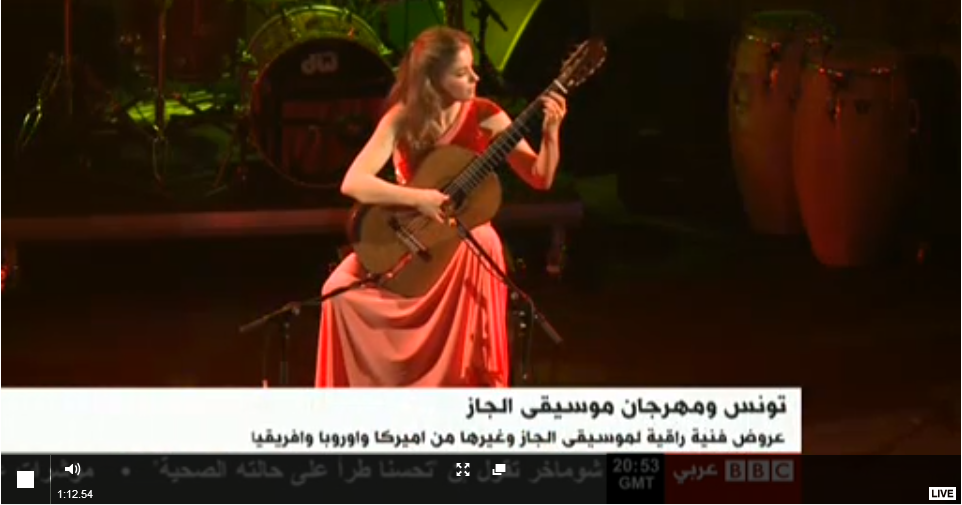
Jazz Festival in Tunis

(April 4, 2014)

The BBC Arabic aired a report from a jazz festival held in the Tunisian city of Carthage.

A talented musician who had come from Croatia to play:

Enthused audience members:

This is an American lady:

Sunday, March 9, 2014

Anna Lindh and Arab Debates

(March 3, 2014)

Apparently, there's a whole array of spaces for young Arabs to debates. There's something called Young Arab Voices behind the movement, and the BBC Arabic supports them as well, as it often broadcasts these debates. And they even get a BBC Arabic presenter, Samir Farah, to moderate them.

The other day, I was watching on of these debates, and I was so happy because I noticed that the Anna Lindh Foundation is also supporting these debates:

The Anna Lindh Foundation is a Swedish organization named after Sweden's former foreign minister. Every time the camera focused on the guy in the photo above, who was one half of the debate, I saw Anna Lindh's name. It was very nice!

The debates are about all sorts of things. This debate took place amongst Tunisian college students. The first debate questioned: should Tunisian workers be allowed to strike or not?

One girl said: yes, because strikes are a democratic way for workers to have power.
The opposing guy said: no, because strikes disrupt the economy.

An audience was watching. At the end, the audience voted that the girl was far more eloquent in her presentation; but, as for the audience's convictions, it was split evenly between those who agreed that workers can strike, and those who disagreed.

The second debate question was: should there be a quota in the Tunisian Parliament for women. Here they are going at it:


A girl called Rania presented a case for the quota, and a guy called Hamza presented a case against.

Hamza said: there's already equality amongst Tunisian men and women, so the quota would be an unfair advantage for women, something they don't need. Women in Tunisia have all the rights and freedoms that men have.

Rania said: no, there's not yet equality.

Hamza said: you just finished telling us how Tunisian women are equal to men, and also, if you are so interested in the democratic process, then note that no other established democratic countries have quotas for women.

The girl choked on this. Then the moderator, Samir Farah, told her: you could have responded by saying: those more established countries used to have quotas, until women's rights had become more and more guaranteed by social norms and the laws.

In Tunisia, there's a law that says half the candidates on the election sheet must be women, and half must be men. So Hamza said: even with this special provision, still not nearly as many women were elected as men! I think he used that to show that people don't want to vote for women in the first place, so there ought not to be a quota.

But a girl from the audience said: yes, and when they made the election sheets, they put all the men's names at the top (!). We are in a eastern society, we have to acknowledge that there are obstacles fronting women that men don't face. So we have to have a quota.

Then another girl from the audience got up with her question:

She said to Rania: my valued madam, you said that Tunisian women have accomplished a lot. I agree with you whole-heartedly, and this is why I don't think a quota is to the advantage of women. Why? Because women are capable of reaching high positions based on their skills alone. When we have a quota, it gives the impression that women are weak and unable to compete on their own against men. It should be a fair competition between men and women, and whoever is more qualified should be the person chosen.

"My valued madam" Rania said: well, the current government only has three women ministers. That's not even a tenth. So where is the equality?

The girl from the audience said (I think): well, a quota is not going to help. It has to be a whole change in the society.

In this case, the audience voted at the end with a very slight majority in favor of not having a quota; and they also voted for Hamza being more eloquent in handling the debate than Rania, though in my opinion, he was all that good, either.

Thursday, February 13, 2014

Shaking hands

(February 7, 2014)

A Tunisian politician has visited the Gaza Strip and met with the government. In fact, he was welcomed with flowers, and everyone lined up decorously to shake hands.

Now, we all know that the government in Gaza is very conservative, but the Tunisian politician is shaking the hands of a woman - the woman in red.


Sunday, February 2, 2014

Fida and women

(November 18, 2013)

Back in November, the BBC Arabic did another show all about women. It was 'hÃĪrligt', because all the participants were women. That meant that no one started yelling, no one interrupted, there were hardly even any pointed fingers! Different opinions, yes, but no one chomping at the bit and insulting others for thinking a different way. Ah, peaceful!

The show was helmed by the very capable Fida Bassil.

The basis for the show was a poll which had ranked Arab countries based on how women are treated. Egypt ended up really low in the poll.

This is an Egyptian activist for women's rights.

She says: probably the reason Egypt fares so badly in the poll is because it focused on violence. Maybe in other areas related to women's rights Egypt does pretty well, but when it comes to violence, it's really bad.

Fida: not so fast. The report did not just focus on violence. It looked at violence, but also at the role of women in families, involvement in politics and economics; and also besides violence, it also focused on sexual harassment.

Lady in the blue sweater: yes, the report did also focus on early marriages for girls, female genital mutilation, harassment and sexual assault. Yes, Egypt is right now seeing lots of these violations against women. And yes, I agree that we are not involved enough in political arenas, though we are present.

Fida: the report looked at four areas: violence towards women; how much of a choice a woman has in her reproductive rights; how women are treated inside a family, and the inclusion of women in politics and economics. Do you agree that those were the right metrics?

Lady in the blue sweater: I agree that these were the right standards to go by, and they follow what the UN and what Unicef would say the standards are. However, I think we should remember that the research team behind the report ignored political movements that are in fact happening. But when it comes to violence, the report is entirely correct; yes, we Egyptian women do suffer from violence.

Next a Tunisian lady, Ms. Fatoom, joined the conversation. She is a member of the political assembly in the Tunisian Nahda party.


Ms. Fatoom: We say that in spite of some things, the Arab Spring helped the status of women, because women were actors in the revolutions, part of the protests, and it is our right to enjoy our accomplishments of overturning the governments. I think this report revealed the fears that perhaps in the years to come, women won't continue to progress, but when it comes to Tunisia, Tunisia was ranked pretty high amongst all the Arabs, and was the first out of the North African countries, so we think we're doing pretty well, especially compared to the other countries who recently had revolutions.

Fida: what do you make of the fact that the role of women in society went backwards in some cases under the Arab Spring, for all that women participated in the revolutionary process?

Ms. Fatoom: it is a basis of Middle Eastern societies to revere men at the expense of women; and to be lacking in giving women true opportunities to distinguish themselves.


Tunisia's shiny new Constitution

(January 27, 2014)

'Destour' is the Arabic word for Constitution, and right now it is the only word on the street in Tunisia. Tunisia just ratified a Constitution with equal rights for all, men and women, and judging from the BBC Arabic interviews and features, most everyone is very happy about it.

The BBC Arabic had a regular story about the new Constitution that played every half an hour or so. It was one of the top stories, but I don't remember if it was the very top. After all, the Syrian negotiations were happening at the same time.

Aside from that, the BBC Arabic also did interviews with Tunisians, devoted a call-in show to Tunisia, did an in-depth hour-long analysis with Tunisian experts, and probably some other things as well.

This is the Tunisian president or prime minister or someone announcing the final agreement and ratification. They are calling it the "first constitution in the Arab world." There's a nice ring to that! Except it's not really the first ... Tunisia itself had a constitution under its former dictator. But then again, a constitution under a dictator probably doesn't count!

 All the politicians in the Parliament rose up, grabbed hands and flags, and started singing the national anthem! Well, and they have something to be proud of!

Then all the politicians abandoned their orderly pews and started hugging and kissing ...

This man says: I never felt Tunisia as one until today. I never felt Tunisia to be as happy as she is today, and inshallah this will lead to lots of ... [lists an assortment of good stuff!]

 At a later point, the BBC Arabic collected reactions from random people on the Tunisian street:
 This man says: I am so proud! (and he looks it.)

 This lady says: I have faith in my country and in the youth of my country.

 This man says: I am filled with joy.

 This man said: when I heard of the news, I started crying and drowning in love for my people and country. [I mean, I never knew an Arab man could admit to crying, so I might have heard or recorded this part wrong.]

 This lady really did start crying, right on the camera. She said a lot of things, of which I caught: now no one will be afraid and we will all be one left hand and one right hand joined together as one hand.

This lady says: We are suffering from unemployment and rising prices. Inshallah the Destour will help.

Then, one of the BBC Arabic presenters traveled to Tunisia to host a discussion with Tunisian youth. So that tells you how special the moment was, because usually Samir Farah doesn't travel anywhere. Usually, he holds his discussions in Great Britain (where the BBC Arabic studio is located.)

This man says: both the Nahda (the ruling party which is kind of Islamic) and the opposition (which is more liberal) compromised. I think he was saying that both sides gave in a little, in order to find a happy middle ground. That's beautiful!

 This lady says: through this process, we've learned to listen to others' opinions and to respect what others have to say.

This lady works for Human Rights Watch in Tunisia. She says: the Destour is a shared Destour between all Tunisians, and its passage shows the good level of maturity, intelligence, and sense in the Tunisian society.

This man is married to a lady who holds a Parliamentary seat. I don't know what he said, but he supports his wife.

I think he spoke up when the conversation turned to how many women are in the Tunisian parliament, and in general what the new constitution will mean for women.

I don't know all the details, but the Tunisian constitution is supposed to be very progressive for women, especially relative to other Arab countries. But when Samir Farah asked, "who here is happy with the outcome for women in the constitution?" only the girl in the white knit hat above raised her hand.

 Then there was a fight! The guy in the striped shirt and with the idiotically raised hands started yelling at the girl standing in the back, with the pinkish scarf. 


 He's the only one who had to raise his voice during the whole discussion. What a loser. And I don't even know what he was yelling about: just something about 'chapter six', your conscience, and who was beating up whom. 

So I guess not everything is perfect in Tunisia even now, but at least there's lots of happy people and bet they are going to make us all proud ('us' meaning those of us who are not fortunate enough to come from Arab countries with acceptable levels of maturity, intelligence, and sense!)