Tidbits of Arabic News translated into English

Showing posts with label Sudan. Show all posts

Sunday, May 31, 2015

The Arabic News From Al Akayshi

We found a restaurant that had good, cheap Iraqi food, so we had to go there at every possible chance.

All this cost $25:


And all this cost $50 (and some of that included food we got later):


This restaurant was playing a TV news channel called something like Al Maydaan. Here's what they were reporting about.

First, here is the lady who was giving the news:


This man was reporting from Yemen:


A lot of bombs have exploded in Yemen:


They showed a clip of the UN Secretary General Ban Ki-Moon because they are trying to put together a conference to stop the violence. But I think at this stage, there was no agreement, so they had postponed everything.


Then, we got news from Saudi Arabia. This was the day after, or two days after, a bomb exploded in a Shia mosque in Saudi, and killed dozens of people. Here is the funeral and the protest:


Then, we took a commercial break to see a random animation of birds and sad-looking people sitting in barren places:


Then, it was time to move on to Iraq. This time, we followed the Iraqi army as they try to bomb Daa-esh:


The Iraqi army on the prowl:


Lest we forget, there is still a war in Syria, which was next on the agenda.

This Syrian in Palmyra was describing conditions, now that the city has fallen to Daa-esh:


The caption is mentioning the 400 people who Daa-esh are suspected of massacring when they entered the city.

This lady looks like she's packed up. But where can she go?


Talking about the ancient ruins of Palmyra:


Meanwhile, the Syrian city of Halab was also enduring military operatons:


I think this channel was pro-Syrian president. They didn't talk at all about the atrocities he has committed. They just talked about the atrocities that Daa-esh has committed, and how the Syrian army, led by the president, are the heroes who are going to fix everything.

More news from Syria: apparently, a Ukrainian airlines has decided to start airplane trips to Syria. The trips are weekly between Kiev and Latakiya. Sounds like a great vacation to me!

Here's a lady from the airlines explaining the reasoning behind their business model:


And finally, something is happening in Sudan, but I'm not sure what:


If you want to check out this place, look for it. It's on Warren Street, I think.


Wednesday, December 31, 2014

Darfur on the BBC Arabic again

Sudan recently kicked two UN workers out of the country, so the BBC Arabic hosted a dialogue between a representative of the UN, and a representative of Sudan's government:

Resha Qandeel is the lady on the left. She works for the BBC Arabic and she was asking the questions.
First, they showed footage of the UN activities in Sudan. Especially, they were focused on UNAMID, a peacekeeping force from the UN and African United that is stationed in Darfur.


Resha started with the UN representative first. I've seen him on the BBC Arabic before talking about this very topic. His name is Abdul-Hamid Siyam.

Resha from the BBC: This isn't the first time Sudan has kicked out UN workers, is it?

Siyam from the UN: No, indeed, there have been many crises between the UN and Sudan. For example, Sudan ordered Jan Pronk out of the country a few years ago.

(Jan Pronk was the Special Representative of the UN in Sudan at one point).

Mr. Siyam continued: Last year, Sudan asked the representative another UN agency also to get out. And now Sudan is asking two additional UN officials to leave. And they asked one of them to completely shut her office. There is a crisis of confidence between Sudan and the UN, especially when it comes to Darfur. And I want to say that 2014 has been the worst for Darfur, in which 470,000 local people were kicked out of their homes. It's been the worst year. That's why the UN wants to have these officials there. But Sudan doesn't want to be subjected to investigation, and that is why Sudan is mad.

Resha now turned to the man speaking for Sudan. Resha asked: Just last week, the UN asked for permission to visit a certain area of the country that has seen fighting, and possibly civilians being attacked. Why every time the UN asks for permission to visit a part of the country do you end up closing an office or kicking people out?

Man from Sudan's government: We don't have a crisis with the UN. We are a member of the UN, and blah blah blah. However, there are people who have an unfair political agenda against Sudan. And I would like to correct some of the stuff that the man from America said.

[Yes, the Man from Sudan's government actually referred to Mr. Siyam from the UN as the 'Man from America', just because Mr. Siyam was skyping in from New York. Wow!]

The Man from Sudan spoke in a kind of mumbled voice, so I had a hard time understanding him and what exactly he was so mad about, but apparently Mr. Siyam had given the wrong title for Jan Pronk's job in Sudan, so that needed to be corrected. The Man from Sudan was also mad because according to him, something had happened in 2006 and 'is it right that a person from the UN should say such a thing? Is that diplomatic language?'

Resha: Okay, back to my question. The UN asked for permission to visit an area of the country. They asked to investigate a place. The question is, every time the UN asks to see a part of the country, you have a problem with that.

Man from Sudan: My dear lady, we asked a woman called Yvonne Hilli to leave, this is true, and by the way, she's from Holland.This lady had already visited the place under question, and she already wrote a report about it, so that's the end of it.

Rehsa: So why do you want her to leave?

Man from Sudan: Why should they want to go investigating the same place all over again? Why should they want to go find evidence for things that they couldn't find the first time? Why such an insistence for something that is not justified? I think this is a plot against Sudan. Also, the other man whom we kicked out, Mr. Al Zaatari: he said that the Sudanese people are living under an iron first because of President Bashir. Saying such a thing is not just an insult to President Bashir, that is an insult to all of Sudan!!

Resha: Okay, so to prove that Sudan is not under an iron fist, you decide to kick the UN official out? Yes?

Man from Sudan: No! No!


My respect for Resha Qandeel went up about 10 times at that point.

Resha: Mmmm hmmmm. Turns back to Mr. Siyam from the UN and asks him: what measures can the UN take if Sudan keeps kicking people out every time they want to investigate something?

Mr. Siyam from the UN: First, I want to respond to the Man from Sudan. I want to say that I personally know Mr. Al Zaatari, he is a wonderful, very honorable person, he has worked in Libya and Iraq, and he has a very high reputation. He would never insult anyone. I will tell you what happened. Mr. Al Zaatari did an interview with a Norwegian journalist. When that journalist wrote up her article, she wrote that Sudan is living under the iron fist of President Bashir. Mr. Al Zaatari wasn't the one who said that, and he would never insult the Sudanese people, and besides that, he is Arab himself!

The Man from Sudan (right screen) and Mr. Siyam from the UN (left screen)

Mr. Siyam continues: As for the place where we want to investigate: yes, it is true we already have a report from there. But, this report was done very fast, and it was criticized internally at the UN, and so the UN asked that the investigation be reopened. It was very important because it is about crimes happening in Darfur. We have also had an independent group criticizing the UN, and saying the UN is trying to cover up crimes happening in Darfur. That is why we wanted to send the team again.

Then Resha asked some more questions but I didn't really understand. My Arabic could use some more work.

Tuesday, August 5, 2014

UN in South Sudan

These pictures are from March or April of this year. UN peacekeepers were moving civilians I guess to safer places.


Sunday, June 15, 2014

Child Rape in Sudan

Back in March or April, the BBC Arabic did a report on child rape in Sudan.

The hard questions were asked by Malak Jaafar:

 Malak Jaafar

Malak spoke with two guests via telephone or video. The sound was blurry, or maybe I am unused to the Sudanese accent, so I only caught bits and pieces. 
One of the guests was called Mr. Suliman. He represented Sudan's government. The other guest was Ms. Amil. She is an activist for children's rights. 

Mr. Suliman started off by saying, in response to one of Malak's questions: No, we do not treat rape victims as adulterers. We are talking about a nine-year-old girl who's been raped. 

Then he mentioned a special law that protects kids. 

Malak turned next to Ms. Amil. 

Malak: if a child has been raped, what happens when the parents turn to the courts or try to find lawyers?

Ms. Amil: they face many problems. 

But I didn't catch the details. I only caught her saying that before the new law was passed in 2010, a rapist's punishment could not exceed a seven-year jail term, and a 14-year-old girl who had been raped was tried for adultery. 

Ms. Amil said that rapists were protected by societal norms, or something like that. 

Malak: but how can you claim society protects the rapists? Mr. Suliman said the law does not protect rape, nor does it allow girls to be tried for adultery. How does the law get twisted around from its original intent?

Whatever Ms. Amil said, I didn't understand. 

Then Malak turned back to Mr. Suliman. 

Malak: There have been 3000 cases of child rape recorded by the courts (I didn't catch the time period referenced.) Why is this number on the rise?

Suliman: Sound too blurry. I think he said: you can't trust those numbers, and we've taken many protective measures. 

Malak: so you doubt the numbers from your courts?

Suliman: no!

Malak: you know, Suliman, if there's hundreds of rape cases recorded, that means there's many more that go unrecorded because parents are afraid their daughters will get a bad reputation. This happens in conservative societies like Sudan. So what guarantees do parents get that they can go to the courts and be treated fairly?

Suliman: ehhhhhhhhhhhhhhhhhhhhhh.

Saturday, January 18, 2014

Aid workers

(January 14 and 17, 2014)

I think the BBC Arabic spends a lot of time showing the work that aid workers do during their newscasts. I've never before seen so much footage. These shots are from the last couple of days in South Sudan.

 Here's a man working for Doctors Without Borders.

 The man in the yellow works for Oxfam.

 A helicopter from the World Food Programme.

And a sack of food from the World Food Programme.

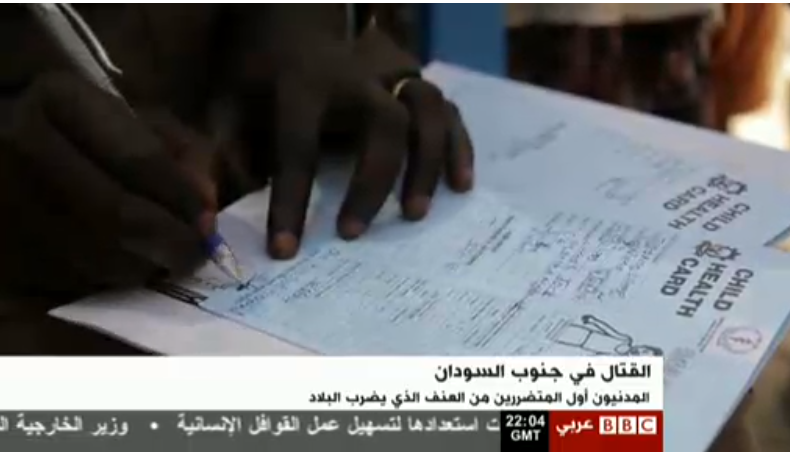
Here is someone filling out a Child Health Card for the displaced kids. 

Thursday, December 5, 2013

Opposition groups in Darfur

(November 25, 2013)

I am trying to keep track of every news story about Darfur on the BBC Arabic. This is very important, because Sudan's president is indicted by the International Criminal Court, accused of committing genocide in the Sudanese region of Darfur. Since Sudan's president is Arab and Muslim, I think other Arabs and Muslims should be ratting his tail out and dumping him to the court, but we don't do that. Instead, we give him kisses. GROSS.

Any case, the BBC Arabic did an interview with some of the opposition groups who are fighting for an independent state in Darfur. One of the groups interviewed wants to engage in peace-talks with the national government.


Another opposition group, represented by this man calling in from France, says you would have to be crazy to even consider talking to the national government in Sudan.

And I don't remember anything else, this was a while ago.

Saturday, November 2, 2013

Saudi holds a protest

(late October, 2013)

Saudi Arabia withdrew from the UN Security Council. I say good riddance. To hear what lots of people across the Arab world had to say, the BBC Arabic had a call-in show to solicit various opinions. I guess Saudi Arabia's government withdrew from the Council because it wanted to be shocking, and it wanted to be a hero, and it wants to pretend it stands on some sort of principle. Luckily, things did not go entirely according to plan, as you can see here.

Opinions of random people on the Jordanian street:

A man: I don't support the Saudi withdrawal because you have to solve your problems by facing them, and withdrawal is negative. People are being slaughtered in Syria? That doesn't mean that Saudi should withdraw and turn its head. It should advance ideas for solving the problem.

Another man: I support Saudi because it is the leader of the Arab nation! And knows all about the failure of international organizations in solving Arab problems.

Another man: I support the Saudi position because when it comes to Arab and Islamic affairs, the Security Council does not care, and our Saudi brothers caught on to this!

Another man (apparently there's only men on the Jordanian street!): I support it because whether Saudi Arabia is on the Security Council or not won't make any difference for Arabs.

Another man: I think they made a huge mistake in withdrawing. Arab countries should be members on the Council.

Note: I just want to make sure everyone sees the irony in Saudi Arabia's government trying to lecture everyone else about international law, which it doesn't follow itself. Saudi Arabia allows Sudan's president (who is an Arab) to visit. Sudan's president is wanted on charges of genocide at the International Criminal Court. International law states that if Sudan's president strays into your border, you need to pack him up and ship him off to face trial. Does Saudi Arabia's government do this? No, it does the opposite and welcomes him with kisses. So why is it all of a sudden so concerned about bloodshed in Syria, when clearly it are not shocked by bloodshed in and of itself, seeing as it is friends with the guy at the helm of so much of it in Sudan?

An Arab living in Great Britain called to say it was clear the real concern to Saudi Arabia is that the US is becoming buddy-buddy with Iran. Saudi Arabia does not like Iran, and I guess vice versa, and both are Muslim countries. Isn't that just lovely! (So don't take it personally when we don't like the west, because we clearly don't like ourselves, either!)

The man from Great Britain had two other theories as to why Saudi refused the seat: because Saudi's current king is too old and infirm, and couldn't deal with the extra stress involved with a UN Security Council seat; and because Saudi knew its reign on the Council would be ineffective for Arab and Muslim causes, and instead of enduring the embarrassment of this in front of the whole Arab world to see, they took the easy way out and withdrew.

And he concluded, how in the first place did a government like Saudi Arabia get nominated to be on the Security Council - a country that is without rights, either for humans or for animals? A country in the 21st century that still now treats its citizens like slaves! Ouch!

Then a man called in to say that the real issue was Security Council reform; and at one point in the past, other countries like Germany, India, South Africa, and Brazil asked for permanent Security Council seats. They didn't get their way, so I think he was saying, Saudi Arabia probably isn't going to get a lot of results from their protest, either.

But then, a man who works at an economic newspaper in Saudi Arabia said, no, no! We Saudis understand that we are not as crucial a country as Germany or Brazil or India (listen to that modesty!) And also, even if the US getting buddy-buddy with Iran had an effect on the Saudi decision, it was not the main cause. We have been saying for over a year that the Security Council really needs to do something about Syria, and this was long before Iran and the US started softening towards each other.

A proud Saudi man sent in his thoughts through webcam: I am against Saudi membership in the Council. The true desire of the Council is to promote the floundering US policies. The Security Council has been deficient in stopping the spread of weapons of mass destruction in the Arab world; gives double-standards to Israel and Iran; and has not succeeded in anything except for what is on the agenda of the five permanent members, and the Saudi Kingdom refuses to be part of this! Ah, but I guess you are not against being best friends with Sudan's president.

Now, here are some comments of people who wrote in. Keep in mind that 300,000 people were killed in Darfur, either by Sudan's Arab government or by militias backed by Sudan's government, and 3 million people were routed from their villages and made to walk to the border with Chad and live in refugee camps there. I think this happened between 2003 and 2006. And Saudi Arabia's government even now welcomes Sudan's president with open arms. But these people don't seem to know that, they apparently think everyone except for themselves is evil:

Ahmed Saeed says: Saudi made a great decision, because it sends a message to the world about the corruption in the Security Council (and there's  no corruption in inviting a president wanted on genocide charges?)

Mohamed Ismail says: the Saudi decision is a good one, it's just too bad all the other Arab and Muslim countries didn't do this earlier. And by the way, where are the Security Council resolutions against the Israeli occupation of Palestine, even after it's been going on for sixty years? (that would be nice, but since you're so committed to basic human rights, a word of protest against Sudan's policies in Darfur would also be appropriate.)

Siaad al-Ameri says: Saudi Arabia is the best country for representing the Muslim world, and I support their decision! (oh my God, if he thinks Saudi Arabia is representing me, I am going to scream.)

Opinions of random people in Beirut came next:

A lady: I support Saudi's decision.

A man: it is crucial to have an Arab country on the Council. But how to advance the Arab agenda, that is the real question.

A young lady: I think she said it doesn't matter either way.

A man with sunglasses: it's important to have an Arab member on the Council.

A man with a smug expression: Thank God they quit, I don't want any Gulf Arab country to be on the Security Council!

A man: you have to be on the Council in order to have an impact.

A man: I think there should be a voice for Arabs.

A lady: it is crucial for an Arab country to be on the Council.

A man: the Security Council is controlled by the US and Russia, and they toss us around like pebbles.

Then came a short interview with an analyst. Here he is via video linkage with BBC presenter Resha Qandil:


First, he called out the "weak, sickly Arab political culture." Then he said Arabs have very little confidence that they can have an impact on the world stage, mainly because they have not been able to advocate for Palestine, their chief cause for 60 years. And when there are Arab-led initiatives for peace, they are ignored.

He continued: there's lots of suspicion directed towards the reasons Saudi gave for turning down the Council. Most people don't believe it was an act in solidarity with Palestine, because that has to be done in a systematic way. The analyst suggested the proper execution would be as follows: all the Arab and Muslim countries get together and plan and take the decision together, that if problems in Palestine are not immediately addressed, they are all going to withdraw from all international bodies.

And finally, opinions of random people on the streets of Baghdad:

A man: there's important issues on the table, it would have been best if Saudi had taken the seat and done something about all these problems.

An old man:


I don't at all support Saudi's withdrawal, or the withdrawal of any Arab country from the Security Council. This weakens our cause and it steals away from us our voice.

A man: Saudi did right.

Two men: I didn't understand

An old man man: I don't support the Saudi withdrawal, and I wish they were present on the Council, even though, if they were present, it wouldn't have made a difference. It's just a symbolic seat, and it only lasts for two years, you can't really do anything in that time.


Lots of interesting opinions!

Some new Arabic words I learned:
محرج - mohrij - embarrassing
يضر - ye-thir - hurts

You can watch the program here.

Thursday, October 10, 2013

Arab man and the cane

(October 9, 2013)

You remember about the Arab man and the finger. Now it's time to introduce the Arab man and the cane.

This is Sudan's president:

 He is pontificating to a group of loyal supporters in the middle of the desert somewhere in Sudan. There have been many protests against this man recently in Sudan. The protesters are upset that gas subsidies are getting ready to be removed.


The response of the government has been live fire directed towards the protestors. There have been many killed. 

And here, the president is calling all the protestors traitors. 

All the while, he twirls his cane like a color-guard audition.

 The BBC Arabic made sure to mention during the report that Sudan's president is wanted on genocide charges at the International Criminal Court. Then they drew a red band across his picture, because yes, sir, you do have blood on your hands. That was a nice touch!


Tuesday, October 1, 2013

Qatar Exploiting Workers

(September 25, 2013)

I don't think that Qatar has been putting in a good showing at the BBC Arabic news. The last time I remember a story about them, they were inviting Sudan's president and giving him kisses upon arrival, when he is wanted to stand trial on genocide at The Hague. No country is supposed to let him into their borders without arresting him, but many Muslim countries have been flouting this rule for the past ten years.

Now Qatar is in the news again because FIFA got wind that foreign laborers building all the Soccer World Cup stadiums and venues are being mistreated. So the BBC Arabic had a short clip about this running throughout the day:

I really should have checked Al-Jazeera that day to see if they bothered to mention it at all, or decided to sweep it all under the rug. 

I think the BBC Arabic should do a big investigative story about all the mistreatment of foreign laborers in all the Arab Gulf countries. That way they can do a close-up scrutiny on violations, and they can even mention what aspects are fairly practiced. We can get the whole story, instead of just bits and pieces like this. I don't remember seeing any other story on the BBC Arabic about mistreatment of foreign workers in the Arab Gulf countries in the past year that I have been paying attention.

Friday, July 26, 2013

Debate on Darfur


Seven UN peacekeepers in Darfur were killed recently. The peacekeeping force there is called 'Unamid'.
The government says that the rebels in Darfur did it; the rebels say the government did it.

Fida Bassil was doing the moderating honors. 


She started by asking the guy representing Sudan’s government: this isn’t the first time Unamid (the name of the UN peacekeepers) have been attacked and killed in Darfur. Every time it happens, the government says it’s going to investigate the true cause, and then it never does. Why?

Government guy: how are we supposed to do an investigation if the rebels are running amok and we can’t even track them down fast enough to pin the blame on them?
Fida: okay then, if the government has found itself incapable of carrying out an investigation, why do you promise each time that you’re going to carry one out, anyways?
Government guy: stutters. Then repeats what he already said: "we go to the place of attack, we try to save whoever was hurt; we try to catch up with the rebel groups running around, but they all flee to the mountains, so what are we to do?"
Fida: so, in other words, your promise of an investigation is just manipulation, an empty maneuver.
Government guy: "no! It’s not a maneuver!" Then he repeats himself all over again.
Fida: alright then, even if the government can’t get all the information, then it should at least publish what it does get. For example, all the circumstances, all the results, and all the evidence that the government is able to gather.
Government guy: yet again, he repeats himself! “We go to the site of the attack! We help the wounded! The rebels flee to the mountains, they live in the mountains (those backwards people) …”
Fida (speaking really slowly to help him out): I’m not talking about the groups who are fleeing, I am talking about the government publishing all the material that it can gather and that sheds light, transparently, on who exactly is responsible for all these attacks.
Government guy: oh, that’s what you meant! Yes, indeed, we’ve determined that the blame is all due to the rebel groups, we’ve already published and advertised that, and why won’t the international community cooperate with the Sudanese government (to help us annihilate the nasty rebels)? I mean, to bring them to justice. And to top it all off, the international community knows where the leaders of these groups live!

Fida gives up on the government guy, and turns to the guy sitting right next to him, with a completely opposite opinion. This guy is part of the rebels. It’s amazing to see him and the government guy sitting side by side.

Rebel guy: it’s the government’s fault the UN peacekeepers were killed.
Fida: but Sudan’s government allowed these peacekeepers into its territory. Why would Sudan attack peacekeepers that it’s invited?
Rebel guy: I’m not sure how his response answered Fida’s question; all I caught is that he accused Sudan’s government of having kidnapped an Italian, a Norwegian, and a Bulgarian. They’re probably aid workers. Now, that ain’t right.

Then the third guest, a former UN spokesman, got into it. He was very critical of Sudan’s government. Woah. How’s the Government Guy going to react now??

The former UN spokesman said: Sudan’s government only allowed UN peacekeepers into the country after 3 years of dragging their feet. They did it under pressure, and put a bunch of conditions as obstacles to their work. For example, Ethiopia sent 5 armed helicopters to the peacekeepers that the government objected to, were never used, and were eventually sent back to Ethiopia.

He said further: the UN peacekeepers are being attacked by three sides: the government militias, rebel groups, and other random armed groups and thugs. (I don’t know why everyone would do that when the UN peacekeepers are just trying to help out and keep the peace, but if you watch the news at all, then you know by now that when it comes to Muslims and Arabs, this is just what we like to do. It’s our favorite pastime. We just can’t help ourselves.)

The former spokesman concluded by saying: every time there is an attack, each of the three sides just blames the other. And he ended by mentioning that the UN had come out with a report recounting all the attacks against the peacekeepers since they got on the ground in 2007. They put down all the details and known facts as far as they could, and Sudan’s government is found to have a large share of the responsibility for many of the attacks.

Of course, when Fida put all this to the government guy, he objected. "No! It’s all lies! They’re making it up. Everything he said is false! And by the way, how dare a UN spokesman attack Sudan! I’m surprised!"
Fida: he’s a journalist now, he doesn’t work there anymore.
Government guy: stutters. 
Fida: tell me exactly what was wrong about the specific examples of Sudanese obstruction you just heard. 
Government guy:  (being very exact) it was all lies! We had no pressure. We didn’t buckle under pressure. We weren’t forced into allowing international peacekeepers. We just had to study the position first.
Fida: Why did you put conditions, like you didn’t allow them to have heavy weapons? What about those Ethiopian helicopters?
Government guy: No! We have put no conditions! We expect Unamid to defend itself! The rebel groups are attacking Unamid and we, the government, are very surprised: why doesn’t it defend itself?!

Fida turns back to the former UN spokesman turned journalist: how can Unamid protect civilians if it can’t protect itself?
UN journalist: yes, Unamid can’t protect itself because it was never allowed to use the strong weapons, technology, communications equipment, etc, that would help. Also, between January and May of this year, 300,000 people in Darfur were kicked out of their homes. This was not covered on the Arab news, nor was it brought to discussion on the Security Council. So Unamid also doesn’t want to broadcast this because it would be broadcasting its own failure, and it is unable to protect anyone; and the Security Council really needs to sit down and make a new resolution that really gives the peacekeepers the tools to protect people in Darfur.

I’m putting the picture of this guy in here. It is good to highlight Arabs willing to speak out about Darfur, since they seem so few and far between.


The former UN spokesman continued: the only action about Darfur that the Security Council has recently taken is that the number of peacekeepers was reduced from 19,000 to 14,000, and the international police force was reduced from 6000 to 4000, as if to show that there has been improvement on the ground, and progress in negotiations between the government and the rebels.

Then another guy spoke via video link-up. He lives in Darfur right now. He said how horrible it was for the peacekeepers to be attacked. I couldn’t really hear all else that he said, the sound was pretty bad.

Then Fida asked the government guy a new question, but he quickly thwarted her. He was still thinking about the UN journalist and how he needed to refute him. He said: no, no, the peacekeeping troops do have the full potential to defend themselves, but they just don’t do it!!! And we are all so surprised about it.
Fida: so, logically, is there anyone who just allows someone to kill them without trying to defend themselves? 
Government guy: stutters. Then: "I’ve been to Darfur myself and I saw for myself all the arms and weapons they have. So why don’t they use them? Unamid will have to answer to that!" Then he goes on to say that the situation in Darfur is getting more and more stable. 
Fida: how? When you have 300,000 people displaced in the last few months? There’s apparently also been assassinations, and now the latest attack on Unamid. And the UN’s humanitarian operations have announced that they will be scaling back their work because it is so unsafe. So how can you say the situation is stable? 
Government guy: I’m going to reply to all this! Those 300,000 you keeping bringing up, part of them fled because of attacks that the rebel groups are responsible for! Another part fled because of tribal fighting that has been going on since before the government rampaged in. And by the way (pointing at the Rebel guy) the reason the tribes are fighting each other now is all because of the actions of the rebel groups, who have allowed weapons to flow to all the tribes so that now everyone has a weapon.
Fida turns to the Rebel guy: aren’t the armed rebel groups partly responsible for some of the devastation you say is going on in Darfur today?
Rebel guy: wheels and deals away from answering the question. Didn’t catch how, or if, he finally answered.

Well, honestly, it just got really boring from there. You got the impression that no one was answering any question, they were just propagandizing. But I still liked the former UN spokesman; his name is Abdel-Hamid Siyam. So I skipped ahead of all the other blabbers to listen to him towards the end. He said that part of the problem in the Security Council is that China gets so much oil from Sudan. So China is loath to put any real pressure on Sudan’s government to cooperate with Unamid (but I thought that the new country of South Sudan, and not Sudan, had most of the oil). And in answer to the Government Guy who had accused him of being unbiased, Mr. Siyam answered, “no, I am not biased towards any side, it’s just that I happen to follow very closely what happens in Darfur, I probably know more about what is happening in Darfur than most people in Sudan.” A good man. Here is his picture again.


Then the government guy got to talk again. Fida brought up a human rights report from a group in Geneva that was rather negative about Sudan’s government. The government guy got quite feisty. “We are so tired of hearing that Geneva, and Kampala, and who knows what other cities, all have it in for Sudan. Sudan, Sudan, Sudan. Doesn’t Sudan have the right to hear its name called without fifty accusations tacked on?”

This guy says so many spectacular things, we really should take a look at his picture:


Fida reminded him that although Sudan dismisses all those other cities, that it was cooperating with Qatar.
Government guy: ah! Well, we trust Qatar. 
Fida: but not Geneva? 
The Government guy waves his arms wildly. “No, no, we don’t trust Geneva! And by the way, the real problem in Sudan is the West. It’s all the West’s fault that we went around killing people in Darfur, FYI.”
Rebel guy: We’ve been hearing this kind of talk, and the perpetual blaming of everyone else, from Sudan’s government for a long time, what is there left to say in response?
           
After that it was a lot of trading insults. Says the Rebel Guy: Sudan’s government thinks it has been sent down from Heaven, they want all the power, everything.

Fida: Yes, it sounds like Sudan’s government believes everything is a conspiracy, but don’t they have a legitimate concern when there are rebel groups with weapons running around?

Oh, dear, it just goes on and on and on.

This debate happened at some point between July 17 and July 23, 2013.
Disclaimer: I don't mean to attribute any of these words to any one; everything was said in Arabic, I am not an official Arabic-English translator, and I am paraphrasing (and in the case of the Government guy, I added some sarcastic comments, but in parenthesis. Basically, he himself said most of the stupid stuff he said.)

Sunday, July 7, 2013

World Refugee Day

The week of June 25, 2013, the BBC Arabic ran a lot of stories about refugees (mostly Arab refugees), in honor of World Refugee Day. Here is what some of them said:

First, Eman in Norway called in. Eman is from Sudan, but was born and lived all her life in Libya. She says that her arrival in Norway was 'mumtaz' - that is an Arabic word meaning great, terrific, wonderful, beautiful. The only thing she doesn't like is that during the seven years you have to wait to get your Norwegian citizenship, you can leave, so she can't visit her home country.

Then, a guy in Sweden called in or wrote in an email. I didn't catch from where he was originally. He said there is no other country which takes such good care of its refugees, but for all that I won't forget my home country.

Then a guy living as a refugee in Sudan called in. He was a refugee from another Arab country. He said "I forget I'm a refugee because of everyone's great kindness," blah blah blah, must have been a fluke.

And finally, here is the crowning glory. A smart Iraqi guy was interviewed from where he lived in Hull, England. He said: yes, I want to go back to Iraq because there are more opportunities to work in Iraq than in Britain, and also because here, the taxes take up three fourths, well, half of your salary, whereas in Iraq, we are a 'tax-free country'. Right, and this is something to be proud of! The sucky countries usually are the ones with no taxes. Thank you for clarifying.

As an afterthought - a mere afterthought - he says: now all I have to do is to take consideration of the security situation.

Sudan's president landing in Doha

Sudan's president is indicted on genocide charges by the International Criminal Court. However, your average Arab does not think this is a big deal, and so he gets invited left, right, and center to conferences and summits throughout the Middle East. Governments are supposed to arrest him if he travels to their territories, but not the Arabs, no! They make special invitations for him.

Last year (2012), a big summit of Islamic countries met in Mecca (Islam's holiest city), so Sudan's president ended up there, too. That makes me want to throw up.

These screenshots are from March 25, 2013. Here Sudan's president is arriving in Qatar's capital, Doha.  How can they stand to shake his hand or kiss his cheek? GROSS.