This is from August, 2016.
Wow, almost a year ago!
France was banning the burqini on public beaches.
Of course, the BBC Arabic had to discuss the controversy, and they brought on all sorts of experts.
Here's on the "experts" from France, being interviewed by Rasha Qandeel:
Expert: And if they want to wear the burqini, in that case, then don't come to the beach. I'm sorry!
Rasha: So what do you think when you see photos of armed French police telling women to take their clothes off on the beach?
Expert: I've been on the beach. I haven't seen anything like that. So please don't talk about things you don't understand.
The "expert" again: I don't believe women like to be in such clothes when it's 40 degrees Celsius. I'm sorry.
Yes, I'm sorry, too. What a moron.
Rasha: Sir, this is your own assumption.
Showing posts with label Rasha Qandeel. Show all posts
Showing posts with label Rasha Qandeel. Show all posts
Wednesday, August 23, 2017

Friday, August 11, 2017
Security Debate after Belgium Attack
This is BBC Arabic coverage from way back when - the bombing of the airport in Brussels (March, 2016).
They showed images of stunned passengers at the airport ...


They showed people evacuating the city by foot - if I remember, the metro and public transport systems were shut down.

The empty and echoing Brussels metro system:

Then, they had all the analysts come out. Rasha Qandeel was the BBC anchorwoman steering the conversation.
Some of the analysts said: Belgium was surprised by the attack, so it was a big security failure. And they must not have done enough security preparations.
Rasha said: ok, but we complain when governments do take harsh measures. Can we really blame Belgium for not doing what some extreme right-wing governments have proposed doing?
Security expert: no, no, but --- and then the internet cut off!
This American expert said: It's hard to monitor everyone. The San Bernardino murderers were not on the radar of the government. The government can monitor email and Facebook, but sometimes people aren't announcing their plans there.

Then he added (this was before the 2016 American elections) this will probably help Trump's standing in the polls. People will think he's the only one who can stop all the attacks.
But then he seemed to say, maybe it won't make that much of a difference. He said, "at the end of the day, it's just talk" (not really sure what he was referring to). "You know, neither Democrats nor Republicans want terror in the United States. No one wants a terror attack on their watch, they get blamed for it."
Resha: "But Trump says he's going to ban Muslims, he's playing on hate."
American security expert: "He didn't just talk about Muslims, he talked about Latinos, too. And now the US has a population that is 45% minorities, it's very hard to hate on all of them."
Again, this conversation is from March 2016.
They showed a lot of mourners and tributes to the dead and wounded:

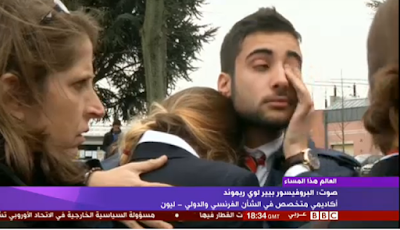

They showed images of stunned passengers at the airport ...


They showed people evacuating the city by foot - if I remember, the metro and public transport systems were shut down.

The empty and echoing Brussels metro system:

Then, they had all the analysts come out. Rasha Qandeel was the BBC anchorwoman steering the conversation.
Some of the analysts said: Belgium was surprised by the attack, so it was a big security failure. And they must not have done enough security preparations.
Rasha said: ok, but we complain when governments do take harsh measures. Can we really blame Belgium for not doing what some extreme right-wing governments have proposed doing?
Security expert: no, no, but --- and then the internet cut off!
This American expert said: It's hard to monitor everyone. The San Bernardino murderers were not on the radar of the government. The government can monitor email and Facebook, but sometimes people aren't announcing their plans there.

Then he added (this was before the 2016 American elections) this will probably help Trump's standing in the polls. People will think he's the only one who can stop all the attacks.
But then he seemed to say, maybe it won't make that much of a difference. He said, "at the end of the day, it's just talk" (not really sure what he was referring to). "You know, neither Democrats nor Republicans want terror in the United States. No one wants a terror attack on their watch, they get blamed for it."
Resha: "But Trump says he's going to ban Muslims, he's playing on hate."
American security expert: "He didn't just talk about Muslims, he talked about Latinos, too. And now the US has a population that is 45% minorities, it's very hard to hate on all of them."
Again, this conversation is from March 2016.
They showed a lot of mourners and tributes to the dead and wounded:


Sunday, August 2, 2015
The Baby Burned in Palestine
The BBC Arabic with Rasha Qandeel had a discussion about a baby burned to death in Palestine by some Israeli settlers.
Here is the baby:

This is Rasha Qandeel:

This is actually a picture from a year ago, or maybe more. But I didn't get a chance to take her picture today.
First, they had a clip about the reaction in Israel. There have been big protests by those on the left against what happened, as you can witness by the grim face of this Israel man:

From the pictures, the protests look pretty big:


This Israeli man said: as long as we continue occupying Palestine, we will see crimes like this happen.

And people expressed hope that this would lead to more attention paid to the anti-settler movement, and this man spoke at the protest and said: Mr. Prime Minister, we suggest that you treat Jewish terrorists in the exact same way that you treat Islamic ones.

The Israeli prime minister did condemn what happened; but that made a lot of the right-wing Israelis really mad:

So then it was time for Rasha Qandeel to talk to her guests:

She was talking to two people, one in a place called Nasariya, and one in Tel Aviv. But her time was mostly taken up by the guy in Tel Aviv, because he wouldn't stop talking. He was Israeli, but man, he looked Arab!

Tel Aviv man: If there is terrorism - and this was obviously terrorism - then it shouldn't matter who did it. And if there's a need to outlaw Jewish terrorism, then we should do it. But don't take this tragic situation and use it for a political reason. This was an attack that individuals did. As far as organized terrorism in the Middle East, then that only exists in the form of Palestinian terrorism. While this death is very tragic, still don't bring in the political stuff, because as a whole, there is only one party that stands for peace and that is us, the Israelis. The other side is not for peace.
Then Rasha Qandeel asked him if the burning death of this baby wasn't an indication of many Israelis who would like to commit similar acts, but the Tel Aviv Man cut her off: this was an individual act!
Rasha Qandeel: This baby was just killed. A boy called Mohammed was killed a few days ago (?). Three years ago, there was a terrible murder of a Palestinian by an Israeli, and the Israeli man was sentenced to 22 years in prison. However, he was just released a few weeks ago. So tell what's the difference between Palestinian and Israeli terrorism?
Tel Aviv Man: I'll tell you the difference. Israeli society stands against these acts, while the Palestinians are for such acts. They declare those that fight against Israel are heroes.
Then he wouldn't stop talking.
But finally, Rasha got a word in: You know, the Israeli Prime Minister himself just said that these Jewish terrorists are receiving help to commit these acts.
And then Rasha listed a lot of other Israeli politicians who had said similar things, and then she said that one of the Israeli politicians had even called this the rise of the Jewish Daaesh (ISIS).
Then she turned to her other guest. His names was something like Rab Zinger:

Zinger said: An Israeli politician called Rabin, who is on the right, spoke out against this act; and in response, Rabin is being called a terrorist himself by right-wing Israelis, just because he is standing with innocent Palestinians. There's a lot of talk among the politicians now that they will have to start using the same tactics against Jewish terrorists as they use against Palestinian terrorists. It is a new day for Israeli security.
Rasha asked the man from Tel Aviv: So, what has Netanyahu (the Israeli Prime Minister) done to deal with Israeli terrorism over the last 10 years?
Tel Aviv Man: Well, Israel is a democracy, we have free speech and free dialogue, and I depend on the Israeli police and the government. But Israel is not a racist country or a terrorist country, and this is what the leftist Israelis have been saying. This is not good for our country.
Rasha: My question was clear. What are the measures Netanyahu has taken against Israeli terrorism, or what has his dialogue been with the Israeli democracy on this front?
Tel Aviv Man: Yes, and I'm also proud of all of it. If there is a need to take measures against Jewish militias, then we will take those measures. But we should not connect this to the stoppage of building settlements (?). We should not mix up the political to this tragic, heinous thing.
Then he started yelling and wouldn't stop.
Rasha: so I hear you saying that you'd welcome such measures against Israeli terrorists, but that they don't exist yet. Thank you for your time anyways.
Here is the baby:

This is Rasha Qandeel:
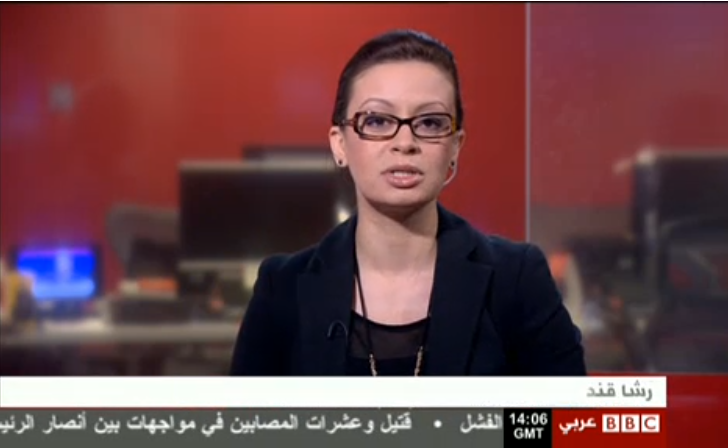
This is actually a picture from a year ago, or maybe more. But I didn't get a chance to take her picture today.
First, they had a clip about the reaction in Israel. There have been big protests by those on the left against what happened, as you can witness by the grim face of this Israel man:

From the pictures, the protests look pretty big:


This Israeli man said: as long as we continue occupying Palestine, we will see crimes like this happen.

And people expressed hope that this would lead to more attention paid to the anti-settler movement, and this man spoke at the protest and said: Mr. Prime Minister, we suggest that you treat Jewish terrorists in the exact same way that you treat Islamic ones.

The Israeli prime minister did condemn what happened; but that made a lot of the right-wing Israelis really mad:

So then it was time for Rasha Qandeel to talk to her guests:

She was talking to two people, one in a place called Nasariya, and one in Tel Aviv. But her time was mostly taken up by the guy in Tel Aviv, because he wouldn't stop talking. He was Israeli, but man, he looked Arab!
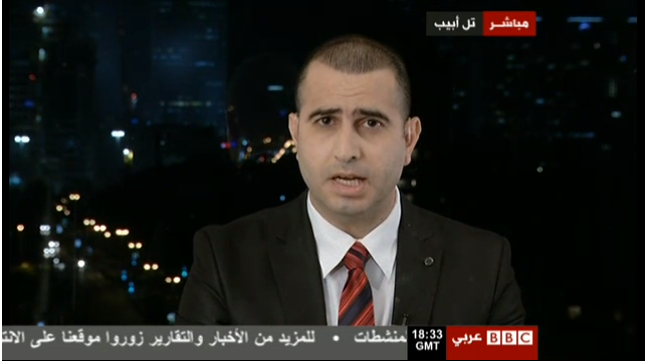
Tel Aviv man: If there is terrorism - and this was obviously terrorism - then it shouldn't matter who did it. And if there's a need to outlaw Jewish terrorism, then we should do it. But don't take this tragic situation and use it for a political reason. This was an attack that individuals did. As far as organized terrorism in the Middle East, then that only exists in the form of Palestinian terrorism. While this death is very tragic, still don't bring in the political stuff, because as a whole, there is only one party that stands for peace and that is us, the Israelis. The other side is not for peace.
Then Rasha Qandeel asked him if the burning death of this baby wasn't an indication of many Israelis who would like to commit similar acts, but the Tel Aviv Man cut her off: this was an individual act!
Rasha Qandeel: This baby was just killed. A boy called Mohammed was killed a few days ago (?). Three years ago, there was a terrible murder of a Palestinian by an Israeli, and the Israeli man was sentenced to 22 years in prison. However, he was just released a few weeks ago. So tell what's the difference between Palestinian and Israeli terrorism?
Tel Aviv Man: I'll tell you the difference. Israeli society stands against these acts, while the Palestinians are for such acts. They declare those that fight against Israel are heroes.
Then he wouldn't stop talking.
But finally, Rasha got a word in: You know, the Israeli Prime Minister himself just said that these Jewish terrorists are receiving help to commit these acts.
And then Rasha listed a lot of other Israeli politicians who had said similar things, and then she said that one of the Israeli politicians had even called this the rise of the Jewish Daaesh (ISIS).
Then she turned to her other guest. His names was something like Rab Zinger:

Zinger said: An Israeli politician called Rabin, who is on the right, spoke out against this act; and in response, Rabin is being called a terrorist himself by right-wing Israelis, just because he is standing with innocent Palestinians. There's a lot of talk among the politicians now that they will have to start using the same tactics against Jewish terrorists as they use against Palestinian terrorists. It is a new day for Israeli security.
Rasha asked the man from Tel Aviv: So, what has Netanyahu (the Israeli Prime Minister) done to deal with Israeli terrorism over the last 10 years?
Tel Aviv Man: Well, Israel is a democracy, we have free speech and free dialogue, and I depend on the Israeli police and the government. But Israel is not a racist country or a terrorist country, and this is what the leftist Israelis have been saying. This is not good for our country.
Rasha: My question was clear. What are the measures Netanyahu has taken against Israeli terrorism, or what has his dialogue been with the Israeli democracy on this front?
Tel Aviv Man: Yes, and I'm also proud of all of it. If there is a need to take measures against Jewish militias, then we will take those measures. But we should not connect this to the stoppage of building settlements (?). We should not mix up the political to this tragic, heinous thing.
Then he started yelling and wouldn't stop.
Rasha: so I hear you saying that you'd welcome such measures against Israeli terrorists, but that they don't exist yet. Thank you for your time anyways.
Wednesday, December 31, 2014
Darfur on the BBC Arabic again
Sudan recently kicked two UN workers out of the country, so the BBC Arabic hosted a dialogue between a representative of the UN, and a representative of Sudan's government:
 Resha Qandeel is the lady on the left. She works for the BBC Arabic and she was asking the questions.
First, they showed footage of the UN activities in Sudan. Especially, they were focused on UNAMID, a peacekeeping force from the UN and African United that is stationed in Darfur.


Resha started with the UN representative first. I've seen him on the BBC Arabic before talking about this very topic. His name is Abdul-Hamid Siyam.
Resha from the BBC: This isn't the first time Sudan has kicked out UN workers, is it?
Siyam from the UN: No, indeed, there have been many crises between the UN and Sudan. For example, Sudan ordered Jan Pronk out of the country a few years ago.
(Jan Pronk was the Special Representative of the UN in Sudan at one point).
Mr. Siyam continued: Last year, Sudan asked the representative another UN agency also to get out. And now Sudan is asking two additional UN officials to leave. And they asked one of them to completely shut her office. There is a crisis of confidence between Sudan and the UN, especially when it comes to Darfur. And I want to say that 2014 has been the worst for Darfur, in which 470,000 local people were kicked out of their homes. It's been the worst year. That's why the UN wants to have these officials there. But Sudan doesn't want to be subjected to investigation, and that is why Sudan is mad.
Resha now turned to the man speaking for Sudan. Resha asked: Just last week, the UN asked for permission to visit a certain area of the country that has seen fighting, and possibly civilians being attacked. Why every time the UN asks for permission to visit a part of the country do you end up closing an office or kicking people out?
Man from Sudan's government: We don't have a crisis with the UN. We are a member of the UN, and blah blah blah. However, there are people who have an unfair political agenda against Sudan. And I would like to correct some of the stuff that the man from America said.
[Yes, the Man from Sudan's government actually referred to Mr. Siyam from the UN as the 'Man from America', just because Mr. Siyam was skyping in from New York. Wow!]
The Man from Sudan spoke in a kind of mumbled voice, so I had a hard time understanding him and what exactly he was so mad about, but apparently Mr. Siyam had given the wrong title for Jan Pronk's job in Sudan, so that needed to be corrected. The Man from Sudan was also mad because according to him, something had happened in 2006 and 'is it right that a person from the UN should say such a thing? Is that diplomatic language?'
Resha: Okay, back to my question. The UN asked for permission to visit an area of the country. They asked to investigate a place. The question is, every time the UN asks to see a part of the country, you have a problem with that.
Man from Sudan: My dear lady, we asked a woman called Yvonne Hilli to leave, this is true, and by the way, she's from Holland.This lady had already visited the place under question, and she already wrote a report about it, so that's the end of it.
Rehsa: So why do you want her to leave?
Man from Sudan: Why should they want to go investigating the same place all over again? Why should they want to go find evidence for things that they couldn't find the first time? Why such an insistence for something that is not justified? I think this is a plot against Sudan. Also, the other man whom we kicked out, Mr. Al Zaatari: he said that the Sudanese people are living under an iron first because of President Bashir. Saying such a thing is not just an insult to President Bashir, that is an insult to all of Sudan!!
Resha: Okay, so to prove that Sudan is not under an iron fist, you decide to kick the UN official out? Yes?
Man from Sudan: No! No!

Resha: Mmmm hmmmm. Turns back to Mr. Siyam from the UN and asks him: what measures can the UN take if Sudan keeps kicking people out every time they want to investigate something?
Mr. Siyam from the UN: First, I want to respond to the Man from Sudan. I want to say that I personally know Mr. Al Zaatari, he is a wonderful, very honorable person, he has worked in Libya and Iraq, and he has a very high reputation. He would never insult anyone. I will tell you what happened. Mr. Al Zaatari did an interview with a Norwegian journalist. When that journalist wrote up her article, she wrote that Sudan is living under the iron fist of President Bashir. Mr. Al Zaatari wasn't the one who said that, and he would never insult the Sudanese people, and besides that, he is Arab himself!

Mr. Siyam continues: As for the place where we want to investigate: yes, it is true we already have a report from there. But, this report was done very fast, and it was criticized internally at the UN, and so the UN asked that the investigation be reopened. It was very important because it is about crimes happening in Darfur. We have also had an independent group criticizing the UN, and saying the UN is trying to cover up crimes happening in Darfur. That is why we wanted to send the team again.
Then Resha asked some more questions but I didn't really understand. My Arabic could use some more work.
First, they showed footage of the UN activities in Sudan. Especially, they were focused on UNAMID, a peacekeeping force from the UN and African United that is stationed in Darfur.
Resha started with the UN representative first. I've seen him on the BBC Arabic before talking about this very topic. His name is Abdul-Hamid Siyam.
Resha from the BBC: This isn't the first time Sudan has kicked out UN workers, is it?
Siyam from the UN: No, indeed, there have been many crises between the UN and Sudan. For example, Sudan ordered Jan Pronk out of the country a few years ago.
(Jan Pronk was the Special Representative of the UN in Sudan at one point).
Mr. Siyam continued: Last year, Sudan asked the representative another UN agency also to get out. And now Sudan is asking two additional UN officials to leave. And they asked one of them to completely shut her office. There is a crisis of confidence between Sudan and the UN, especially when it comes to Darfur. And I want to say that 2014 has been the worst for Darfur, in which 470,000 local people were kicked out of their homes. It's been the worst year. That's why the UN wants to have these officials there. But Sudan doesn't want to be subjected to investigation, and that is why Sudan is mad.
Resha now turned to the man speaking for Sudan. Resha asked: Just last week, the UN asked for permission to visit a certain area of the country that has seen fighting, and possibly civilians being attacked. Why every time the UN asks for permission to visit a part of the country do you end up closing an office or kicking people out?
Man from Sudan's government: We don't have a crisis with the UN. We are a member of the UN, and blah blah blah. However, there are people who have an unfair political agenda against Sudan. And I would like to correct some of the stuff that the man from America said.
[Yes, the Man from Sudan's government actually referred to Mr. Siyam from the UN as the 'Man from America', just because Mr. Siyam was skyping in from New York. Wow!]
The Man from Sudan spoke in a kind of mumbled voice, so I had a hard time understanding him and what exactly he was so mad about, but apparently Mr. Siyam had given the wrong title for Jan Pronk's job in Sudan, so that needed to be corrected. The Man from Sudan was also mad because according to him, something had happened in 2006 and 'is it right that a person from the UN should say such a thing? Is that diplomatic language?'
Resha: Okay, back to my question. The UN asked for permission to visit an area of the country. They asked to investigate a place. The question is, every time the UN asks to see a part of the country, you have a problem with that.
Man from Sudan: My dear lady, we asked a woman called Yvonne Hilli to leave, this is true, and by the way, she's from Holland.This lady had already visited the place under question, and she already wrote a report about it, so that's the end of it.
Rehsa: So why do you want her to leave?
Man from Sudan: Why should they want to go investigating the same place all over again? Why should they want to go find evidence for things that they couldn't find the first time? Why such an insistence for something that is not justified? I think this is a plot against Sudan. Also, the other man whom we kicked out, Mr. Al Zaatari: he said that the Sudanese people are living under an iron first because of President Bashir. Saying such a thing is not just an insult to President Bashir, that is an insult to all of Sudan!!
Resha: Okay, so to prove that Sudan is not under an iron fist, you decide to kick the UN official out? Yes?
Man from Sudan: No! No!
My respect for Resha Qandeel went up about 10 times at that point.
Resha: Mmmm hmmmm. Turns back to Mr. Siyam from the UN and asks him: what measures can the UN take if Sudan keeps kicking people out every time they want to investigate something?
Mr. Siyam from the UN: First, I want to respond to the Man from Sudan. I want to say that I personally know Mr. Al Zaatari, he is a wonderful, very honorable person, he has worked in Libya and Iraq, and he has a very high reputation. He would never insult anyone. I will tell you what happened. Mr. Al Zaatari did an interview with a Norwegian journalist. When that journalist wrote up her article, she wrote that Sudan is living under the iron fist of President Bashir. Mr. Al Zaatari wasn't the one who said that, and he would never insult the Sudanese people, and besides that, he is Arab himself!
The Man from Sudan (right screen) and Mr. Siyam from the UN (left screen)
Mr. Siyam continues: As for the place where we want to investigate: yes, it is true we already have a report from there. But, this report was done very fast, and it was criticized internally at the UN, and so the UN asked that the investigation be reopened. It was very important because it is about crimes happening in Darfur. We have also had an independent group criticizing the UN, and saying the UN is trying to cover up crimes happening in Darfur. That is why we wanted to send the team again.
Then Resha asked some more questions but I didn't really understand. My Arabic could use some more work.
Monday, October 6, 2014
Should there be strikes againt Da-esh?
In September, the BBC Arabic had a call-in show. Everyone got to air his or her opinion as to whether or not they support the American air-strikes against Da-esh (ISIS), even though the Syrian government had not approved of them. And even though the UN Security Council has not okay-ed those strikes either.
The show started by reading out some comments people had posted on Facebook:
One person wrote: Da-esh is dangerous for the whole world, not just Iraq and Syria, so I support military strikes, with or without UN approval.
And another person wrote: these strikes are just going to kill Syrian soldiers and make Arabs weaker.
Then, the BBC Arabic took their camera around the streets of Beirut, Lebanon, and asked random people what they think.
This man said: Yes, I support the strikes, with or without UN approval, especially after what happened to our soldiers. (Apparently, Da-esh has beheaded a couple of Lebanese soldiers.)

Without Syrian approval, it's wrong, says this man.
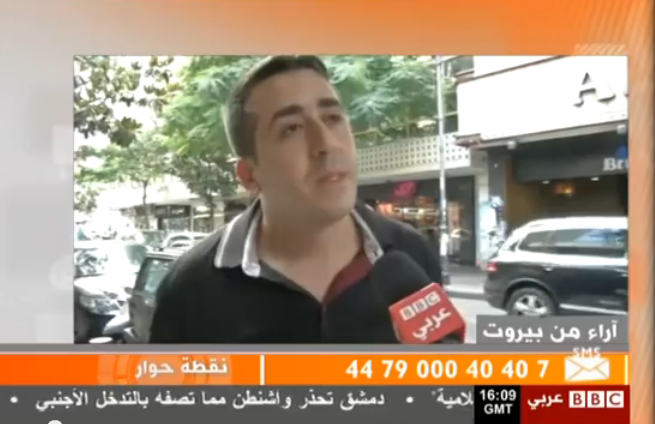
They have to hit Da-esh, says this man. Whether for the sake of the people of Lebanon or Syrian soldiers, hit them, hit them!

This super-annoying lady, with a super-annoying way of talking, said in a slurred, drawling way: of coooouuuurse not. Someone coming into your house without permission. Would you allow it? (swings her purse violently.)

100% yes I agree with the strikes, because they [Da-esh] are criminals.

Strike them? Of course! Not just in Syria, but in Lebanon and Iraq, wherever they are.
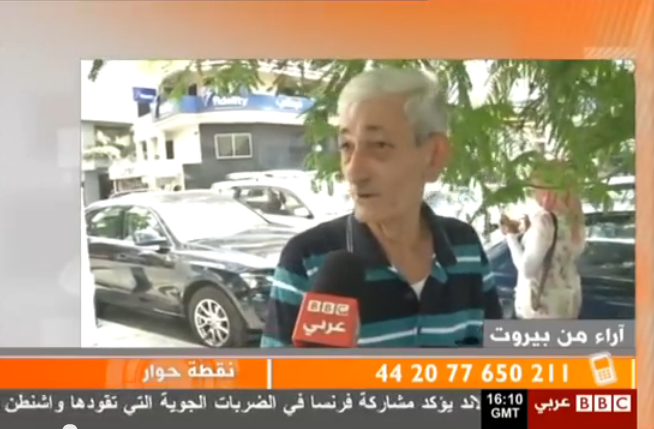
No! Because this is an attack on Syria, not on Da-esh. They need Syria's approval first.

Today you hit Da-esh and tomorrow you strike Syria herself, and there's no limits.

I support striking Da-esh in Syria because it's a terrorist organization, with or without Syria's approval.


Resha: mmmmmm.
The show started by reading out some comments people had posted on Facebook:
One person wrote: Da-esh is dangerous for the whole world, not just Iraq and Syria, so I support military strikes, with or without UN approval.
And another person wrote: these strikes are just going to kill Syrian soldiers and make Arabs weaker.
Then, the BBC Arabic took their camera around the streets of Beirut, Lebanon, and asked random people what they think.
This man said: Yes, I support the strikes, with or without UN approval, especially after what happened to our soldiers. (Apparently, Da-esh has beheaded a couple of Lebanese soldiers.)
Without Syrian approval, it's wrong, says this man.
They have to hit Da-esh, says this man. Whether for the sake of the people of Lebanon or Syrian soldiers, hit them, hit them!
This super-annoying lady, with a super-annoying way of talking, said in a slurred, drawling way: of coooouuuurse not. Someone coming into your house without permission. Would you allow it? (swings her purse violently.)
100% yes I agree with the strikes, because they [Da-esh] are criminals.
Strike them? Of course! Not just in Syria, but in Lebanon and Iraq, wherever they are.
No! Because this is an attack on Syria, not on Da-esh. They need Syria's approval first.
Today you hit Da-esh and tomorrow you strike Syria herself, and there's no limits.
I support striking Da-esh in Syria because it's a terrorist organization, with or without Syria's approval.
After that stroll through Beirut, we returned to the BBC Arabic studio in London where the moderator, Resha Qandeel, was taking calls. First she spoke to Abdullah, a Syrian man living in the UAE.
Abdullah started by saying: the US had a red line over the use of chemical weapons, in which many women and children died.
That was where he started. Before I knew it, he was talking about Oman and Iran. I'm not sure how he ended up there. But he concluded by saying:
The US just wants to arm the Shias against the Sunnis in Syria. American planes operated just the other day in a conspiracy with Hezbollah, and you all don't report that news. They are conspiring with the Shias in Syria. I ask you all to be honest! I ask you one thing only: why is Hezbollah not on the listed groups of terrorists!? Why is it just Da-esh and Jebhet el Nusra!? It's not just the beheadings and the killings that is terrorism! The media is also terrorists! The killers are terrorists! The silence is terrorism!
BBC Arabic Reporter reacts to Abdullah: the US wants to arm the Shias against the Sunnis!
Next, Resha talked with Aziz Kathem from Britian. He said: I think the US involvement came too late. Because the crisis has been going on for a long time.
Resha asked a question to her callers: many Arabs think that the US had a role in creating Al Qaida, a a role in creating Da-esh, and therefore is reaping what it's sown, and thus that the US should take the primary role in defeating Da-esh, although with the help of Arab countries. What do you think?
Mohamed Gherbi answered. He said: look, I'm against any foreign involvement in Arab affairs. The whole world is saying that these extremist groups are supported by the US, were created by the US, the foreign minister of the US Hilary Clinton said that yes, we made Da-esh. I call upon the US and the western countries to stop supporting these extreme groups with money and arms.
Resha: yes, but you know, what you're suggesting is that Da-esh is purely a business, and that they just need money and weapons to keep going. However, many of the fighters in Da-esh are not fighting because they get paid and such, they are fighting because they believe in a cause. So even if monetary support was withdrawn, that would not stop them from fighting.
Mohamed Gherbi: But these groups are actually benefiting the US. Because the US wants the Arab world to be ruined.
Gherbi: all the Arab countries now supporting American strikes against Da-esh are the same ones who also supported the strikes against Iraq and the destruction of Iraq.
Resha: but it's also in the interests of the US to have a stable Middle-East, and I say 'stable' between quotation marks because this is a concept that varies widely in its meaning between the US and how Arabs see it. What is the benefit to the US if the Middle East is taken over by extremist groups?
Gherbi: no, no, the US does not want any stability (Resha nods her head) because it really just wants the collapse of the Arab world and its soldiers and people and civilization. It wants the Arab world to be weak, and it wants to be the hegemony, the only power in the region. And it wants Israel to stay occupying Palestine! Now, the US wants Syria to be weaker and weaker. They don't care whether Bashar stays or not, but they just want Syria to get weaker and weaker and for its soldiers to get weaker, too.
Next, Resha turned to a professor at the National Defense College in Washington, DC, and had a little interview with him. His name was Walid Faris.
Faris: the US has no other choice. Da-esh is completely dangerous for the US, and it's dangerous for the region, too. It's not a question of having a business or cooperation with terrorist organizations.
Resha: look, the US armed fighters in Afghanistan. Then the US said that Iraq was a threat, and attacked it without legal world approval through the UN. Now the US says we have to strike Syria, even though so far Russia and China have opposed this and it's pretty certain that they will continue to oppose this in the Security Council. So, should the US still talk about striking Syria in light of their previous non-approved experiences?
Faris: actually, it's different, because we are talking about an organization, Da-esh, that is a threat to each of the five countries on the UN Security Council, and in Russia's case, some of these fighters may end up in Chechnya. Right now the coalition against Da-esh consists of the world powers and the Arab countries, and this is what Obama will lean upon as he makes his case.
That was only 19 minutes out of 51 total minutes, but it started getting boring.
But if you want to watch the whole show, do so by clicking on the YouTube link here.
Saturday, March 15, 2014
Syrian refugees
(March 11, 2014)
It's been three years since the start of the Syrian War, so the BBC Arabic's Rasha Qandeel was talking about refugees.
First, they showed footage of camps and of schools:

Then Rasha spoke with a lady who had fled Syria for Lebanon three years ago via telephone. Her name was Mother of Khaled. They didn't have a picture to show of the Syrian lady, so the camera studied Rasha's concerned face instead.
 The Syrian Mother of Khaled lady had given birth to a child three years ago, just as she was fleeing her home country. She said that in all that time, they had been given no support out of anyone. Also, her family numbered in the dozens, or close to a dozen, and the only person earning any wage was her brother.
In the meantime, I think the peace talks are not going so well. In February, when the peace talks were breaking down, the BBC Arabic's Malak Jaafar interviewed this Syrian guy. He was giving his version of events and blaming everyone else, when finally Malak told him: you talk as if the failure of the Geneva talks is the fault of the international community and not yours at all.
Looks like there's plenty of blame and pity to be shared.
It's been three years since the start of the Syrian War, so the BBC Arabic's Rasha Qandeel was talking about refugees.
First, they showed footage of camps and of schools:
Then Rasha spoke with a lady who had fled Syria for Lebanon three years ago via telephone. Her name was Mother of Khaled. They didn't have a picture to show of the Syrian lady, so the camera studied Rasha's concerned face instead.
In the meantime, I think the peace talks are not going so well. In February, when the peace talks were breaking down, the BBC Arabic's Malak Jaafar interviewed this Syrian guy. He was giving his version of events and blaming everyone else, when finally Malak told him: you talk as if the failure of the Geneva talks is the fault of the international community and not yours at all.

Looks like there's plenty of blame and pity to be shared.
Sunday, November 10, 2013
100 women
In October 2013, the entire BBC apparatus kept running stories about women. The BBC Arabic did the same, culminating in an hour-long call in show in which both Arab men and women shared their opinions of women's standing in the Arab world today.
I did not think it was a great program, because sometimes when the men called in, they said ridiculous things, and no one gave them a comeuppance for it. I wanted a fight and a showdown! But it was mostly congenial, as you see here:
The discussion was moderated by the BBC Arabic's Rasha Qandeel, dressed in lemon and gray:

She started off by saying: I am honored to be the moderator for this discussion.
Then a Tunisian guy called in to say: "Tunisian women are strong!"
Saha Tariq from Egypt called in: "The condition for Egyptian women is getting worse."
The discussion turned to Syria. Hasaar al Harak, a Syrian lady, called in to say that the experience of women in Syria has for some time been about the same as a man's experience. They have the same positions in society, they are both involved in politics, and it is not a very patriarchal mindset.
Rasha the moderator said: but right now we know there is a war in Syria, and that during the vacuum in security many girls have been raped and subjected to horrible crimes.
Hasaar: yes, but men have suffered as well, with horrible crimes. During wars, women and children are always the weaker parts, so it's expected that they get more of the suffering.
Rasha had a guest with her in the studio for a while, an Arab lady called Bahia.

This lady is an artist, and she is pretty famous. She came up with the artwork theme of "No to dictatorship!", "No to [insert any injustice you want]!" with which some parts of Egypt have been plastered, and which became a symbol of the Egyptian Revolution.
Rasha asked Bahia: is the Arab woman the way she is because of society, because of the lack of education, or because of her intrinsic qualities?
Bahia: Because of education. I've met lots of Arab mothers who cannot read or write.
Rasha: well, then, what can educated Arab women do to help? If educated Arab women are only 30% of the total population (is that statistic true?!), then how can such a small sliver change the world?
Bahia: we can use the media as a way to educate and reach a lot of people at once. That makes is less of a formidable challenge.
Now, changing topics, Rasha asks: there's an idea that strong women end up with neither kids nor husbands. This is a stereotype that is quite distasteful. What does the audience say?
Abd Al Salam Mohamed from the UAE via phone: I agree that this stereotype is not nice. He said lots more, but I lost track of what he was saying.
Rasha asks: if you have an Arab girl and an Arab boy with the exact same qualifications, why does the girl end up with the stereotype of being 'aggressive', while the boy does not?
Mohamed Al Qasar from Morocco answered to that by phone, but I could not understand his Moroccan accent. But Rasha replied back to him, "so education can change stereotypes."
Mohamed: yes, education is important for everything. Education has let women grow and develop. And she has rights to participate socially, politically, artistically, ....
Rasha moves on: we know that things have changed for women. Have the laws made things better?
Bahia: there's still laws that hold us back. For example, I have citizenship of Lebanon which I cannot pass on to my daughter, just because I'm female! This is how it is in many Arab countries. In Egypt, just recently, they changed that law.
Rasha: right now, with the Arab spring and many countries re-writing their constitutions, should they include strong rights for women?
Bahia: laughs.
Rasha, also laughs: you laugh because the answer is, of course!
Bahia: of course those rights should be guaranteed, but that is not always the case.
Next, they read out some comments from twitter and Facebook.
Facebook comment: biggest problem in Egypt is sexual harassment (ah, those wonderful, flawless, saintly, virtuous Muslim men!)
Comment from a man: the worst thing is women not getting enough education.
Comment: Nothing will change until society and its attitudes towards women changes.
Comment: we need less of a patriarchal society.
Other comments mentioned domestic violence, lack of opportunities, and more harassment.
Comment from Abu Sufyan: women are not suffering today, and I don't want them to suffer. If women stay at home, they will not suffer.
Comment from a man: today, women are professors, government officials, etc, so they don't have anything left to achieve.
Comment from Rita: the revolutions have made things worse for women.
Mohamed al-Sayid's comment: it got better for lots of women during the Arab Spring, but in Syria, it got worse.
Comment from Akram (pretty sure this is a male name): there is not true participation by women, and this is women's fault, because they don't want it.
Comment: it is women's silence that has led her to this position. If you want something, you will work hard enough to get it.
[I thought comments like that deserved some comeuppance. I was talking to a Libyan lady the other day. She said how when she was little, she could bike around. But as soon as she and all her friends turned 13 or so, it became a matter of, "don't you know that girls don't do things like that, and isn't it best if you stay at home?" Now, how can you claim it is all women's fault and women's silence, when you can't do something as peaceful and freeing as ride a bike????]
Rasha asks an open question: is there truly a problem that women are scared of being on the streets because of societal pressures, or is this an exaggeration?
She was answered by Mabrook Aqila, a lady who called in: she said the real problem with Arab women is their lack of confidence.
Rasha: I know strong Arab women who have worked as journalists in wars, who have served in armies (Arab women????), and clearly they are all confident. So why do you think some other Arab women are so different and lack confidence?
Mabrook: They think that if they succeed outside, they will fail in their house; and then, if on top of everything they also fail outside, everyone will know it, and they'll know they're failing inside as well. They will have failed everywhere.
Rasha said: this is really unfair, sometimes people succeed, sometimes they fail, both men and women. How unfair that for a man it is okay for him to fail publicly, yet for a woman, attached to the spectacle of failure will be a lot of commentary about her choices and lots of I-told-you-so's.
Bahia left the studio, and Rasha had two new female guests, a politician (in pink) and a journalist (in black) from Yemen. Here they are:

Because of the politician, it was a good time for the program to mention that in 2011, Yemen got a new law that really opened up opportunities for women in politics. The law was supported by both liberals and Islamists. One female caller from Yemen made a point of saying this shows Yemen is not like other Arab countries, where the liberals and Islamists are often at loggerheads.
Rasha asked of her new guests: what is it like for female journalists?
The journalist in black: it can be hard because of societal attitudes, because of the expectations of your boss or director, and you always get stuck reporting purely about women and children. On the other hand, women journalists can do stories, sensitive stories, that male journalists cannot do.
The politician in pink: in the past in Yemen, whenever you opened a newspaper or the TV, you never saw any women. Now it's getting better, and it's even better than in many other places, because we don't have pressures about news presenters being beautiful. You don't have to be blond and skinny.
Rasha: I agree with that. When you talk of a female news reporter, the first thing said about her is, oh, she's so beautiful!
[I have done that exact same thing on this blog, yikes!]
The politician in pink: it's not like that in Yemen. A woman of any looks can be on the news, no problem.
Rasha: lots of people say that we women are our own worst enemies.
The politician in pink: That is true, but there's also a lot of men that are our worst enemies, so let's not stereotype. People of any category can be the factor that tries to set us back. And if you don't have support, then search for it. There's many women who do want to help.
Now for opinions from random people on the Arab street:
 This man, wearing an NY baseball cap, says that after the revolutions, women are fine, they have all their rights.
 This lady is happily talking about how now there are women in all the government ministries and legislative bodies.

 This man says he hopes there will be more women well-educated and in politics.
 This man says, an Arab woman will not get to be president, because there's no laws to help her get there.
 This Tunisian lady echoes a previous caller to say, Tunisian women are strong!
 This man says, there will be an Arab woman president because fifty years ago we did not have female government ministers, and now we do; so it's just a matter of time.
 This man says, sure there will be an Arab woman president one day, why not? Because they are already lawyers now.
 This lady says, when you are a girl, you are told you can't do this and you can't do that. All that hurts girls.
One other man whose picture I did not get said: sure, there should be a woman president. After all, they are one half of society.
So, ladies and gentlemen, that was the program on women at the BBC Arabic. Really, I had wished there would be some arguments, some fireworks, a fiery debate in which the women shot down all the men! But that did not happen. It was pretty tame.
I did not think it was a great program, because sometimes when the men called in, they said ridiculous things, and no one gave them a comeuppance for it. I wanted a fight and a showdown! But it was mostly congenial, as you see here:
The discussion was moderated by the BBC Arabic's Rasha Qandeel, dressed in lemon and gray:

She started off by saying: I am honored to be the moderator for this discussion.
Then a Tunisian guy called in to say: "Tunisian women are strong!"
Saha Tariq from Egypt called in: "The condition for Egyptian women is getting worse."
The discussion turned to Syria. Hasaar al Harak, a Syrian lady, called in to say that the experience of women in Syria has for some time been about the same as a man's experience. They have the same positions in society, they are both involved in politics, and it is not a very patriarchal mindset.
Rasha the moderator said: but right now we know there is a war in Syria, and that during the vacuum in security many girls have been raped and subjected to horrible crimes.
Hasaar: yes, but men have suffered as well, with horrible crimes. During wars, women and children are always the weaker parts, so it's expected that they get more of the suffering.
Rasha had a guest with her in the studio for a while, an Arab lady called Bahia.

This lady is an artist, and she is pretty famous. She came up with the artwork theme of "No to dictatorship!", "No to [insert any injustice you want]!" with which some parts of Egypt have been plastered, and which became a symbol of the Egyptian Revolution.
Rasha asked Bahia: is the Arab woman the way she is because of society, because of the lack of education, or because of her intrinsic qualities?
Bahia: Because of education. I've met lots of Arab mothers who cannot read or write.
Rasha: well, then, what can educated Arab women do to help? If educated Arab women are only 30% of the total population (is that statistic true?!), then how can such a small sliver change the world?
Bahia: we can use the media as a way to educate and reach a lot of people at once. That makes is less of a formidable challenge.
Now, changing topics, Rasha asks: there's an idea that strong women end up with neither kids nor husbands. This is a stereotype that is quite distasteful. What does the audience say?
Abd Al Salam Mohamed from the UAE via phone: I agree that this stereotype is not nice. He said lots more, but I lost track of what he was saying.
Rasha asks: if you have an Arab girl and an Arab boy with the exact same qualifications, why does the girl end up with the stereotype of being 'aggressive', while the boy does not?
Mohamed Al Qasar from Morocco answered to that by phone, but I could not understand his Moroccan accent. But Rasha replied back to him, "so education can change stereotypes."
Mohamed: yes, education is important for everything. Education has let women grow and develop. And she has rights to participate socially, politically, artistically, ....
Rasha moves on: we know that things have changed for women. Have the laws made things better?
Bahia: there's still laws that hold us back. For example, I have citizenship of Lebanon which I cannot pass on to my daughter, just because I'm female! This is how it is in many Arab countries. In Egypt, just recently, they changed that law.
Rasha: right now, with the Arab spring and many countries re-writing their constitutions, should they include strong rights for women?
Bahia: laughs.
Rasha, also laughs: you laugh because the answer is, of course!
Bahia: of course those rights should be guaranteed, but that is not always the case.
Next, they read out some comments from twitter and Facebook.
Facebook comment: biggest problem in Egypt is sexual harassment (ah, those wonderful, flawless, saintly, virtuous Muslim men!)
Comment from a man: the worst thing is women not getting enough education.
Comment: Nothing will change until society and its attitudes towards women changes.
Comment: we need less of a patriarchal society.
Other comments mentioned domestic violence, lack of opportunities, and more harassment.
Comment from Abu Sufyan: women are not suffering today, and I don't want them to suffer. If women stay at home, they will not suffer.
Comment from a man: today, women are professors, government officials, etc, so they don't have anything left to achieve.
Comment from Rita: the revolutions have made things worse for women.
Mohamed al-Sayid's comment: it got better for lots of women during the Arab Spring, but in Syria, it got worse.
Comment from Akram (pretty sure this is a male name): there is not true participation by women, and this is women's fault, because they don't want it.
Comment: it is women's silence that has led her to this position. If you want something, you will work hard enough to get it.
[I thought comments like that deserved some comeuppance. I was talking to a Libyan lady the other day. She said how when she was little, she could bike around. But as soon as she and all her friends turned 13 or so, it became a matter of, "don't you know that girls don't do things like that, and isn't it best if you stay at home?" Now, how can you claim it is all women's fault and women's silence, when you can't do something as peaceful and freeing as ride a bike????]
Rasha asks an open question: is there truly a problem that women are scared of being on the streets because of societal pressures, or is this an exaggeration?
She was answered by Mabrook Aqila, a lady who called in: she said the real problem with Arab women is their lack of confidence.
Rasha: I know strong Arab women who have worked as journalists in wars, who have served in armies (Arab women????), and clearly they are all confident. So why do you think some other Arab women are so different and lack confidence?
Mabrook: They think that if they succeed outside, they will fail in their house; and then, if on top of everything they also fail outside, everyone will know it, and they'll know they're failing inside as well. They will have failed everywhere.
Rasha said: this is really unfair, sometimes people succeed, sometimes they fail, both men and women. How unfair that for a man it is okay for him to fail publicly, yet for a woman, attached to the spectacle of failure will be a lot of commentary about her choices and lots of I-told-you-so's.
Bahia left the studio, and Rasha had two new female guests, a politician (in pink) and a journalist (in black) from Yemen. Here they are:

Because of the politician, it was a good time for the program to mention that in 2011, Yemen got a new law that really opened up opportunities for women in politics. The law was supported by both liberals and Islamists. One female caller from Yemen made a point of saying this shows Yemen is not like other Arab countries, where the liberals and Islamists are often at loggerheads.
Rasha asked of her new guests: what is it like for female journalists?
The journalist in black: it can be hard because of societal attitudes, because of the expectations of your boss or director, and you always get stuck reporting purely about women and children. On the other hand, women journalists can do stories, sensitive stories, that male journalists cannot do.
The politician in pink: in the past in Yemen, whenever you opened a newspaper or the TV, you never saw any women. Now it's getting better, and it's even better than in many other places, because we don't have pressures about news presenters being beautiful. You don't have to be blond and skinny.
Rasha: I agree with that. When you talk of a female news reporter, the first thing said about her is, oh, she's so beautiful!
[I have done that exact same thing on this blog, yikes!]
The politician in pink: it's not like that in Yemen. A woman of any looks can be on the news, no problem.
Rasha: lots of people say that we women are our own worst enemies.
The politician in pink: That is true, but there's also a lot of men that are our worst enemies, so let's not stereotype. People of any category can be the factor that tries to set us back. And if you don't have support, then search for it. There's many women who do want to help.
Now for opinions from random people on the Arab street:


This man says, inshallah one day there will be an Arab woman president! (or prime minister or what have you!)


One other man whose picture I did not get said: sure, there should be a woman president. After all, they are one half of society.
So, ladies and gentlemen, that was the program on women at the BBC Arabic. Really, I had wished there would be some arguments, some fireworks, a fiery debate in which the women shot down all the men! But that did not happen. It was pretty tame.
Saturday, November 2, 2013
Saudi holds a protest
(late October, 2013)
Saudi Arabia withdrew from the UN Security Council. I say good riddance. To hear what lots of people across the Arab world had to say, the BBC Arabic had a call-in show to solicit various opinions. I guess Saudi Arabia's government withdrew from the Council because it wanted to be shocking, and it wanted to be a hero, and it wants to pretend it stands on some sort of principle. Luckily, things did not go entirely according to plan, as you can see here.
Opinions of random people on the Jordanian street:
A man: I don't support the Saudi withdrawal because you have to solve your problems by facing them, and withdrawal is negative. People are being slaughtered in Syria? That doesn't mean that Saudi should withdraw and turn its head. It should advance ideas for solving the problem.
Another man: I support Saudi because it is the leader of the Arab nation! And knows all about the failure of international organizations in solving Arab problems.
Another man: I support the Saudi position because when it comes to Arab and Islamic affairs, the Security Council does not care, and our Saudi brothers caught on to this!
Another man (apparently there's only men on the Jordanian street!): I support it because whether Saudi Arabia is on the Security Council or not won't make any difference for Arabs.
Another man: I think they made a huge mistake in withdrawing. Arab countries should be members on the Council.
Note: I just want to make sure everyone sees the irony in Saudi Arabia's government trying to lecture everyone else about international law, which it doesn't follow itself. Saudi Arabia allows Sudan's president (who is an Arab) to visit. Sudan's president is wanted on charges of genocide at the International Criminal Court. International law states that if Sudan's president strays into your border, you need to pack him up and ship him off to face trial. Does Saudi Arabia's government do this? No, it does the opposite and welcomes him with kisses. So why is it all of a sudden so concerned about bloodshed in Syria, when clearly it are not shocked by bloodshed in and of itself, seeing as it is friends with the guy at the helm of so much of it in Sudan?
An Arab living in Great Britain called to say it was clear the real concern to Saudi Arabia is that the US is becoming buddy-buddy with Iran. Saudi Arabia does not like Iran, and I guess vice versa, and both are Muslim countries. Isn't that just lovely! (So don't take it personally when we don't like the west, because we clearly don't like ourselves, either!)
The man from Great Britain had two other theories as to why Saudi refused the seat: because Saudi's current king is too old and infirm, and couldn't deal with the extra stress involved with a UN Security Council seat; and because Saudi knew its reign on the Council would be ineffective for Arab and Muslim causes, and instead of enduring the embarrassment of this in front of the whole Arab world to see, they took the easy way out and withdrew.
And he concluded, how in the first place did a government like Saudi Arabia get nominated to be on the Security Council - a country that is without rights, either for humans or for animals? A country in the 21st century that still now treats its citizens like slaves! Ouch!
Then a man called in to say that the real issue was Security Council reform; and at one point in the past, other countries like Germany, India, South Africa, and Brazil asked for permanent Security Council seats. They didn't get their way, so I think he was saying, Saudi Arabia probably isn't going to get a lot of results from their protest, either.
But then, a man who works at an economic newspaper in Saudi Arabia said, no, no! We Saudis understand that we are not as crucial a country as Germany or Brazil or India (listen to that modesty!) And also, even if the US getting buddy-buddy with Iran had an effect on the Saudi decision, it was not the main cause. We have been saying for over a year that the Security Council really needs to do something about Syria, and this was long before Iran and the US started softening towards each other.
A proud Saudi man sent in his thoughts through webcam: I am against Saudi membership in the Council. The true desire of the Council is to promote the floundering US policies. The Security Council has been deficient in stopping the spread of weapons of mass destruction in the Arab world; gives double-standards to Israel and Iran; and has not succeeded in anything except for what is on the agenda of the five permanent members, and the Saudi Kingdom refuses to be part of this! Ah, but I guess you are not against being best friends with Sudan's president.
Now, here are some comments of people who wrote in. Keep in mind that 300,000 people were killed in Darfur, either by Sudan's Arab government or by militias backed by Sudan's government, and 3 million people were routed from their villages and made to walk to the border with Chad and live in refugee camps there. I think this happened between 2003 and 2006. And Saudi Arabia's government even now welcomes Sudan's president with open arms. But these people don't seem to know that, they apparently think everyone except for themselves is evil:
Ahmed Saeed says: Saudi made a great decision, because it sends a message to the world about the corruption in the Security Council (and there's no corruption in inviting a president wanted on genocide charges?)
Mohamed Ismail says: the Saudi decision is a good one, it's just too bad all the other Arab and Muslim countries didn't do this earlier. And by the way, where are the Security Council resolutions against the Israeli occupation of Palestine, even after it's been going on for sixty years? (that would be nice, but since you're so committed to basic human rights, a word of protest against Sudan's policies in Darfur would also be appropriate.)
Siaad al-Ameri says: Saudi Arabia is the best country for representing the Muslim world, and I support their decision! (oh my God, if he thinks Saudi Arabia is representing me, I am going to scream.)
Opinions of random people in Beirut came next:
A lady: I support Saudi's decision.
A man: it is crucial to have an Arab country on the Council. But how to advance the Arab agenda, that is the real question.
A young lady: I think she said it doesn't matter either way.
A man with sunglasses: it's important to have an Arab member on the Council.
A man with a smug expression: Thank God they quit, I don't want any Gulf Arab country to be on the Security Council!
A man: you have to be on the Council in order to have an impact.
A man: I think there should be a voice for Arabs.
A lady: it is crucial for an Arab country to be on the Council.
A man: the Security Council is controlled by the US and Russia, and they toss us around like pebbles.
Then came a short interview with an analyst. Here he is via video linkage with BBC presenter Resha Qandil:

First, he called out the "weak, sickly Arab political culture." Then he said Arabs have very little confidence that they can have an impact on the world stage, mainly because they have not been able to advocate for Palestine, their chief cause for 60 years. And when there are Arab-led initiatives for peace, they are ignored.
He continued: there's lots of suspicion directed towards the reasons Saudi gave for turning down the Council. Most people don't believe it was an act in solidarity with Palestine, because that has to be done in a systematic way. The analyst suggested the proper execution would be as follows: all the Arab and Muslim countries get together and plan and take the decision together, that if problems in Palestine are not immediately addressed, they are all going to withdraw from all international bodies.
And finally, opinions of random people on the streets of Baghdad:
A man: there's important issues on the table, it would have been best if Saudi had taken the seat and done something about all these problems.
An old man:

I don't at all support Saudi's withdrawal, or the withdrawal of any Arab country from the Security Council. This weakens our cause and it steals away from us our voice.
A man: Saudi did right.
Two men: I didn't understand
An old man man: I don't support the Saudi withdrawal, and I wish they were present on the Council, even though, if they were present, it wouldn't have made a difference. It's just a symbolic seat, and it only lasts for two years, you can't really do anything in that time.

Lots of interesting opinions!
Some new Arabic words I learned:
محرج - mohrij - embarrassing
يضر - ye-thir - hurts
You can watch the program here.
Saudi Arabia withdrew from the UN Security Council. I say good riddance. To hear what lots of people across the Arab world had to say, the BBC Arabic had a call-in show to solicit various opinions. I guess Saudi Arabia's government withdrew from the Council because it wanted to be shocking, and it wanted to be a hero, and it wants to pretend it stands on some sort of principle. Luckily, things did not go entirely according to plan, as you can see here.
Opinions of random people on the Jordanian street:
A man: I don't support the Saudi withdrawal because you have to solve your problems by facing them, and withdrawal is negative. People are being slaughtered in Syria? That doesn't mean that Saudi should withdraw and turn its head. It should advance ideas for solving the problem.
Another man: I support Saudi because it is the leader of the Arab nation! And knows all about the failure of international organizations in solving Arab problems.
Another man: I support the Saudi position because when it comes to Arab and Islamic affairs, the Security Council does not care, and our Saudi brothers caught on to this!
Another man (apparently there's only men on the Jordanian street!): I support it because whether Saudi Arabia is on the Security Council or not won't make any difference for Arabs.
Another man: I think they made a huge mistake in withdrawing. Arab countries should be members on the Council.
Note: I just want to make sure everyone sees the irony in Saudi Arabia's government trying to lecture everyone else about international law, which it doesn't follow itself. Saudi Arabia allows Sudan's president (who is an Arab) to visit. Sudan's president is wanted on charges of genocide at the International Criminal Court. International law states that if Sudan's president strays into your border, you need to pack him up and ship him off to face trial. Does Saudi Arabia's government do this? No, it does the opposite and welcomes him with kisses. So why is it all of a sudden so concerned about bloodshed in Syria, when clearly it are not shocked by bloodshed in and of itself, seeing as it is friends with the guy at the helm of so much of it in Sudan?
An Arab living in Great Britain called to say it was clear the real concern to Saudi Arabia is that the US is becoming buddy-buddy with Iran. Saudi Arabia does not like Iran, and I guess vice versa, and both are Muslim countries. Isn't that just lovely! (So don't take it personally when we don't like the west, because we clearly don't like ourselves, either!)
The man from Great Britain had two other theories as to why Saudi refused the seat: because Saudi's current king is too old and infirm, and couldn't deal with the extra stress involved with a UN Security Council seat; and because Saudi knew its reign on the Council would be ineffective for Arab and Muslim causes, and instead of enduring the embarrassment of this in front of the whole Arab world to see, they took the easy way out and withdrew.
And he concluded, how in the first place did a government like Saudi Arabia get nominated to be on the Security Council - a country that is without rights, either for humans or for animals? A country in the 21st century that still now treats its citizens like slaves! Ouch!
Then a man called in to say that the real issue was Security Council reform; and at one point in the past, other countries like Germany, India, South Africa, and Brazil asked for permanent Security Council seats. They didn't get their way, so I think he was saying, Saudi Arabia probably isn't going to get a lot of results from their protest, either.
But then, a man who works at an economic newspaper in Saudi Arabia said, no, no! We Saudis understand that we are not as crucial a country as Germany or Brazil or India (listen to that modesty!) And also, even if the US getting buddy-buddy with Iran had an effect on the Saudi decision, it was not the main cause. We have been saying for over a year that the Security Council really needs to do something about Syria, and this was long before Iran and the US started softening towards each other.
A proud Saudi man sent in his thoughts through webcam: I am against Saudi membership in the Council. The true desire of the Council is to promote the floundering US policies. The Security Council has been deficient in stopping the spread of weapons of mass destruction in the Arab world; gives double-standards to Israel and Iran; and has not succeeded in anything except for what is on the agenda of the five permanent members, and the Saudi Kingdom refuses to be part of this! Ah, but I guess you are not against being best friends with Sudan's president.
Now, here are some comments of people who wrote in. Keep in mind that 300,000 people were killed in Darfur, either by Sudan's Arab government or by militias backed by Sudan's government, and 3 million people were routed from their villages and made to walk to the border with Chad and live in refugee camps there. I think this happened between 2003 and 2006. And Saudi Arabia's government even now welcomes Sudan's president with open arms. But these people don't seem to know that, they apparently think everyone except for themselves is evil:
Ahmed Saeed says: Saudi made a great decision, because it sends a message to the world about the corruption in the Security Council (and there's no corruption in inviting a president wanted on genocide charges?)
Mohamed Ismail says: the Saudi decision is a good one, it's just too bad all the other Arab and Muslim countries didn't do this earlier. And by the way, where are the Security Council resolutions against the Israeli occupation of Palestine, even after it's been going on for sixty years? (that would be nice, but since you're so committed to basic human rights, a word of protest against Sudan's policies in Darfur would also be appropriate.)
Siaad al-Ameri says: Saudi Arabia is the best country for representing the Muslim world, and I support their decision! (oh my God, if he thinks Saudi Arabia is representing me, I am going to scream.)
Opinions of random people in Beirut came next:
A lady: I support Saudi's decision.
A man: it is crucial to have an Arab country on the Council. But how to advance the Arab agenda, that is the real question.
A young lady: I think she said it doesn't matter either way.
A man with sunglasses: it's important to have an Arab member on the Council.
A man with a smug expression: Thank God they quit, I don't want any Gulf Arab country to be on the Security Council!
A man: you have to be on the Council in order to have an impact.
A man: I think there should be a voice for Arabs.
A lady: it is crucial for an Arab country to be on the Council.
A man: the Security Council is controlled by the US and Russia, and they toss us around like pebbles.
Then came a short interview with an analyst. Here he is via video linkage with BBC presenter Resha Qandil:

First, he called out the "weak, sickly Arab political culture." Then he said Arabs have very little confidence that they can have an impact on the world stage, mainly because they have not been able to advocate for Palestine, their chief cause for 60 years. And when there are Arab-led initiatives for peace, they are ignored.
He continued: there's lots of suspicion directed towards the reasons Saudi gave for turning down the Council. Most people don't believe it was an act in solidarity with Palestine, because that has to be done in a systematic way. The analyst suggested the proper execution would be as follows: all the Arab and Muslim countries get together and plan and take the decision together, that if problems in Palestine are not immediately addressed, they are all going to withdraw from all international bodies.
And finally, opinions of random people on the streets of Baghdad:
A man: there's important issues on the table, it would have been best if Saudi had taken the seat and done something about all these problems.
An old man:

I don't at all support Saudi's withdrawal, or the withdrawal of any Arab country from the Security Council. This weakens our cause and it steals away from us our voice.
A man: Saudi did right.
Two men: I didn't understand
An old man man: I don't support the Saudi withdrawal, and I wish they were present on the Council, even though, if they were present, it wouldn't have made a difference. It's just a symbolic seat, and it only lasts for two years, you can't really do anything in that time.

Lots of interesting opinions!
Some new Arabic words I learned:
محرج - mohrij - embarrassing
يضر - ye-thir - hurts
You can watch the program here.
Subscribe to:
Posts (Atom)