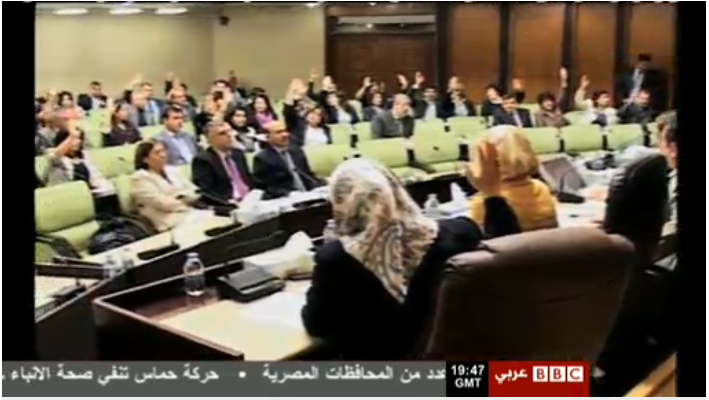
This lady was in a news report on the BBC Arabic:
She is a Kurdish soldier against Daa-esh (that is, against ISIS.)
She said that she is fighting to get revenge for her fellow sisters, and that Daa-esh has believes in no rights for women.
Showing posts with label Kurds. Show all posts
Saturday, January 10, 2015
Wednesday, November 19, 2014
Kurdish women fighters
(October 19, 2014)
Kurdish women are on the battlefield, raising their arms against Daa-esh. "Daa-esh" is how Arabs refer to ISIS. And ISIS doesn't like it. So, let's go for it full-throttle!
The BBC Arabic had a call-in show all about those female fighters.
Here was an on-line comment they read out on the air: These Kurdish women fighters are changing the world's opinion of the Middle Eastern woman! These fighters are showing strength and perseverance.
One of the Kurdish ladies interviewed promised that: we are going to fight. And we are not going to be swept aside by the men later on, but be able to claim a fair place in society (because the BBC Arabic moderator had been hinting that.)
Then they started talking about why young Muslims in Europe end up leaving to fight with Daa-esh. Many of the comments revolved around: they don't feel accepted and they don't feel like citizens in Europe.
Some of these young Muslims are girls. Someone said: these girls are being tricked with lies about Islam and lies about how they will go to Heaven if they help Daa-esh.
Then, a camera went around Beirut, the capital of Lebanon, and asked random people on the street what they think of the Kurdish women fights. The random men said: yes, if there's a need, the women should help out.
But the random women picked said: sure, the Kurdish women can help their husbands at home, but not in the battlefields.
Only one man said: the Kurdish women can help with logistics and maybe do the cooking. Overall, the men were more anxious for the women to fight than the women themselves.
The moderator asked: why are girls leaving all their well-being and contentment and freedoms and Europe, to go fight for Daa-esh.
Said an expert: the crisis of integration and racism and the search for a better life and wanting to serve the word of the Quran, all these things are involved. And then there's also women who listen to what their men tell them to do.
Moderator: you say some of these girls are searching for a better life. But how can you say that when they are entering a war zone?
Expert: well, some of these girls are in hard conditions in Europe. Maybe they fail their studies. And then the expert listed some other problems that I couldn't understand. He concluded: with all these problems, there's an idea that there's another life out there, a better life, an Islamic life. All these things play a role in moving these girls towards a better life.
Moderator: some statistics say that a big proportion of Muslim European girls who left for Syria are from France. What is up with that?
Expert: yes, it gets in the news a lot that they arrest girls on the French border who are on their way to Syria or other places. Right now, France has banned some extremist websites to try to limit the flow of information and the networking that is giving these girls the knowledge of how and where they can access routes to Syria.
The expert was called Dr. Khattab.
Some one during the program also said: There's a crisis of Islamic integration in Europe. For example, in Britain, many of the Muslim men who go to Syria are coming out of prison. They had already been in trouble with the law. In France, in Austria, it is women who are not working (?). There is racism, and there are women who want to wear a niqab. And there's people who are just very mad and they want to go live in a Muslim paradise.
Monday, October 6, 2014
Kobane
A Kurdish city in Syria has just fallen to Da-esh, that is, "ISIS", and the BBC Arabic is covering it in a flurry of tense reporting.
The city is called Kobane.
Here's a view of the city:
And this man I think fled from Kobane a few days ago. He said the conditions for the people still there are really bad (they were under seige). And he said they had no weapons.
And here are Kurdish protesters in the Hague calling for action.
The city is called Kobane.
Here's a view of the city:
And this man I think fled from Kobane a few days ago. He said the conditions for the people still there are really bad (they were under seige). And he said they had no weapons.
And here are Kurdish protesters in the Hague calling for action.
Saturday, November 16, 2013
Community activists in Iraq change laws
(October 31, 2013)
There is a film-maker called Nabaz Ahmed. He is from Iraqi Kurdistan. Here are some pictures of that northern part of Iraq:
City ...
Countryside ...
Nabaz Ahmed knew that female genital mutilation (FGM) was widespread in Kurdistan, but the Iraqi government was in denial.
For example, the man above is the director of the government's Department for the Fight against Violence towards Women. He said that his team had been to many schools, and had not found a single circumcised girl. This was in 2004.
So the filmmaker Nabaz decided to take matters into his own hands, dig up real evidence, and put it all on camera. He knew that people would not talk about such intimate topics to a man, so he got help from a lady called Shara Amin.
Here are the two filmmakers together as they go about their investigation:
Here is a great shot of Mr. Nabaz's nose-hairs:
And here is Ms. Shara. She is also Kurdish. She was motivated to work on the film because she felt so strongly about it. She said: she hoped that the film would have some sort of impact and change some attitudes and provide some help for women.
And here is one of the Kurdish ladies they filmed, who practices FGM, displaying her knife of choice as she administers her purifying magic:
Sometimes, the BBC Arabic will devote a whole hour to covering a topic in-depth, and this week, they kept showing this documentary about the making of Shara and Nabaz's film nine years ago, and its after-effects.
First, Shara and Nabaz drove all over the mountains of Kurdistan, and documented just how widespread FGM is:
They found out it was all over the place.
Here they do some interviews:
Everyone's clothes and colors are so pretty.
They'd go to villages where nearly all the girls had been circumcised, with some exceptions. For example, this little girl called Fernaz.
She said when the witch doctors came to circumcise her, she told them to leave her alone! Then she grabbed a big stone and threw it at the older women. That part of her story made the other girls laugh:
After producing their film, Nabaz and Shara took it to the Iraqi Parliament. The women in Parliament decided to watch it all together. They were driven to act, and wrote up a law about it.
But the men in the Iraqi Parliament were too embarrassed, so they refused to watch the film, and the law never came to a vote!
At that point, I think that Human Rights Watch got involved. They wrote a report that was published internationally about FGM in Kurdistan. This embarrassed everyone, because Kurdistan likes to project an image of being more modern than the rest of Iraq.
All of a sudden, female circumcision was being discussed all over the Kurdistani TV, which was previously unheard of:
So finally, the men in Parliament were forced to talk about it, they voted, and the law passed. Now you can go to jail for practicing FGM. The law was passed in 2011:
That made the man below very happy, because the UN has also been urging all countries to do what they can to stop the practice. "Now, if anyone from the United Nations asks what we've done to stop FGM, Iraq can say, well, we have a very beautiful law against it. This is a great thing. I like this law a lot, but it needs to be implemented."
On the other hand, the law made this Kurdish man below very angry. I think he is a religious leader. Female circumcision does not have a basis in Islam, but some Muslims think whatever they like.
If you read the subtitles in the picture below, he is saying, "female circumcision is a must in our religion!" This man looks like he enjoys yelling and screaming and shouting, so that's probably his proper state no matter what law is being passed.
But others amongst the religious leadership said there was nothing in the Quran to support circumcising your girls, so the debate went both ways.
Here is a leader of a Kurdish village:
He said, once we heard about the law, and found out you can go to jail, we prohibited the practice in our village.
And here are two women being interviewed by the filmmaker Shara recently. She and Nabaz tracked down the people they had interviewed in 2004, to see what had happened to them.
These women are saying: we were poor, simple people, and were cut off from knowledge. We did not know this was not an Islamic practice.
The lady in the flowered dress: I had all six of my daughters cut. I regret it.
The lady in the purple dress: But I can't do anything about it now. If this is a thing without a religious basis, why were we doing it?
The lady in the flowered dress seemed upset; the lady in purple seemed like she didn't want to think about it.
The filmmakers met this girl, Nisar, in 2004. She had refused to be circumcised. In 2013 they went back to talk to her. She had avoided being cut even so many years later, but said that if she ever got married, she'd tell her husband she was, for tradition's sake.
They even went back to talk to Fernaz, the girl who had thrown the stone at the witch doctors. She also remained uncircumcised, in spite of many attempts. She did not want to be cut, and neither did her dad. Her dad said: I have only one girl, and I don't want her to go through such pain.
This little girl is going off to school. In 2004, her mother had been debating whether to circumcise her or not. Now, upon the return of the filmmakers, she has decided 'no', although, says the mother, if anyone asks me, I'll tell them 'yes.' You can just see the mother sitting on the right edge of the picture. I thought I should include the picture because it is such a family values sort of moment.
This is one of the witch doctors proud of her skill with the knife. Unfortunately, I did not catch the shot when her face was at its smuggest.
Ah! This is a little better:
She says: I don't care what the law says. I don't care what the president or vice-president say! I don't even care what Mullah says! I swear to God! I will keep circumcising girls because I am a true Muslim (when you have debates about Islam, it usually ends up as a fight over who is and who is not the true Muslim!)
But there were other witch doctors, a little gentler in appearance, who said, "since you can go to jail now, I won't be doing it any longer."
The documentary ended with this parting information:
It says: after passage of the 2011 law prohibiting female genital mutilation, the government of Kurdistan promised to produce statistics about FGM in its territory through a partnership with the United Nations Children's Fund (UNICEF).
You can watch the program by clicking here to get to its YouTube link.
There is a film-maker called Nabaz Ahmed. He is from Iraqi Kurdistan. Here are some pictures of that northern part of Iraq:
City ...
Countryside ...
Nabaz Ahmed knew that female genital mutilation (FGM) was widespread in Kurdistan, but the Iraqi government was in denial.
For example, the man above is the director of the government's Department for the Fight against Violence towards Women. He said that his team had been to many schools, and had not found a single circumcised girl. This was in 2004.
So the filmmaker Nabaz decided to take matters into his own hands, dig up real evidence, and put it all on camera. He knew that people would not talk about such intimate topics to a man, so he got help from a lady called Shara Amin.
Here are the two filmmakers together as they go about their investigation:
Here is a great shot of Mr. Nabaz's nose-hairs:
And here is Ms. Shara. She is also Kurdish. She was motivated to work on the film because she felt so strongly about it. She said: she hoped that the film would have some sort of impact and change some attitudes and provide some help for women.
And here is one of the Kurdish ladies they filmed, who practices FGM, displaying her knife of choice as she administers her purifying magic:
Sometimes, the BBC Arabic will devote a whole hour to covering a topic in-depth, and this week, they kept showing this documentary about the making of Shara and Nabaz's film nine years ago, and its after-effects.
First, Shara and Nabaz drove all over the mountains of Kurdistan, and documented just how widespread FGM is:
They found out it was all over the place.
Here they do some interviews:
Everyone's clothes and colors are so pretty.
They'd go to villages where nearly all the girls had been circumcised, with some exceptions. For example, this little girl called Fernaz.
She said when the witch doctors came to circumcise her, she told them to leave her alone! Then she grabbed a big stone and threw it at the older women. That part of her story made the other girls laugh:
After producing their film, Nabaz and Shara took it to the Iraqi Parliament. The women in Parliament decided to watch it all together. They were driven to act, and wrote up a law about it.
But the men in the Iraqi Parliament were too embarrassed, so they refused to watch the film, and the law never came to a vote!
At that point, I think that Human Rights Watch got involved. They wrote a report that was published internationally about FGM in Kurdistan. This embarrassed everyone, because Kurdistan likes to project an image of being more modern than the rest of Iraq.
All of a sudden, female circumcision was being discussed all over the Kurdistani TV, which was previously unheard of:
So finally, the men in Parliament were forced to talk about it, they voted, and the law passed. Now you can go to jail for practicing FGM. The law was passed in 2011:
That made the man below very happy, because the UN has also been urging all countries to do what they can to stop the practice. "Now, if anyone from the United Nations asks what we've done to stop FGM, Iraq can say, well, we have a very beautiful law against it. This is a great thing. I like this law a lot, but it needs to be implemented."
I thought this was Nabaz nine years later, but it is not. It is a man who works for an Iraqi NGO called Wadi, who helped Nabaz make the film. Wadi means valley in Arabic.
On the other hand, the law made this Kurdish man below very angry. I think he is a religious leader. Female circumcision does not have a basis in Islam, but some Muslims think whatever they like.
If you read the subtitles in the picture below, he is saying, "female circumcision is a must in our religion!" This man looks like he enjoys yelling and screaming and shouting, so that's probably his proper state no matter what law is being passed.
But others amongst the religious leadership said there was nothing in the Quran to support circumcising your girls, so the debate went both ways.
Here is a leader of a Kurdish village:
He said, once we heard about the law, and found out you can go to jail, we prohibited the practice in our village.
And here are two women being interviewed by the filmmaker Shara recently. She and Nabaz tracked down the people they had interviewed in 2004, to see what had happened to them.
These women are saying: we were poor, simple people, and were cut off from knowledge. We did not know this was not an Islamic practice.
The lady in the flowered dress: I had all six of my daughters cut. I regret it.
The lady in the purple dress: But I can't do anything about it now. If this is a thing without a religious basis, why were we doing it?
The lady in the flowered dress seemed upset; the lady in purple seemed like she didn't want to think about it.
The filmmakers met this girl, Nisar, in 2004. She had refused to be circumcised. In 2013 they went back to talk to her. She had avoided being cut even so many years later, but said that if she ever got married, she'd tell her husband she was, for tradition's sake.
They even went back to talk to Fernaz, the girl who had thrown the stone at the witch doctors. She also remained uncircumcised, in spite of many attempts. She did not want to be cut, and neither did her dad. Her dad said: I have only one girl, and I don't want her to go through such pain.
This little girl is going off to school. In 2004, her mother had been debating whether to circumcise her or not. Now, upon the return of the filmmakers, she has decided 'no', although, says the mother, if anyone asks me, I'll tell them 'yes.' You can just see the mother sitting on the right edge of the picture. I thought I should include the picture because it is such a family values sort of moment.
This is one of the witch doctors proud of her skill with the knife. Unfortunately, I did not catch the shot when her face was at its smuggest.
She says: I don't care what the law says. I don't care what the president or vice-president say! I don't even care what Mullah says! I swear to God! I will keep circumcising girls because I am a true Muslim (when you have debates about Islam, it usually ends up as a fight over who is and who is not the true Muslim!)
But there were other witch doctors, a little gentler in appearance, who said, "since you can go to jail now, I won't be doing it any longer."
The documentary ended with this parting information:
It says: after passage of the 2011 law prohibiting female genital mutilation, the government of Kurdistan promised to produce statistics about FGM in its territory through a partnership with the United Nations Children's Fund (UNICEF).
You can watch the program by clicking here to get to its YouTube link.
Labels:
BBC Arabic,
human rights,
Iraq,
Kurds,
Muslims,
United Nations,
women
Tuesday, September 24, 2013
Kids at refugee school
These videos are from Unicef's YouTube site.
First, here is a group of girls in the Zaatari refugee camp (in Jordan?) walking around the camp to spread the word about the camp school for displaced Syrian children.
They are loaded with school uniforms, backpacks, books, toothpaste, and soap, which they bought and collected through fundraising to give to the refugee kids. They even did bake sales (that is so American.)
Then, there is a big mingle, and everyone starts coloring banners to decorate the new school with:
The local kids raised the funds and did all the work themselves. Sounds like it was their idea, too, and fully organized by them.
I wanted to embed the full video on this site, but I can't get it to work. Click here and it will take you to the YouTube site to watch the original (and check out the girl who is interviewed about one minute in. Where did she grow up that she speaks English with practically an American accent?)
First, here is a group of girls in the Zaatari refugee camp (in Jordan?) walking around the camp to spread the word about the camp school for displaced Syrian children.
Now they're walking to another part of the camp to continue their ambassadorship for education:
The religious leaders in the camp are also in on the act, and are promoting education during Friday prayers. This is one of the leaders sitting behind the fan.
Unicef put English subtitles in when people spoke in Arabic, but they have the wrong order here. He actually said, "religion, science, morality, and culture".
Here the kids are walking two kilometers to their school:
And here's their fearless teacher:
I love this picture of all the assembled bookbags, full of Unicef caps and school books and supplies:
Here's the full video (in English):
And here's a second video about Kurdish refugee kids in school in Iraq.
Here the kids are lining up for the first day of school:
In the meantime, older local kids from the neighboring town are being bussed over:
Then, there is a big mingle, and everyone starts coloring banners to decorate the new school with:
The local kids raised the funds and did all the work themselves. Sounds like it was their idea, too, and fully organized by them.
I wanted to embed the full video on this site, but I can't get it to work. Click here and it will take you to the YouTube site to watch the original (and check out the girl who is interviewed about one minute in. Where did she grow up that she speaks English with practically an American accent?)
Subscribe to:
Posts (Atom)